 Back
Study Guide: The Endocrine System (Human Anatomy & Physiology, Chapter 16)
Study Guide - Smart Notes
 Tailored notes based on your materials, expanded with key definitions, examples, and context.
The Endocrine System Overview
Introduction to the Endocrine System
The endocrine system works alongside the nervous system to coordinate and integrate the activity of body cells. It influences metabolic activities through hormones transported in the blood, with responses that are slower but longer lasting than those of the nervous system. The study of hormones and endocrine organs is called endocrinology.
Hormones: Chemical messengers released into the blood to regulate various bodily functions.
Endocrine system functions: Controls reproduction, growth and development, maintenance of electrolyte, water, and nutrient balance, regulation of cellular metabolism and energy balance, and mobilization of body defenses.
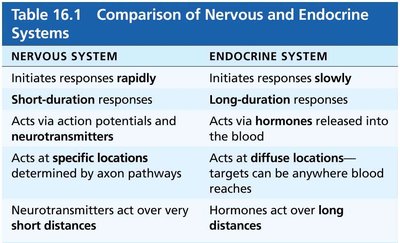
Table Purpose: Comparison of Nervous and Endocrine Systems
Nervous System | Endocrine System |
|---|---|
Initiates responses rapidly | Initiates responses slowly |
Short-duration responses | Long-duration responses |
Acts via action potentials and neurotransmitters | Acts via hormones released into the blood |
Acts at specific locations determined by axon pathways | Acts at diffuse locations—targets can be anywhere blood reaches |
Neurotransmitters act over very short distances | Hormones act over long distances |
Endocrine vs. Exocrine Glands
Glands are classified as either endocrine or exocrine based on their products and method of secretion.
Exocrine glands: Produce nonhormonal substances (e.g., sweat, saliva) and have ducts to carry secretion to membrane surface.
Endocrine glands: Produce hormones and lack ducts.
Major Endocrine Organs
The main endocrine glands include the pituitary, thyroid, parathyroid, adrenal, and pineal glands. The hypothalamus is a neuroendocrine organ. Some organs, such as the pancreas and gonads, have both endocrine and exocrine functions. Other tissues (e.g., adipose cells, thymus, stomach, kidneys, heart) also produce hormones.
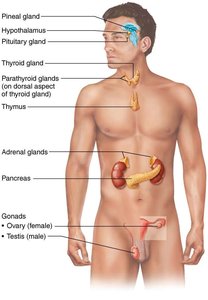
Hormones: Types and Mechanisms
Classes of Hormones
Hormones are classified into two main types based on their chemical structure:
Amino acid–based hormones: Includes amino acid derivatives, peptides, and proteins.
Steroid hormones: Synthesized from cholesterol; includes gonadal and adrenocortical hormones.
Target Cells and Hormone Action
Although hormones circulate systemically, only cells with specific receptors (target cells) are affected. Hormones alter target cell activity in several ways:
Alter plasma membrane permeability and/or membrane potential by opening or closing ion channels
Stimulate synthesis of enzymes or other proteins
Activate or deactivate enzymes
Induce secretory activity
Stimulate mitosis
Hormone Mechanisms of Action
Hormones act in one of two ways, depending on their chemical nature and receptor location:
Water-soluble hormones: (all amino acid–based hormones except thyroid hormone) act on plasma membrane receptors via G protein second messengers; cannot enter the cell.
Lipid-soluble hormones: (steroid and thyroid hormones) act on intracellular receptors that directly activate genes; can enter the cell.
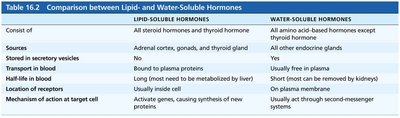
Table Purpose: Comparison between Lipid- and Water-Soluble Hormones
Lipid-Soluble Hormones | Water-Soluble Hormones |
|---|---|
All steroid hormones and thyroid hormone | All amino acid–based hormones except thyroid hormone |
Adrenal cortex, gonads, thyroid gland | Other endocrine glands |
Bound to plasma proteins | Usually free in plasma |
Long half-life | Short half-life |
Inside cell | On plasma membrane |
Activate genes, cause synthesis of new proteins | Act through second-messenger systems |
Second Messenger Systems
Cyclic AMP (cAMP) Signaling Mechanism
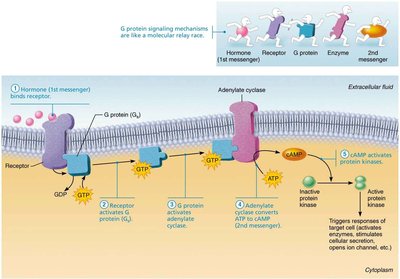
Amino acid–based hormones (except thyroid hormone) exert effects through second-messenger systems, mainly cyclic AMP (cAMP) and PIP2-calcium. The cAMP mechanism involves:
Hormone (first messenger) binds to receptor
Receptor activates a G protein
G protein activates or inhibits effector enzyme adenylate cyclase
Adenylate cyclase converts ATP to cAMP (second messenger)
cAMP activates protein kinases that phosphorylate other proteins
Intracellular Receptors and Direct Gene Activation
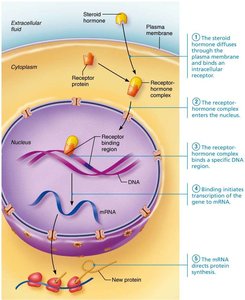
Lipid-soluble steroid hormones and thyroid hormone diffuse into target cells and bind with intracellular receptors. The receptor-hormone complex enters the nucleus, binds to specific DNA regions, and initiates transcription to produce mRNA, which is then translated into specific proteins.
Hormone Release and Regulation
Control of Hormone Release
Blood levels of hormones are controlled by negative feedback systems, keeping levels within a narrow, desirable range. Hormone release is triggered by endocrine gland stimuli or nervous system modulation.
Endocrine Gland Stimuli
Endocrine glands are stimulated to synthesize and release hormones in response to three types of stimuli:
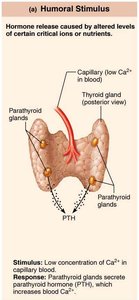
Humoral stimuli: Changing blood levels of ions and nutrients directly stimulate secretion of hormones (e.g., low Ca2+ stimulates parathyroid hormone release).
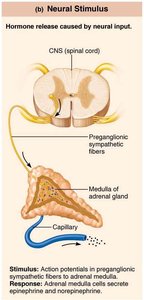
Neural stimuli: Nerve fibers stimulate hormone release (e.g., sympathetic nervous system stimulates adrenal medulla to secrete catecholamines).
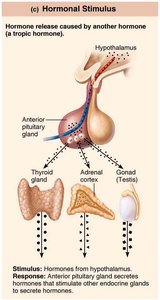
Hormonal stimuli: Hormones stimulate other endocrine organs to release their hormones (e.g., hypothalamic hormones stimulate anterior pituitary hormones).
Nervous System Modulation
The nervous system can adjust hormone levels as needed, overriding normal endocrine controls, especially under stress (e.g., hypothalamus and sympathetic nervous system override insulin to increase blood glucose for "fight or flight").
Target Cell Specificity and Regulation
Target Cell Activation
Target cells must have specific receptors for a hormone. Activation depends on:
Blood levels of hormone
Relative number of receptors on/in target cell
Affinity (strength) of binding between receptor and hormone
Regulation of Receptor Numbers
Up-regulation: Target cells form more receptors in response to low hormone levels.
Down-regulation: Target cells lose receptors in response to high hormone levels, preventing overreaction.
Hormone Activity: Half-Life, Onset, and Duration
Hormone Circulation and Removal
Hormones circulate in blood either free or bound. Steroids and thyroid hormone are attached to plasma proteins; others circulate without carriers. Concentration reflects rate of release and speed of inactivation/removal (by degrading enzymes, kidneys, or liver).
Half-life: Time required for hormone level in blood to decrease by half; varies from seconds to a week.
Response times vary: some are immediate, others (especially steroids) take hours to days.
Duration of response is usually limited, ranging from seconds to hours.
Hormone Interactions at Target Cells
Types of Hormone Interactions
Permissiveness: One hormone cannot exert its effects without another hormone being present (e.g., reproductive hormones need thyroid hormone).
Synergism: More than one hormone produces the same effects, causing amplification (e.g., glucagon and epinephrine both cause liver to release glucose).
Antagonism: One or more hormones oppose the action of another (e.g., insulin and glucagon).
The Hypothalamus and Pituitary Gland
Hypothalamus-Pituitary Relationships
The hypothalamus is connected to the pituitary gland (hypophysis) via the infundibulum. The pituitary has two major lobes:
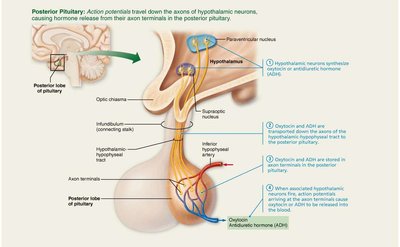
Posterior pituitary: Neural tissue that secretes neurohormones (oxytocin and ADH); forms the neurohypophysis with the infundibulum.
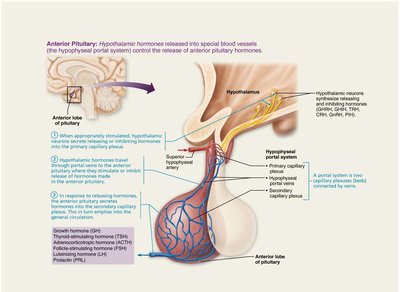
Anterior pituitary: Glandular tissue (adenohypophysis) that secretes hormones regulated by hypothalamic releasing and inhibiting hormones.
Posterior Pituitary and Hypothalamic Hormones
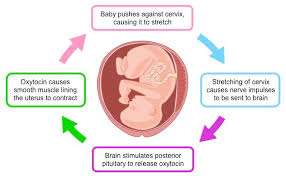
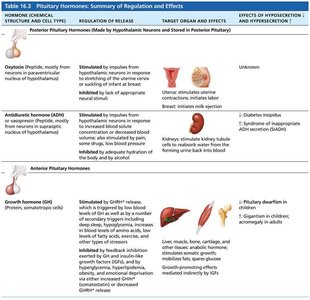
Oxytocin: Strong stimulant of uterine contractions during childbirth; triggers milk ejection; both are positive feedback mechanisms.
Antidiuretic hormone (ADH): Released in response to high solute concentration; targets kidney tubules to reabsorb more water, inhibiting urine formation; inhibited by alcohol and diuretics; high concentrations cause vasoconstriction (vasopressin).
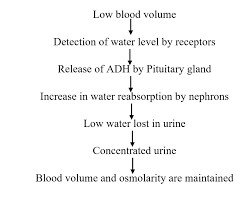
Clinical Homeostatic Imbalances
Diabetes insipidus: ADH deficiency due to damage to hypothalamus or posterior pituitary; requires hydration.
SIADH: Syndrome of inappropriate ADH secretion; causes fluid retention, headache, disorientation; managed by fluid restriction and monitoring blood sodium.
Anterior Pituitary Hormones
Overview of Anterior Pituitary Hormones
All six anterior pituitary hormones are peptide hormones. All but growth hormone (GH) activate target cells via cAMP second-messenger system. All but two are tropic hormones (regulate secretion of other hormones).
Growth hormone (GH): Direct actions on metabolism and indirect growth-promoting actions; stimulates most cells to enlarge and divide, especially bone and skeletal muscle.
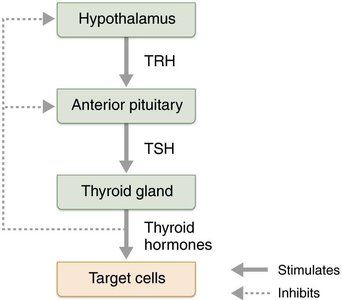
Thyroid-stimulating hormone (TSH): Tropic hormone (thyrotropin); stimulates normal development and secretory activity of thyroid; release triggered by thyrotropin-releasing hormone from hypothalamus; inhibited by rising thyroid hormone levels.
Adrenocorticotropic hormone (ACTH): Stimulates adrenal cortex to release corticosteroids; release triggered by corticotropin-releasing hormone (CRH); highest levels in morning; altered by fever, hypoglycemia, and stressors.
Gonadotropins (FSH and LH): FSH stimulates production of gametes; LH promotes production of gonadal hormones; absent from blood in prepubertal children.
Prolactin (PRL): Stimulates milk production in females; increased estrogen stimulates PRL; blood levels rise toward end of pregnancy; suckling stimulates PRL release.


Clinical Imbalances of Anterior Pituitary Hormones
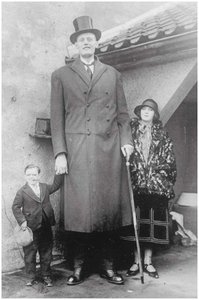
GH hypersecretion: Causes gigantism in children and acromegaly in adults.
GH hyposecretion: Causes pituitary dwarfism in children; usually no problems in adults.
Hyperprolactinemia: Most frequent abnormality of anterior pituitary tumors; causes inappropriate lactation, lack of menses, infertility in females, and impotence in males.
Summary Table: Pituitary Hormones
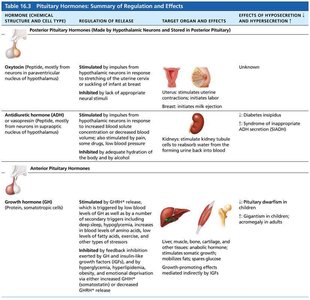
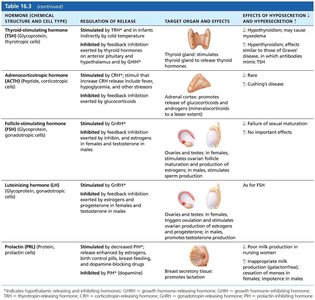
Table Purpose: Summary of Regulation and Effects of Pituitary Hormones
Hormone | Regulation of Release | Target Organ and Effects | Effects of Hyposecretion and Hypersecretion |
|---|---|---|---|
Oxytocin | Stimulated by impulses from hypothalamic neurons in response to cervical/uterine stretching and suckling | Uterus: stimulates contractions; Breast: initiates milk ejection | Unknown |
Antidiuretic hormone (ADH) | Stimulated by impulses from hypothalamic neurons in response to increased blood solute concentration or decreased blood volume | Kidneys: stimulate kidney tubule cells to reabsorb water | Diabetes insipidus (hyposecretion); SIADH (hypersecretion) |
Growth hormone (GH) | Stimulated by GHRH release; inhibited by GHIH | Liver, muscle, bone, cartilage, other tissues: stimulates growth | Pituitary dwarfism (hyposecretion); Gigantism/acromegaly (hypersecretion) |
Thyroid-stimulating hormone (TSH) | Stimulated by TRH; inhibited by feedback inhibition by thyroid hormones | Thyroid gland: stimulates release of thyroid hormones | Hyposecretion: cretinism, myxedema; Hypersecretion: hyperthyroidism |
Adrenocorticotropic hormone (ACTH) | Stimulated by CRH; inhibited by feedback inhibition by glucocorticoids | Adrenal cortex: promotes release of glucocorticoids and androgens | Hyposecretion: rare; Hypersecretion: Cushing's disease |
Follicle-stimulating hormone (FSH) | Stimulated by GnRH; inhibited by feedback inhibition by estrogen/testosterone | Ovaries/testes: stimulates gamete production | Failure of sexual maturation |
Luteinizing hormone (LH) | Stimulated by GnRH; inhibited by feedback inhibition by estrogen/progesterone/testosterone | Ovaries/testes: triggers ovulation and hormone production | Failure of sexual maturation |
Prolactin (PRL) | Stimulated by decreased PIH; release enhanced by estrogens, birth control pills, breast-feeding | Breast: promotes lactation | Poor milk production (hyposecretion); Inappropriate milk production (hypersecretion) |
