 Back
BackStudy Guide: The Immune System – Innate and Adaptive Defenses
Study Guide - Smart Notes
 Tailored notes based on your materials, expanded with key definitions, examples, and context.
The Immune System: Overview
Intrinsic Defense Systems
The immune system protects the body from pathogens through two main defense mechanisms: innate (nonspecific) immunity and adaptive (specific) immunity. These systems work together to prevent infection and eliminate invaders.
Innate Immunity: Provides immediate, nonspecific defense against pathogens. Response is the same with each exposure.
Adaptive Immunity: Provides specific defense against particular pathogens. Response improves with repeated exposure due to memory cells.
Innate (Nonspecific) Immunity
First Line of Defense: Physical and Chemical Barriers
The first line of defense consists of physical and chemical barriers that prevent pathogens from entering the body.
Physical Barriers: Skin and mucous membranes act as mechanical barriers. Keratin in skin resists acids, bases, enzymes, and toxins.
Chemical Barriers: Epithelial membranes produce chemicals such as acidic secretions, sebum, HCl in stomach, lysozyme in saliva and tears, and mucus to trap microorganisms.
Second Line of Defense: Internal Defenses
Phagocytes and Phagocytosis
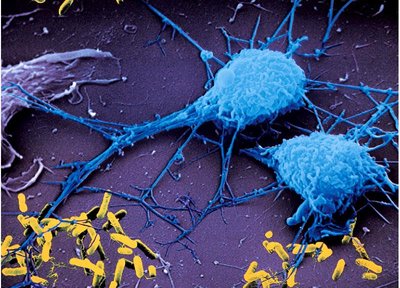
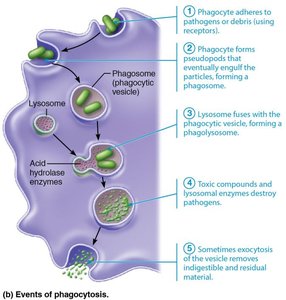
Phagocytes are cells that engulf and destroy pathogens. The process of phagocytosis involves several steps:
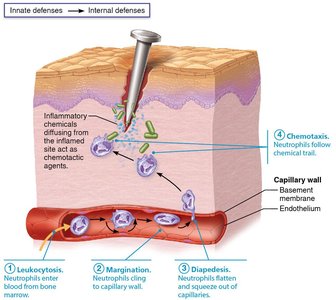
Leukocytosis: Cytokines attract neutrophils from bone marrow.
Margination: Neutrophils adhere to capillary walls in the injured area.
Diapedesis: Neutrophils squeeze through capillary walls.
Chemotaxis: Neutrophils follow chemical signals to the injury site.
Phagocytosis: Pathogens are engulfed and destroyed by lysosomes.
Inflammation
Inflammation is a hallmark of innate immunity, characterized by heat, redness, swelling, pain, and loss of function. It helps contain and eliminate pathogens.
Natural Killer (NK) Cells
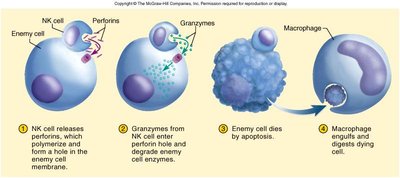
NK cells are a distinct group of lymphocytes that kill infected or abnormal cells by releasing cytolytic chemicals (perforins and granzymes).
NK cells target intracellular pathogens, cancer cells, and transplanted cells.
They induce apoptosis in target cells, which are then engulfed by macrophages.
Antimicrobial Chemicals
Several chemicals contribute to innate immunity:
Cytokines: Promote inflammation and attract white blood cells (e.g., histamine, kinins, prostaglandins, complement).
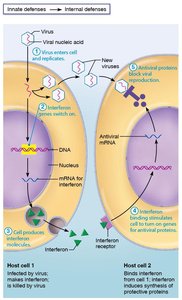
Interferons: Released by virus-infected cells; interfere with viral replication and activate immune cells.
Complement: Plasma proteins that enhance inflammation, phagocytosis, and pathogen lysis.
Pyrogens: Induce fever by increasing body temperature.
Adaptive (Specific) Immunity
Characteristics and Types
Adaptive immunity is acquired through exposure to pathogens and is highly specific. It produces memory cells for faster response upon re-exposure.
Humoral Immunity: Mediated by B lymphocytes and antibodies.
Cellular Immunity: Mediated by T lymphocytes.
Humoral Immunity (Antibody-Mediated)
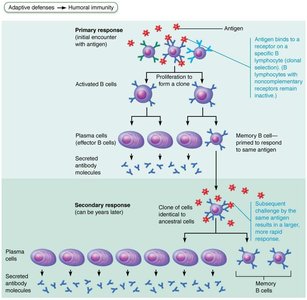
B lymphocytes mature in the bone marrow and differentiate into plasma cells (which secrete antibodies) or memory cells. Antibodies bind to extracellular pathogens and facilitate their destruction.
Types of antibodies: IgD, IgM, IgA (in breast milk), IgG (crosses placenta), IgE (allergic reactions).
B Lymphocyte Differentiation
Immature lymphocytes from bone marrow become immunocompetent as B cells (in bone marrow) or T cells (in thymus). 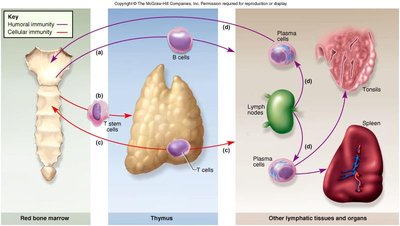
Acquisition of Humoral Immunity
Humoral immunity can be acquired in four ways:
Active Natural Immunity: Antibodies produced after natural exposure to pathogens.
Active Artificial Immunity: Antibodies produced after vaccination.
Passive Natural Immunity: Antibodies passed from mother to fetus or infant.
Passive Artificial Immunity: Antibodies injected from external sources (e.g., antivenom).
Immunological Memory
Memory cells allow for a faster and stronger response upon subsequent exposure to the same pathogen. 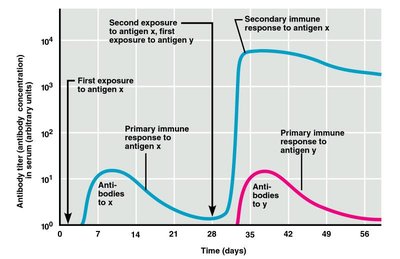
Cellular Immunity (Cell-Mediated)
T lymphocytes mature in the thymus and differentiate into various effector cells: Helper T cells, Cytotoxic T cells, Memory T cells, and Regulatory T cells. They attack intracellular pathogens and diseased host cells. 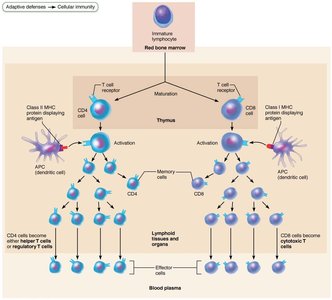
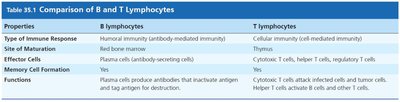
Comparison of B and T Lymphocytes
Properties | B lymphocytes | T lymphocytes |
|---|---|---|
Type of Immune Response | Humoral immunity (antibody-mediated) | Cellular immunity (cell-mediated) |
Site of Maturation | Bone marrow | Thymus |
Effector Cells | Plasma cells (antibody-secreting) | Cytotoxic T cells, Helper T cells, Regulatory T cells |
Memory Cell Formation | Yes | Yes |
Functions | Produce antibodies, tag antigens for destruction | Attack infected/tumor cells, activate other immune cells |
Epidemiology and Immunity in Populations
Key Concepts
Epidemiology: Study of disease distribution and determinants in populations.
Herd Immunity: When a large portion of a population is immune, reducing disease spread.
R0 Value: Average number of people infected by one individual.
Patient Zero: The first identified case in an epidemic.
Summary Table: Types of Immunity
Type | Source | Duration |
|---|---|---|
Active Natural | Exposure to pathogen | Long-lasting |
Active Artificial | Vaccination | Long-lasting (may require booster) |
Passive Natural | Maternal antibodies | Temporary |
Passive Artificial | Injected antibodies | Temporary |
Key Terms and Definitions
Pathogen: Disease-causing microorganism.
Antigen: Substance recognized as foreign by the immune system.
Antibody: Protein produced by B cells that binds to antigens.
Phagocytosis: Cellular process of engulfing and destroying pathogens.
Immunocompetent: Ability of lymphocytes to recognize and respond to antigens.
Memory Cell: Long-lived lymphocyte that responds rapidly upon re-exposure to antigen.
Important Equations
R0 Value:
Additional info:
Immunological memory is crucial for effective vaccination strategies.
Complement proteins can be activated via classical, alternative, or lectin pathways.
