 Back
BackStudy Guide: The Lymphatic System and Immune System (Innate and Adaptive Defenses)
Study Guide - Smart Notes
 Tailored notes based on your materials, expanded with key definitions, examples, and context.
The Lymphatic System and Lymphoid Organs and Tissues
Overview of the Lymphatic System
The lymphatic system is a network of vessels, tissues, and organs that returns leaked fluid to the blood and provides the anatomical basis for the body's defenses. It includes lymphatic vessels, lymph, and lymphoid organs such as lymph nodes, spleen, MALT, and thymus.
Lymphatic vessels: Return fluid from tissues to the bloodstream, forming a one-way system toward the heart.
Lymph: Fluid collected from interstitial spaces, containing proteins and other large molecules.
Lymph nodes: Principal lymphoid organs that filter lymph and house lymphocytes.
Spleen: Largest lymphoid organ, removes old red blood cells and pathogens from blood.
MALT: Mucosa-associated lymphoid tissue, guards entryways against pathogens.
Thymus: Site of T lymphocyte maturation.
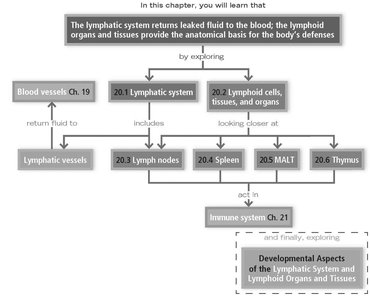
Lymphatic Vessels
Lymphatic vessels begin as highly permeable capillaries in loose connective tissue, allowing large molecules to enter. Lymph flows through collecting vessels, trunks, and ducts, eventually returning to the circulatory system via the thoracic or right lymphatic duct.
Mechanisms of lymph transport: Skeletal muscle compression, breathing-induced pressure changes, and valves prevent backflow.
Key formula: Fluid movement is governed by hydrostatic and osmotic pressures (see Chapter 19).
Lymphoid Cells and Tissues
Lymphoid tissues are found in lymphoid organs and connective tissue throughout the body, providing sites for lymphocyte proliferation and immune surveillance.
Lymphocytes: Arise in red bone marrow; mature into T cells (thymus) or B cells (bone marrow).
Macrophages: Phagocytes that activate T lymphocytes.
Dendritic cells: Activate T lymphocytes; found in lymphoid tissue.
Reticular cells: Produce stroma, supporting other cell types.
Diffuse lymphoid tissue: Found in nearly every organ.
Lymphoid follicles: Aggregations such as Peyer's patches in the intestine.
Lymph Nodes
Lymph nodes filter lymph, removing microorganisms and debris before returning it to the bloodstream. They are surrounded by a fibrous capsule and contain a stroma of reticular fibers.
Afferent vessels: Bring lymph into the node.
Efferent vessels: Fewer in number, allow lymph to exit, causing lymph to slow and increasing exposure to immune cells.
Spleen
The spleen removes bloodborne pathogens and aged red blood cells, and provides a site for lymphocyte proliferation and immune surveillance.
White pulp: Contains lymphocytes.
Red pulp: Contains macrophages.
Comparison: Both spleen and lymph nodes are surrounded by a fibrous capsule and contain immune cells, but the spleen filters blood, not lymph.
MALT (Mucosa-Associated Lymphoid Tissue)
MALT is a collection of lymphoid tissues in mucous membranes throughout the body, protecting against pathogens entering via mucosal surfaces.
Tonsils: Simplest lymphoid organs, form a ring around the pharynx.
Peyer's patches: Aggregated lymphoid nodules in the small intestine.
Appendix: Contains lymphoid follicles.
Thymus
The thymus is the site of T lymphocyte maturation and secretes hormones that cause T cells to become immunocompetent.
Structure: Thymic lobules with cortex and medulla.
Unique features: No B cells or follicles; stroma consists of epithelial cells.
Developmental Aspects
Lymphatic vessels and lymph nodes develop from lymph sacs budding from veins by the fifth week of embryonic development. The thymus is derived from endoderm, while other lymphoid organs are from mesenchyme.
The Immune System: Innate and Adaptive Body Defenses
Overview of the Immune System
The immune system defends the body from disease-causing organisms and cancerous cells through innate and adaptive defenses. Innate defenses are non-specific and immediate, while adaptive defenses are specific and have memory.
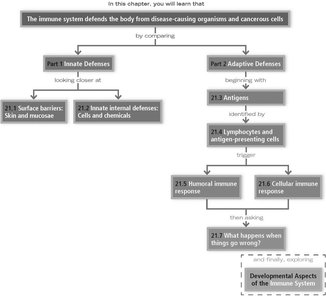
Innate Defenses
Surface Barriers
Skin and mucous membranes act as the first line of defense, providing physical and chemical barriers to pathogens.
Keratinized skin: Blocks entry of microorganisms.
Mucous membranes: Trap pathogens.
Protective chemicals: Acid, lysozyme, mucin, defensins, and specialized secretions inhibit or destroy microbes.
Innate Internal Defenses
Cells and chemicals provide the second line of defense, including phagocytes, natural killer cells, inflammation, antimicrobial proteins, and fever.
Phagocytes: Neutrophils and macrophages engulf and destroy pathogens.
Natural killer cells: Lyse cancer and virally infected cells.
Inflammation: Prevents spread of damage, disposes of debris, and sets up repair. Four cardinal signs: redness, heat, swelling, pain.
Antimicrobial proteins: Interferons and complement proteins attack microbes or hinder their reproduction.
Fever: Systemic response to infection, induced by pyrogens acting on the hypothalamus.
Adaptive Defenses
Antigens
Antigens are substances that trigger adaptive immune responses. Complete antigens have immunogenicity and reactivity; haptens are incomplete antigens. Antigenic determinants are specific regions that bind antibodies or lymphocytes.
Self-antigens: Identified by MHC proteins; not antigenic to self, but to others.
B and T Lymphocytes and Antigen-Presenting Cells
B and T lymphocytes originate in bone marrow and mature in primary lymphoid organs. Immunocompetence and self-tolerance are developed through positive and negative selection.
Clonal selection: Antigen binding selects lymphocytes for proliferation.
Effector cells: Actively fight infection.
Memory cells: Respond quickly to future encounters.
Antigen-presenting cells (APCs): Dendritic cells, macrophages, and B cells present antigens to T cells.
Humoral Immunity
Antibodies produced by B lymphocytes target extracellular antigens. Clonal selection leads to plasma cells (antibody-secreting) and memory cells.
Primary response: First exposure, slower and weaker.
Secondary response: Subsequent exposure, faster and stronger.
Active immunity: Body mounts response (infection or vaccination).
Passive immunity: Preformed antibodies are given (maternal or artificial).
Antibody structure: Four polypeptide chains (2 heavy, 2 light); variable and constant regions.
Antibody classes: IgM, IgG, IgA, IgD, IgE.
Functions: Neutralization, agglutination, precipitation, complement activation.
Cellular Immunity
T lymphocytes direct adaptive immunity or attack cellular targets. CD4 cells become helper or regulatory T cells; CD8 cells become cytotoxic T cells.
MHC proteins: Present antigens for T cell recognition.
Activation: Requires double recognition (MHC and antigen) and co-stimulatory signals.
Cytokines: Chemical signals that amplify immune response.
Helper T cells: Stimulate proliferation of B and T cells.
Cytotoxic T cells: Directly attack infected or cancerous cells.
Regulatory T cells: Suppress immune activity.
Immune System Disorders
Immune responses can be insufficient or overactive, leading to immunodeficiency, autoimmune diseases, or hypersensitivity.
Immunodeficiency: SCID (congenital), AIDS (acquired).
Autoimmune diseases: Loss of self-tolerance; treated by immunosuppression.
Hypersensitivity: Allergies (immediate), subacute, and delayed reactions.
Developmental Aspects of the Immune System
Immune system stem cells originate in the liver and spleen during embryonic development, then in bone marrow. Immunocompetence develops in thymus and bone marrow, and efficiency declines with age.
Additional info:
Recent discoveries highlight new roles for immune cells in metabolism and social behavior.
Cross-references to other chapters provide context for fluid movement, protein structure, and immune cell development.
