 Back
Sketch #3
Study Guide - Smart Notes
 Tailored notes based on your materials, expanded with key definitions, examples, and context.
Action Potentials and Neuronal Signaling
Overview of Membrane Potentials
The membrane potential is a fundamental concept in neurophysiology, describing the voltage difference across a neuron's plasma membrane. This potential is essential for the transmission of electrical signals in the nervous system.
Resting Membrane Potential (RMP): The stable, negative voltage maintained by a neuron when it is not actively transmitting a signal, typically around -70 mV.
Graded Potential (GP): Local changes in membrane potential that can vary in magnitude and are not always sufficient to trigger an action potential.
Action Potential (AP): A rapid, all-or-none electrical event that propagates along the axon, allowing communication between neurons.
Key Phases of Action Potential:
Depolarization (D): The membrane potential becomes less negative (moves toward zero) due to influx of sodium ions (Na+).
Repolarization (R): The membrane potential returns to its resting state, primarily due to efflux of potassium ions (K+).
Hyperpolarization (H): The membrane potential temporarily becomes more negative than the resting potential.
Threshold: The critical level of membrane potential that must be reached for an action potential to be initiated.
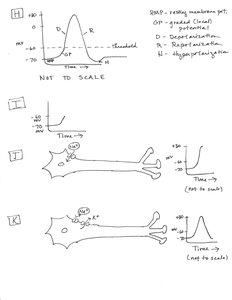
Propagation of Action Potentials
Action potentials are propagated along the axon of a neuron, allowing rapid transmission of signals. The process involves sequential depolarization and repolarization of the membrane.
Initiation: Action potential begins at the axon hillock when the threshold is reached.
Propagation: The action potential travels down the axon as each segment depolarizes and repolarizes.
Unidirectional Flow: Due to refractory periods, action potentials move in one direction—from the cell body toward the axon terminals.
Example: The diagrams show the progression of the action potential along the axon, with corresponding changes in membrane potential over time.
Key Terms and Definitions
Resting Membrane Potential (RMP): The voltage across the membrane when the neuron is inactive.
Graded Potential (GP): Small, local changes in membrane potential that may or may not lead to an action potential.
Depolarization (D): The process of the membrane potential becoming less negative.
Repolarization (R): The return of the membrane potential to its resting state.
Hyperpolarization (H): The membrane potential becomes more negative than the resting state.
Equations and Academic Context
The membrane potential can be described mathematically using the Nernst equation and the Goldman-Hodgkin-Katz equation:
Nernst Equation:
Goldman-Hodgkin-Katz Equation:
Additional info: The diagrams illustrate the sequence of events during an action potential, including the changes in membrane potential and the propagation along the axon. These concepts are directly relevant to Chapter 12: Nervous Tissue and Chapter 13: The Spinal Cord, Spinal Nerves, and Spinal Reflexes in an Anatomy and Physiology course.
