 Back
BackThe Appendicular Skeleton: Structure and Function
Study Guide - Smart Notes
 Tailored notes based on your materials, expanded with key definitions, examples, and context.
The Appendicular Skeleton
Overview of the Appendicular Skeleton
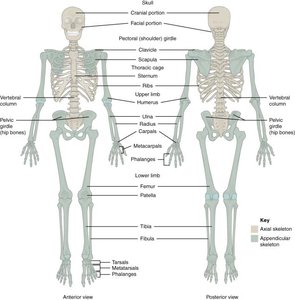
The appendicular skeleton consists of 126 bones that form the limbs and the pectoral and pelvic girdles. These structures are essential for movement and interaction with the environment, providing attachment points for muscles and facilitating locomotion.
Pectoral (shoulder) girdle: Connects the upper limbs to the trunk.
Pelvic girdle: Connects the lower limbs to the trunk.
Upper and lower limbs: Include bones of the arms, forearms, hands, thighs, legs, and feet.
The Pectoral Girdle
Structure and Articulations
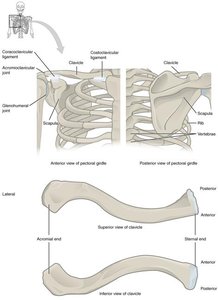
The pectoral girdle is composed of two clavicles and two scapulae. It serves as the attachment point for the upper limbs and allows for a wide range of shoulder movements.
Clavicle (collarbone): S-shaped bone that articulates medially with the manubrium of the sternum (sternoclavicular joint) and laterally with the acromion of the scapula (acromioclavicular joint).
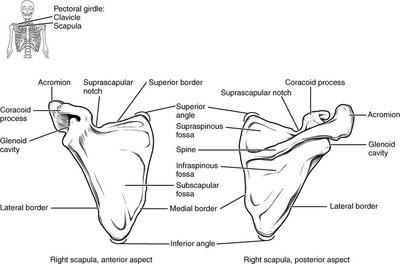
Scapula (shoulder blade): Broad, flat, triangular bone with a glenoid cavity that articulates with the humerus to form the glenohumeral (shoulder) joint.
Bones of the Upper Limb
Regions and Major Bones
The upper limb is divided into the arm (brachium), forearm (antebrachium), and hand. Each upper limb contains 30 bones, specialized for mobility and dexterity.
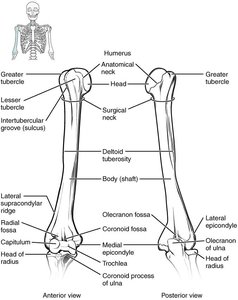
Arm (Brachium): Contains the humerus, which articulates proximally with the scapula and distally with the radius and ulna.
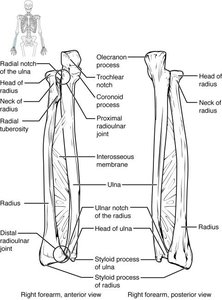
Forearm (Antebrachium): Contains the radius (lateral) and ulna (medial).
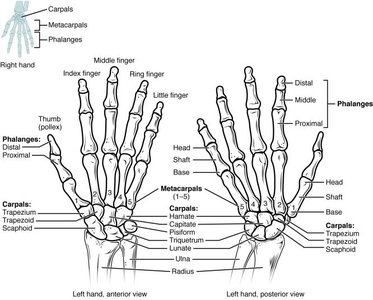
Hand: Composed of carpal bones (wrist), metacarpals (palm), and phalanges (fingers).
Key Articulations and Features
Shoulder Joint (Glenohumeral Joint): Formed by the head of the humerus and the glenoid cavity of the scapula.
Elbow Joint: Formed by the distal humerus (trochlea and capitulum) articulating with the ulna (trochlear notch) and radius (head).
Wrist Joint (Radiocarpal Joint): Formed by the distal radius articulating with the scaphoid and lunate carpal bones.
Hand: 8 carpal bones (wrist), 5 metacarpals (palm), 14 phalanges (fingers and thumb).
Examples of Articulations:
The trochlea of the humerus articulates with the trochlear notch of the ulna.
The capitulum of the humerus articulates with the head of the radius.
The olecranon fossa of the humerus receives the olecranon process of the ulna when the elbow is extended.
The Pelvic Girdle and Pelvis
Structure and Function
The pelvic girdle is composed of two coxal (hip) bones, each formed by the fusion of the ilium, ischium, and pubis. The pelvis includes the two coxal bones, sacrum, and coccyx, providing support for the lower limbs and protecting pelvic organs.
Ilium: Superior and largest part of the coxal bone.
Ischium: Posteroinferior part, bears body weight when sitting.
Pubis: Anterior part, forms the pubic symphysis joint with the opposite pubis.
Acetabulum: Deep socket for articulation with the head of the femur (hip joint).
Obturator foramen: Large opening covered by connective tissue for muscle attachment.
Sacroiliac joint: Articulation between the ilium and sacrum, connecting the pelvic girdle to the axial skeleton.
Bones of the Lower Limb
Regions and Major Bones
The lower limb is specialized for weight-bearing and locomotion, consisting of 30 bones per limb. It is divided into the thigh, leg, and foot.
Thigh: Contains the femur, the longest and heaviest bone in the body.
Leg: Contains the tibia (medial, weight-bearing) and fibula (lateral, non-weight-bearing).
Foot: Composed of tarsal bones (ankle), metatarsals, and phalanges (toes).
Key Articulations and Features
Hip Joint (Coxal Joint): Formed by the head of the femur and the acetabulum of the coxal bone.
Knee Joint: Formed by the distal femur (medial and lateral condyles) and the proximal tibia (medial and lateral condyles), with the patella (kneecap) anteriorly.
Ankle Joint: Formed by the distal tibia (medial malleolus) and fibula (lateral malleolus) articulating with the talus (tarsal bone).
Foot: 7 tarsal bones (including calcaneus and talus), 5 metatarsals, 14 phalanges (toes).
Examples of Articulations:
The patella is a sesamoid bone embedded in the quadriceps tendon and patellar ligament.
The tibial tuberosity is the attachment site for the patellar ligament.
The calcaneus (heel bone) is the largest tarsal bone and attachment site for the Achilles tendon.
Summary Table: Major Bones of the Appendicular Skeleton
Region | Major Bones | Key Joints |
|---|---|---|
Pectoral Girdle | Clavicle, Scapula | Sternoclavicular, Acromioclavicular, Glenohumeral |
Upper Limb | Humerus, Radius, Ulna, Carpals, Metacarpals, Phalanges | Elbow, Radiocarpal (Wrist), Interphalangeal |
Pelvic Girdle | Ilium, Ischium, Pubis (Coxal bone) | Sacroiliac, Pubic Symphysis, Coxal (Hip) |
Lower Limb | Femur, Patella, Tibia, Fibula, Tarsals, Metatarsals, Phalanges | Knee, Ankle, Interphalangeal |
Key Terms and Definitions
Articulation: A joint where two bones meet.
Condyle: A rounded articular projection.
Fossa: A shallow depression in a bone.
Process: A projection or outgrowth of bone.
Sesamoid bone: A bone embedded within a tendon (e.g., patella).
