 Back
BackCh 16: The Autonomic Nervous System (ANS): Structure, Function, and Divisions
Study Guide - Smart Notes
 Tailored notes based on your materials, expanded with key definitions, examples, and context.
The Autonomic Nervous System (ANS)
Overview of the ANS
The Autonomic Nervous System (ANS) is a critical component of the peripheral nervous system that regulates involuntary physiological processes, including heart rate, blood pressure, respiration, digestion, and sexual arousal. The ANS operates largely outside conscious awareness and is essential for maintaining homeostasis.
Two main divisions: Sympathetic and Parasympathetic
Control center: Medulla oblongata in the brainstem
Neural pathway: Each ANS pathway consists of two neurons (preganglionic and postganglionic) connecting the CNS to the target organ
Response modulation: ANS responses are graded (ramp up/down), not all-or-nothing

Divisions of the ANS
Sympathetic Division
The sympathetic division prepares the body for stressful or energetic activity, often referred to as the "fight or flight" response.
Origin: Thoracolumbar region of the spinal cord
Neural structure: Short preganglionic fibers, long postganglionic fibers
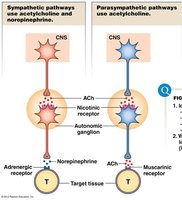
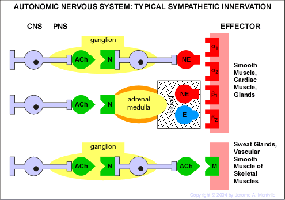
Neurotransmitters: Acetylcholine (ACh) at the first synapse (nicotinic receptors), norepinephrine (NE) at the second synapse (adrenergic receptors: alpha or beta)
Ganglia location: Near the spinal cord (sympathetic chain ganglia)
Key effects: Increases heart rate, blood pressure, respiratory rate, metabolic rate; dilates respiratory passageways; mobilizes energy reserves; reduces digestive and urinary functions
Parasympathetic Division
The parasympathetic division supports "rest and digest" activities, conserving energy and promoting routine maintenance functions.
Origin: Craniosacral region (brainstem and sacral spinal cord)
Neural structure: Long preganglionic fibers, short postganglionic fibers
Neurotransmitters: Acetylcholine (ACh) at both synapses (nicotinic and muscarinic receptors)
Ganglia location: Near or within target organs
Key effects: Decreases heart rate and blood pressure, increases digestive activity, stimulates urination and defecation, promotes sexual arousal
Sympathetic vs. Parasympathetic: Key Differences
Feature | Sympathetic | Parasympathetic |
|---|---|---|
Origin | Thoracolumbar | Craniosacral |
Preganglionic Fiber Length | Short | Long |
Postganglionic Fiber Length | Long | Short |
Neurotransmitters | ACh (preganglionic), NE (postganglionic) | ACh (both synapses) |
Receptors | Nicotinic (first), Adrenergic (second) | Nicotinic (first), Muscarinic (second) |
Main Functions | "Fight or Flight" | "Rest and Digest" |
Neurotransmitters and Receptors in the ANS
Sympathetic Neurotransmitters
Preganglionic neurons: Release ACh, which binds to nicotinic receptors (excitatory)
Postganglionic neurons: Release NE (and sometimes epinephrine), which binds to adrenergic receptors (alpha and beta types)
Adrenergic receptors: Activate intracellular enzymes via G proteins; alpha receptors are more sensitive to NE, beta receptors respond to both NE and epinephrine
Parasympathetic Neurotransmitters
All neurons: Release ACh
Receptors: Nicotinic (on ganglion cells, always excitatory) and muscarinic (on target tissues, can be excitatory or inhibitory)
Inactivation: ACh is rapidly broken down by acetylcholinesterase (AChE) at the synapse
Physiological Responses of the ANS
Sympathetic Activation: Seven Key Responses
Heightened mental alertness (pupil dilation, focused vision)
Increased metabolic rate (more ATP production)
Reduced digestive and urinary functions
Activation of energy reserves (mobilization of fats)
Increased respiratory rate and dilation of airways
Increased heart rate and blood pressure (cardiac output increases)
Activation of sweat glands (thermoregulation)
Parasympathetic Activation: Five Key Responses
Decreased metabolic rate
Decreased heart rate and blood pressure (cardiac output normalizes)
Increased secretion by salivary and digestive glands
Increased motility and blood flow in the digestive tract
Stimulation of urination and defecation
Other effects: Pupil constriction, lens focusing for near vision, secretion of digestive hormones, sexual arousal, increased smooth muscle activity in the digestive tract
Cholinergic Receptors: Nicotinic vs. Muscarinic
Nicotinic receptors: Found on all postganglionic neurons (sympathetic and parasympathetic); always excitatory
Muscarinic receptors: Found on target tissues of parasympathetic neurons and some sympathetic targets; effects can be excitatory or inhibitory, mediated by G proteins and longer-lasting than nicotinic effects
The Enteric Nervous System (ENS)
Structure and Function
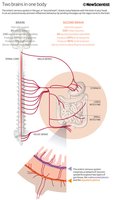
The Enteric Nervous System (ENS) is sometimes considered a third division of the ANS. It is an extensive network of neurons embedded in the walls of the digestive tract, capable of coordinating complex reflexes independently of the CNS.
Contains approximately 100 million neurons
Regulates digestive processes such as motility, secretion, and blood flow
Uses all major neurotransmitters found in the brain
Summary Table: Sympathetic vs. Parasympathetic
Division | Origin | Preganglionic Fiber | Postganglionic Fiber | Neurotransmitters | Main Effects |
|---|---|---|---|---|---|
Sympathetic | Thoracolumbar | Short | Long | ACh (preganglionic), NE (postganglionic) | "Fight or Flight" |
Parasympathetic | Craniosacral | Long | Short | ACh (both synapses) | "Rest and Digest" |
Additional info: The ANS is essential for maintaining homeostasis and adapting the body to changing internal and external environments. Understanding the differences between sympathetic and parasympathetic divisions is crucial for interpreting physiological responses and pharmacological interventions.
