 Back
BackThe Autonomic Nervous System (ANS): Structure, Function, and Physiology
Study Guide - Smart Notes
 Tailored notes based on your materials, expanded with key definitions, examples, and context.
The Autonomic Nervous System (ANS)
Overview of the ANS
The autonomic nervous system (ANS) is a division of the peripheral nervous system that regulates involuntary physiological processes, including the activity of smooth muscle, cardiac muscle, and certain glands. It operates largely below the level of consciousness and is essential for maintaining homeostasis.
Subconscious control: The ANS functions without conscious awareness.
Effectors: Smooth muscle, cardiac muscle, and glands.
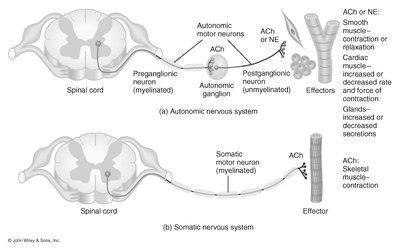
Comparison: The somatic nervous system (SNS) controls voluntary movements of skeletal muscle, while the ANS controls involuntary actions.
Somatic vs. Autonomic Nervous System
Key Differences
SNS: One motor neuron connects the CNS to the effector (skeletal muscle); voluntary control.
ANS: Two motor neurons (preganglionic and postganglionic) connect the CNS to the effector; involuntary control.
Sensations: SNS involves consciously perceived sensations; ANS involves unconsciously perceived visceral sensations.
Autonomic Motor Pathways
Structure of ANS Pathways
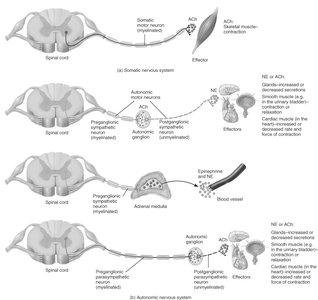
Preganglionic neuron: Cell body in the CNS; myelinated axon extends to an autonomic ganglion or the adrenal medulla.
Postganglionic neuron: Cell body in the autonomic ganglion; nonmyelinated axon extends to the effector (smooth muscle, cardiac muscle, or gland).
Divisions of the ANS
Sympathetic and Parasympathetic Divisions
The ANS is divided into two main branches:
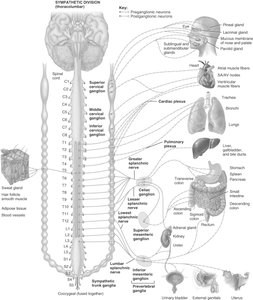
Sympathetic division: Prepares the body for 'fight or flight' responses; increases heart rate, dilates pupils, and redirects blood flow to muscles.
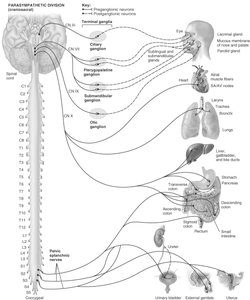
Parasympathetic division: Promotes 'rest and digest' activities; decreases heart rate, stimulates digestion, and conserves energy.
Dual innervation: Most organs receive input from both divisions, which typically have opposing effects.
Autonomic Ganglia
Location and Function
Sympathetic ganglia: Located adjacent or anterior to the spinal column.
Parasympathetic ganglia: Terminal ganglia located near or within the walls of target organs.
Sympathetic Nervous System Circuitry
Divergence and Mass Activation
Divergence: Each preganglionic neuron synapses with many postganglionic neurons, allowing widespread activation (mass activation).
Adrenal gland: Functions as a modified sympathetic ganglion, releasing epinephrine and norepinephrine into the bloodstream for systemic effects.
Neurotransmitters of the ANS
Cholinergic and Adrenergic Neurons
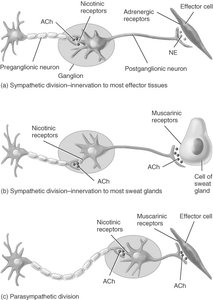
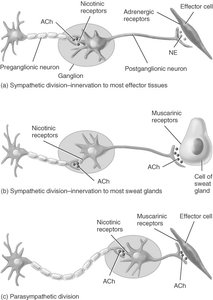
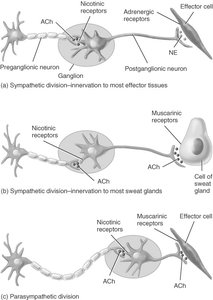
Cholinergic neurons: Release acetylcholine (ACh). Includes all preganglionic neurons, all parasympathetic postganglionic neurons, and a few sympathetic postganglionic neurons (to sweat glands).
Adrenergic neurons: Release norepinephrine (NE). Includes most sympathetic postganglionic neurons.
Cholinergic Receptors
Nicotinic and Muscarinic Receptors
Nicotinic receptors: Found in autonomic ganglia, adrenal medulla, and neuromuscular junctions; activation always causes excitation.
Muscarinic receptors: Found on all parasympathetic effectors (cardiac muscle, smooth muscle, glands); activation can cause excitation or inhibition depending on the organ.
Adrenergic Receptors
Alpha and Beta Receptors
Adrenergic receptors: Respond to norepinephrine and epinephrine; classified as alpha (α1, α2) and beta (β1, β2, β3) receptors.
Effects: Can be excitatory or inhibitory depending on receptor subtype and tissue.
Inactivation: NE is inactivated by monoamine oxidase (MAO) or catechol-O-methyltransferase (COMT); effects are longer lasting than cholinergic effects.
Agonists and Antagonists
Pharmacological Modulation of the ANS
Agonist: Substance that binds to and activates a receptor, mimicking the effect of a natural neurotransmitter or hormone.
Antagonist: Substance that binds to and blocks a receptor, preventing the natural neurotransmitter or hormone from exerting its effect.
Clinical relevance: Many drugs act as agonists or antagonists to selectively activate or block ANS receptors.
Physiological Effects of the ANS
Dual Innervation and Regulation
Dual innervation: Most organs receive both sympathetic and parasympathetic input, allowing fine-tuned regulation.
Hypothalamic control: The hypothalamus balances sympathetic and parasympathetic activity based on sensory input and emotional state.
Organs with only sympathetic innervation: Sweat glands, adrenal medulla, arrector pili muscles, and many blood vessels.
Sympathetic Responses
"Fight or Flight" Response
Triggered by: Physical or emotional stress (emergency, embarrassment, excitement, exercise).
Effects:
Pupil dilation
Increased heart rate, force of contraction, and blood pressure
Decreased blood flow to nonessential organs
Increased blood flow to skeletal and cardiac muscle
Airway dilation and increased respiratory rate
Increased blood glucose levels
Duration: Effects are long-lasting due to lingering NE and adrenal gland hormone release.
Parasympathetic Responses
"Rest and Digest" Response
Functions: Conserves and restores body energy during rest.
SLUDD responses: Salivation, Lacrimation, Urination, Digestion, Defecation.
Three decreases: Decreased heart rate, airway diameter, and pupil diameter.
Paradoxical fear: In situations with no escape, massive parasympathetic activation can cause loss of control over urination and defecation.
Autonomic (Visceral) Reflexes
Components and Function
Purpose: Adjust the activity of visceral effectors (e.g., blood pressure, digestion) unconsciously.
Reflex arc components:
Sensory receptor
Sensory neuron
Integrating center
Preganglionic and postganglionic motor neurons
Visceral effectors
Central Control of the ANS
Role of the Hypothalamus
Major control center: The hypothalamus integrates emotional and visceral sensory information to regulate ANS output.
Inputs: Emotions, smell, taste, temperature, and blood osmolarity.
Consciousness: Most autonomic responses occur without conscious awareness.
Summary Table: Somatic vs. Autonomic Nervous System
Feature | Somatic Nervous System (SNS) | Autonomic Nervous System (ANS) |
|---|---|---|
Control | Voluntary | Involuntary |
Effectors | Skeletal muscle | Smooth muscle, cardiac muscle, glands |
Neurons from CNS to effector | One motor neuron | Two neurons (preganglionic and postganglionic) |
Neurotransmitter | Acetylcholine (ACh) | ACh, Norepinephrine (NE) |
Divisions | None | Sympathetic and Parasympathetic |
