 Back
BackThe Axial Skeleton: Structure and Components of the Human Skull and Vertebral Column
Study Guide - Smart Notes
 Tailored notes based on your materials, expanded with key definitions, examples, and context.
The Skeletal System: Axial Division
Overview of the Axial Skeleton
The axial skeleton forms the central axis of the human body and is essential for protection, support, and movement. It consists of 80 bones, including the skull, vertebral column, and thoracic cage. The axial skeleton supports the head, neck, and trunk, and protects the brain, spinal cord, and thoracic organs.
Major regions: Skull, vertebral column, thoracic cage
Functions: Protection of vital organs, structural support, attachment for muscles
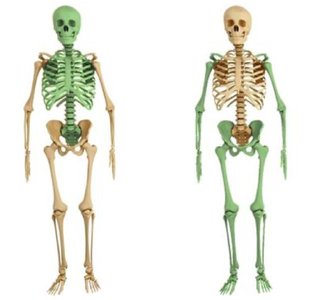
Skull: Cranial and Facial Bones
Cranial Bones
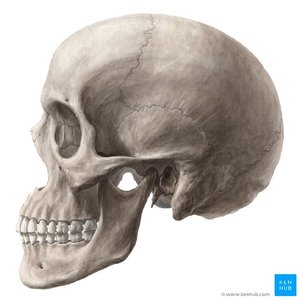
The cranium is composed of eight bones that encase and protect the brain. These bones are tightly joined by immovable joints called sutures.
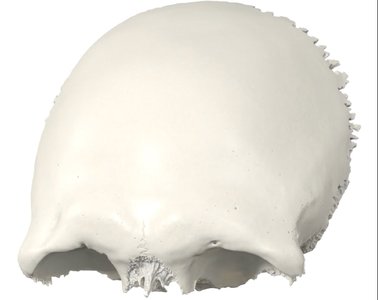
Frontal bone (1): Forms the forehead and the superior part of the eye sockets.
Parietal bones (2): Form the superior and lateral aspects of the skull.
Temporal bones (2): Form the sides and base of the cranium; house structures of the ears.
Occipital bone (1): Forms the posterior and base of the skull; contains the foramen magnum.
Sphenoid bone (1): Forms part of the base of the skull and the sides of the orbits.
Ethmoid bone (1): Forms part of the nasal cavity and the medial wall of the orbits.
Key Cranial Bone Features
Sutures: Coronal, sagittal, lambdoid, and squamous sutures connect the cranial bones.
Foramen magnum: Large opening in the occipital bone for the spinal cord.
External acoustic meatus: Canal in the temporal bone for sound transmission.
Facial Bones
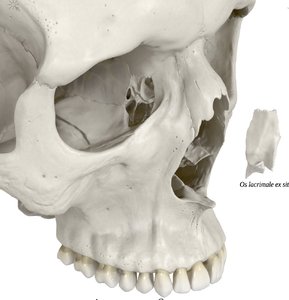
The facial skeleton consists of 14 bones that form the structure of the face, house the teeth, and anchor facial muscles.
Mandible (1): Lower jawbone; only movable bone of the skull.
Maxillae (2): Upper jawbones; form the upper jaw and part of the hard palate.
Zygomatic bones (2): Cheekbones; form part of the orbit.
Nasal bones (2): Bridge of the nose.
Lacrimal bones (2): Small bones in the medial wall of each orbit.
Palatine bones (2): Form part of the hard palate and nasal cavity.
Vomer (1):b> Forms part of the nasal septum.
Inferior nasal conchae (2): Form part of the lateral walls of the nasal cavity.
Bone Markings and Features
Common Bone Markings
Bones display various markings that serve as attachment points for muscles, passageways for nerves and blood vessels, and articulation surfaces for joints.
Foramen: A round or oval opening through a bone (e.g., foramen magnum).
Process: Any bony prominence (e.g., mastoid process).
Condyle: Rounded articular projection (e.g., occipital condyles).
Fossa: Shallow depression in a bone (e.g., mandibular fossa).
Vertebral Column
Structure and Regions
The vertebral column (spine) is a flexible, segmented structure that protects the spinal cord and supports the head and trunk. It consists of 33 vertebrae in five regions:
Cervical (7): Neck region; includes atlas (C1) and axis (C2).
Thoracic (12): Upper back; each articulates with a pair of ribs.
Lumbar (5): Lower back; largest and strongest vertebrae.
Sacrum (1): Five fused vertebrae forming the posterior wall of the pelvis.
Coccyx (1): Four fused vertebrae forming the tailbone.
Vertebral Curvatures
The vertebral column has four normal curvatures that increase resilience and flexibility:
Cervical and lumbar: Concave posteriorly (lordotic curves).
Thoracic and sacral: Convex posteriorly (kyphotic curves).
Thoracic Cage
Components and Function
The thoracic cage protects the heart and lungs and supports the shoulder girdles and upper limbs. It consists of the sternum, ribs, and thoracic vertebrae.
Sternum: Flat bone at the anterior midline of the thorax; consists of the manubrium, body, and xiphoid process.
Ribs (12 pairs): Curved bones attached posteriorly to thoracic vertebrae.
True ribs (1-7): Attach directly to the sternum via costal cartilages.
False ribs (8-12): Attach indirectly or not at all to the sternum; ribs 11 and 12 are floating ribs.
Summary Table: Axial Skeleton Components
Region | Bones Included | Key Functions |
|---|---|---|
Skull | Cranial (8), Facial (14), Auditory ossicles (6), Hyoid (1) | Protects brain, supports facial structure |
Vertebral Column | Cervical (7), Thoracic (12), Lumbar (5), Sacrum (1), Coccyx (1) | Protects spinal cord, supports body axis |
Thoracic Cage | Sternum (1), Ribs (24) | Protects thoracic organs, supports respiration |
Key Terms and Definitions
Axial skeleton: The part of the skeleton forming the central axis of the body.
Suture: Immovable joint between skull bones.
Foramen: Opening in a bone for nerves and blood vessels.
Process: Projection or outgrowth of bone.
Example: Clinical Relevance
Fractures of the vertebral column can lead to spinal cord injury, while trauma to the skull can result in brain injury. Understanding the anatomy of the axial skeleton is essential for diagnosing and treating such injuries.
