 Back
BackThe Axial Skeleton: Structure and Function
Study Guide - Smart Notes
 Tailored notes based on your materials, expanded with key definitions, examples, and context.
The Axial Skeleton
Overview of the Axial Skeleton
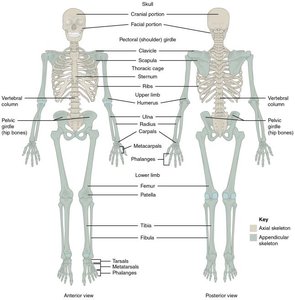
The axial skeleton forms the central axis of the human body and is essential for protection, support, and movement. It consists of 80 bones, accounting for approximately 40% of the bones in the human body. The main components include the skull, vertebral column, and thoracic cage.
Skull: 22 bones (8 cranial, 14 facial)
Bones associated with the skull: 6 auditory ossicles, 1 hyoid bone
Thoracic cage: Sternum and 24 ribs
Vertebral column: 24 vertebrae, sacrum, coccyx
The Skull
Structure and Function of the Skull
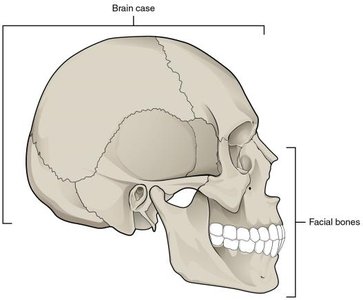
The skull protects the brain and forms the structure of the face. It is divided into the cranial bones (brain case) and facial bones. The cranial cavity houses the brain, while the facial bones form the upper and lower jaws, nasal cavities, and orbits.
Cranial Bones
The cranial bones encase and protect the brain. There are eight cranial bones:
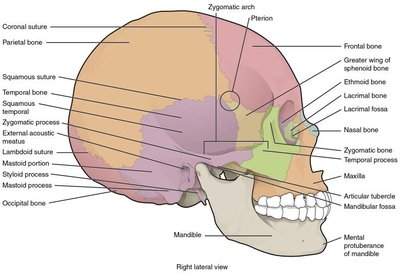
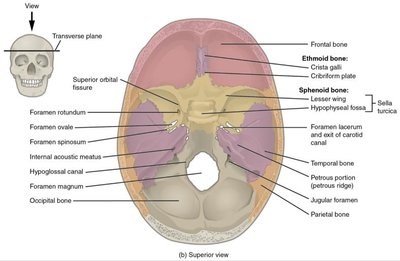
Frontal bone: Forms the forehead and the floor of the anterior cranial cavity.
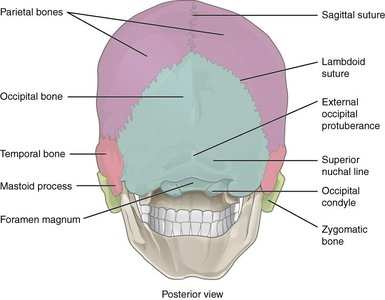
Parietal bones (2): Form most of the upper lateral sides of the skull, joined at the top by the sagittal suture.
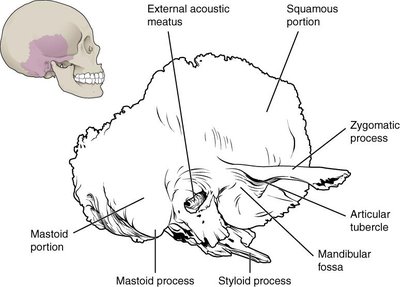
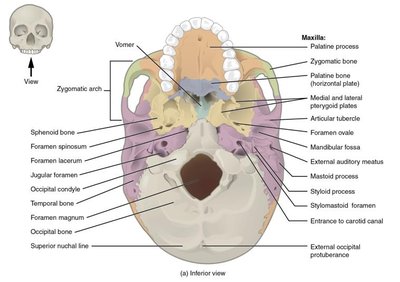
Temporal bones (2): Form the lower lateral sides of the skull and contain structures such as the mastoid process and external acoustic meatus.
Occipital bone: Forms the posterior base of the cranial cavity and contains the foramen magnum for the spinal cord.
Sphenoid bone: Forms part of the floor of the cranium, acts as a cross-bridge, and houses the sella turcica for the pituitary gland.
Ethmoid bone: Forms part of the floor of the anterior cranium, the roof of the nasal cavity, and part of the nasal septum.
Key Features of Cranial Bones
Mastoid process (temporal bone): Muscle attachment site for head rotation.
Mandibular fossa (temporal bone): Part of the temporomandibular joint.
Foramen magnum (occipital bone): Passage for the spinal cord.
Occipital condyles: Articulate with the first cervical vertebra (atlas).
Sella turcica (sphenoid bone): Houses the pituitary gland.
Cribriform plate (ethmoid bone): Contains olfactory foramina for the sense of smell.
Crista galli (ethmoid bone): Attachment for the falx cerebri membrane.External acoustic meatus (temporal bone)Superior nasal conchae
Middle nasal conchae
Ethmoidal labyrinth (air cells / sinuses)
Articular tubercle (temporal bone)
Longitudinal fissure / cerebral hemispheres separation (frontal/parietal context)
Sutures of the Skull
Sutures are immobile joints between adjacent skull bones. Major sutures include:
Coronal suture: Frontal bone to parietal bones
Sagittal suture: Right and left parietal bones
Lambdoid suture: Occipital bone to parietal and temporal bones
Squamous suture: Temporal bone to parietal bone
Facial Bones
The facial bones provide structure for the face, form the upper and lower jaws, and contribute to the orbits and nasal cavities. There are 14 facial bones:
Maxillae (2): Form the upper jaw, most of the hard palate, and part of the orbit and nasal cavity.
Palatine bones (2): Form the posterior portion of the hard palate.
Zygomatic bones (2): Cheekbones; form the lateral wall and margin of the orbit.
Nasal bones (2): Form the bridge of the nose.
Lacrimal bones (2): Form the anterior, medial wall of the orbit.
Inferior nasal conchae (2): Project into the nasal cavity from the lower lateral wall.
Vomer: Forms the posterior-inferior part of the nasal septum.
Mandible: Forms the lower jaw; only moveable skull bone.
Special Features of the Mandible
Body: Horizontal portion
Ramus: Vertical portion
Coronoid process: Muscle attachment
Condylar process: Articulates with the temporal bone
Alveolar process: Anchors lower teeth
Mental protuberance: Chin
Mental foramen: Passage for nerves
Mandibular foramen: Passage for blood vessels and nerves to lower teeth
The Orbit and Nasal Cavity
The orbit is a bony socket formed by seven bones and houses the eyeball. The nasal septum is composed of bone and cartilage, including the perpendicular plate of the ethmoid bone and the vomer. Nasal conchae create air turbulence, warming and humidifying inhaled air.Frontal = roof
Zygomatic = lateral wall
Maxilla = floor (major part)
Palatine = small floor contribution
Ethmoid + lacrimal = medial wall
Sphenoid = posterior orbit
Orbital rim = frontal + zygomatic + maxill
Cranial Fossae
The floor of the cranial cavity is divided into three fossae:
Anterior cranial fossa: Contains the frontal lobes of the brain
Middle cranial fossa: Contains the temporal lobes; includes openings for nerves and blood vessels (optic canal, foramen rotundum, foramen ovale)
Posterior cranial fossa: Contains the cerebellum; includes the internal acoustic meatus, hypoglossal canal, and jugular foramen➕ Middle cranial fossa adds:
Optic canal
Foramen rotundum
Foramen ovale
➕ Posterior cranial fossa adds:
Internal acoustic meatus
Jugular foramen
Hypoglossal canal
Paranasal Sinuses
Paranasal sinuses are air-filled spaces within the frontal, sphenoid, ethmoid, and maxillary bones. They are lined with mucous epithelium, connected to the nasal cavities, and help warm, humidify, and filter inhaled air.
The Hyoid Bone
The hyoid bone is a U-shaped bone in the upper neck that does not articulate with any other bone. It serves as an attachment site for muscles of the larynx, pharynx, and tongue.
The Vertebral Column
Structure and Regions of the Vertebral Column
The vertebral column, or spine, supports the body and protects the spinal cord. It consists of 26 bones: 24 vertebrae, the sacrum, and the coccyx. The regions are:
Cervical (7 vertebrae): Neck region; C1 (atlas) and C2 (axis) allow head movement.
Thoracic (12 vertebrae): Upper back; articulate with ribs.
Lumbar (5 vertebrae): Lower back; largest and support most body weight.
Sacrum: Fusion of 5 vertebrae; part of the pelvis.
Coccyx: Fusion of 3–5 vertebrae; tailbone.
General Structure of a Vertebra
Vertebral body: Weight-bearing portion
Vertebral arch: Forms the posterior part; includes pedicles and laminae
Vertebral foramen: Passage for the spinal cord
Intervertebral foramen: Passage for spinal nerves
Intervertebral disc: Fibrocartilage, shock-absorbing
Transverse and spinous processes: Muscle attachment sites
Articular processes: Superior and inferior, for articulation with adjacent vertebrae
Vertebral foramen → forms spinal canal
Pedicles = lateral walls
Laminae = roof of vertebral arch
Vertebral arch = pedicles + laminae
Specialized Vertebrae
Atlas (C1): No body or spinous process; articulates with occipital condyles for nodding motion.
Axis (C2): Dens (odontoid process) allows side-to-side rotation of the head.
Transverse foramina (VERY IMPORTANT)
Function: passage of blood vessels to brain
Thoracic Cage and Ribs
The thoracic cage protects vital organs and supports respiration. It consists of the sternum, 12 pairs of ribs, and thoracic vertebrae.
Sternum: Composed of the manubrium, body, and xiphoid process.
Ribs:
True ribs (1–7): Directly attach to the sternum via costal cartilage.
False ribs (8–10): Indirectly attach to the sternum via cartilage of rib 7.
Floating ribs (11–12): Do not attach to the sternum.
Costal facets on vertebral bodies
Transverse costal facets (T1–T10)
Rib articulation
Manubrium → clavicle + rib 1
Body → ribs 2–7
Xiphoid → muscle attachment (diaphragm + abdominals)
➕ Sacrum:
Sacral canal
Sacral hiatus
Sacral foramina (anterior & posterior)
Summary Table: Major Bones of the Axial Skeleton
Region | Main Bones | Key Functions |
|---|---|---|
Skull | Cranial (8), Facial (14), Auditory ossicles (6), Hyoid (1) | Protects brain, forms face, supports sensory organs |
Vertebral Column | Cervical (7), Thoracic (12), Lumbar (5), Sacrum (1), Coccyx (1) | Supports body, protects spinal cord |
Thoracic Cage | Sternum (1), Ribs (24) | Protects thoracic organs, supports respiration |
Additional info: The axial skeleton provides the main framework for the body, supports the head and trunk, and serves as an attachment for muscles involved in movement, posture, and respiration.
