 Back
BackThe Axial Skeleton: Structure, Function, and Key Components
Study Guide - Smart Notes
 Tailored notes based on your materials, expanded with key definitions, examples, and context.
The Axial Skeleton
Overview and Major Divisions
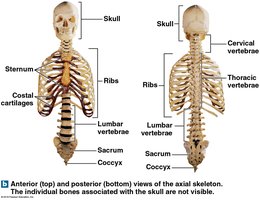
The axial skeleton forms the longitudinal axis of the body and consists of the bones of the head and trunk. It provides structural support, protects vital organs, and serves as an attachment point for muscles involved in movement and posture.
Total bones: 80
Main regions:
Skull (cranial and facial bones)
Bones associated with the skull (auditory ossicles, hyoid bone)
Thoracic cage (sternum, ribs)
Vertebral column (vertebrae, sacrum, coccyx)
Functions of the Axial Skeleton
Supports and protects organs in body cavities (e.g., brain, heart, lungs)
Provides attachment points for muscles that adjust the head, neck, and trunk, perform breathing movements, and stabilize the appendicular skeleton
The Skull
Major Divisions and Bones
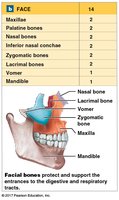
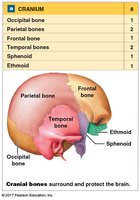
The skull is composed of 22 bones: 8 cranial bones forming the cranium and 14 facial bones. It protects the brain and supports the structures of the face.
Cranial Bone | Number | Function |
|---|---|---|
Occipital | 1 | Posterior base of skull |
Parietal | 2 | Superior and lateral skull |
Frontal | 1 | Forehead, superior eye sockets |
Temporal | 2 | Lateral skull, ear region |
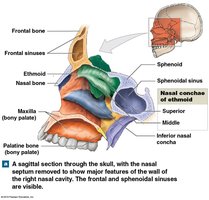
Sphenoid | 1 | Base of cranium, unites cranial/facial bones |
Ethmoid | 1 | Roof of nasal cavity, part of orbit |
Facial Bone | Number | Function |
|---|---|---|
Maxillae | 2 | Upper jaw, hard palate |
Palatine | 2 | Posterior hard palate |
Nasal | 2 | Bridge of nose |
Inferior nasal conchae | 2 | Increase nasal cavity surface area |
Zygomatic | 2 | Cheekbones |
Lacrimal | 2 | Medial orbit wall |
Vomer | 1 | Inferior nasal septum |
Mandible | 1 | Lower jaw |
Associated Bones
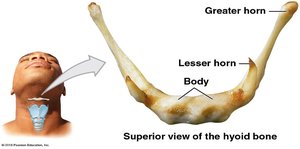
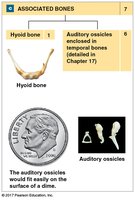
Hyoid bone: U-shaped bone supporting the larynx and serving as an attachment for tongue and neck muscles.
Auditory ossicles: Three tiny bones in each middle ear (malleus, incus, stapes) that transmit sound vibrations.
Major Sutures of the Skull
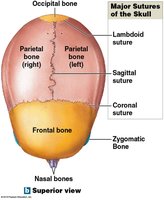
Sutures are immovable joints connecting the bones of the skull. The four major sutures are:
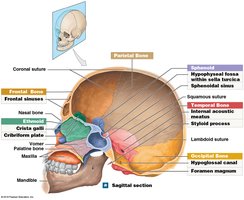
Lambdoid suture: Separates occipital from parietal bones
Coronal suture: Attaches frontal bone to parietal bones
Sagittal suture: Between parietal bones, from lambdoid to coronal suture
Squamous sutures: Join temporal bones with parietal bones
Key Features of Cranial Bones
Occipital bone: Forms posterior/inferior cranium, articulates with parietal, temporal, sphenoid bones, and the atlas (C1).
Temporal bones: Form lateral cranium, house ear structures, articulate with mandible.
Sphenoid: Unites cranial/facial bones, contains sphenoidal sinuses, forms part of cranial floor.
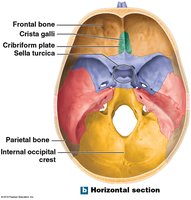
Ethmoid: Forms roof of nasal cavity, part of orbit, contains cribriform plate and crista galli.
Sinuses
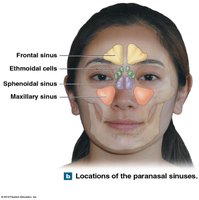
Sinuses are air-filled chambers within cranial and facial bones. They decrease skull weight, produce mucus, and serve as resonating chambers for speech.
Facial Bones: Key Features
Maxillae: Support upper teeth, form upper jaw and hard palate, contain maxillary sinuses.
Nasal bones: Form bridge of nose, connect to nasal cartilage.
Vomer: Forms inferior part of nasal septum.
Inferior nasal conchae: Create turbulence, warm and humidify air.
Zygomatic bones: Cheekbones, part of orbit and zygomatic arch.
Lacrimal bones: Smallest facial bones, form part of medial orbit wall.
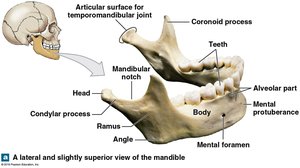
Mandible: Lower jaw, supports lower teeth, forms temporomandibular joint.
Orbits (Eye Sockets)
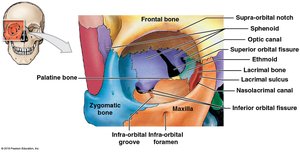
Each orbit is formed by seven bones: frontal, maxilla, lacrimal, ethmoid, sphenoid, palatine, and zygomatic. These bones protect the eyes and provide attachment for muscles.
The Vertebral Column
Structure and Regions
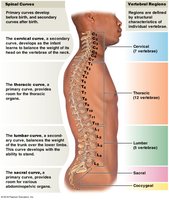
The vertebral column (spine) protects the spinal cord and supports the head and body. It consists of 26 bones: 24 vertebrae, the sacrum, and the coccyx.
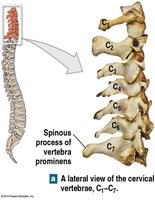
Cervical region: 7 vertebrae (C1–C7)
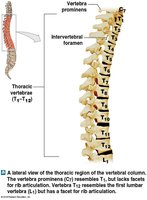
Thoracic region: 12 vertebrae (T1–T12)
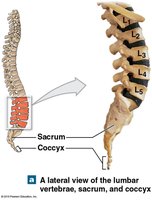
Lumbar region: 5 vertebrae (L1–L5)
Sacrum: 1 (5 fused vertebrae)
Coccyx: 1 (3–5 fused vertebrae)
Spinal Curves
Primary curves (accommodation): Thoracic and sacral, present at birth, accommodate internal organs.
Secondary curves (compensation): Cervical and lumbar, develop after birth, help maintain upright posture.
Structure of a Typical Vertebra
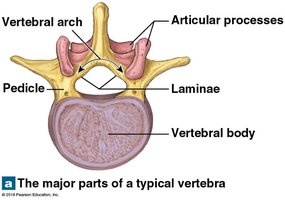
Vertebral body: Main weight-bearing region
Vertebral arch: Forms vertebral foramen (spinal cord passage)
Articular processes: Allow articulation with adjacent vertebrae
Regional Characteristics of Vertebrae
Cervical vertebrae (C1–C7): Small body, large vertebral foramen, support head
Thoracic vertebrae (T1–T12): Heart-shaped body, facets for rib articulation
Lumbar vertebrae (L1–L5): Largest, thick oval bodies, support most body weight
Sacrum and Coccyx
Sacrum: Five fused vertebrae, protects pelvic organs, attaches to pelvic girdle
Coccyx: Three to five fused vertebrae, attachment for ligaments and muscles of the pelvic floor
The Thoracic Cage
Structure and Function
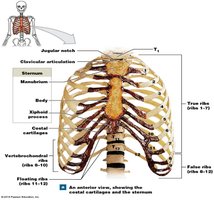
The thoracic cage consists of the thoracic vertebrae, ribs, costal cartilages, and sternum. It protects thoracic organs and provides attachment for muscles involved in respiration and upper limb movement.
Ribs: 12 pairs
True ribs (1–7): Attach directly to sternum via costal cartilages
False ribs (8–12): Do not attach directly to sternum
Vertebrochondral ribs (8–10): Cartilages fuse and merge with rib 7 cartilage
Floating ribs (11–12): No sternal attachment
Sternum: Flat bone with three parts: manubrium, body, xiphoid process
Developmental Notes
The sternal body develops from four bones that fuse by age 25.
The xiphoid process is the last part of the sternum to ossify and can be broken easily.
Summary Table: Axial Skeleton Components
Region | Bones | Key Functions |
|---|---|---|
Skull | 8 cranial, 14 facial, 7 associated | Protects brain, supports face, hearing, speech |
Thoracic cage | 24 ribs, sternum | Protects thoracic organs, respiration |
Vertebral column | 24 vertebrae, sacrum, coccyx | Protects spinal cord, supports body |
