 Back
BackThe Axial Skeleton: Structure, Function, and Key Bones
Study Guide - Smart Notes
 Tailored notes based on your materials, expanded with key definitions, examples, and context.
The Axial Skeleton
Overview and Functions
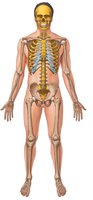
The axial skeleton forms the central axis of the human body and is essential for protection, support, and movement. It consists of the skull, vertebral column, thoracic cage, auditory ossicles, and hyoid bone.
Protection: Shields the brain, spinal cord, and vital organs within the thorax.
Support: Provides structural support for the body and attachment points for muscles.
Movement: Facilitates respiratory movements and stabilizes the appendicular skeleton.
Major Components of the Axial Skeleton
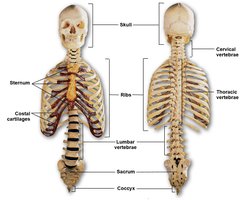
Skull: 8 cranial bones and 14 facial bones
Auditory Ossicles: 6 small bones in the middle ear
Hyoid Bone: Supports the tongue and larynx
Vertebral Column: 24 vertebrae, sacrum, and coccyx
Thoracic Cage: Sternum and 24 ribs
The Skull
Cranial Bones
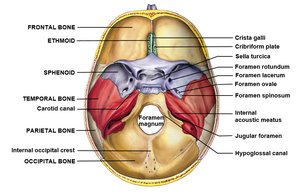
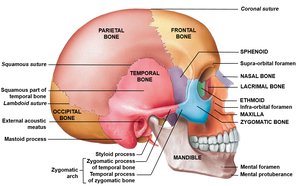
The cranium (braincase) is composed of 8 bones that enclose and protect the brain within the cranial cavity.
Occipital bone
Frontal bone
Sphenoid bone
Ethmoid bone
Left and right parietal bones
Left and right temporal bones
Facial Bones
The 14 facial bones support the entrances to the digestive and respiratory tracts and form the structure of the face.
Paired maxillae, lacrimal, nasal, zygomatic, palatine, inferior nasal conchae
Vomer (single)
Mandible (single)
Key Skull Features
Sinuses: Air-filled chambers that lighten the skull and produce mucus.
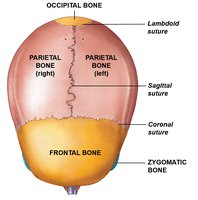
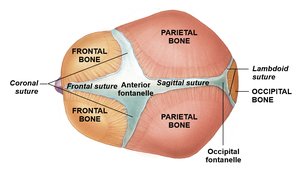
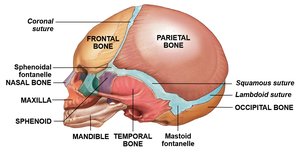
Sutures: Immovable joints connecting skull bones (e.g., coronal, sagittal, lambdoid).
Selected Cranial Bones and Features
Occipital Bone
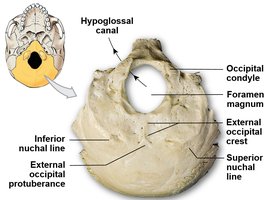
The occipital bone forms the posterior and inferior surfaces of the cranium.
External occipital protuberance: Midline projection for ligament attachment.
Occipital condyles: Articulate with the atlas (C1 vertebra).
Foramen magnum: Large opening for the spinal cord.
Jugular foramen: Passage for internal jugular veins.
Hypoglossal canals: Passage for hypoglossal nerves.
Parietal Bones
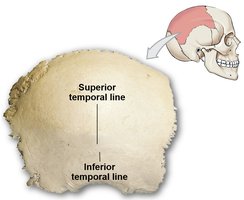
The parietal bones form the superior and lateral aspects of the cranium.
Temporal lines: Attachment points for the temporalis muscle.
Grooves: Indicate the path of blood vessels inside the skull.
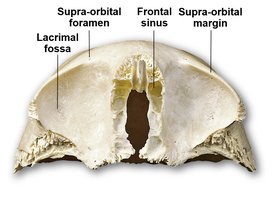
Frontal Bone
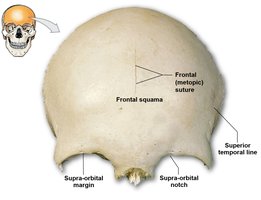
The frontal bone forms the forehead and the superior part of the eye sockets.
Frontal sinuses: Help flush the nasal cavities.
Supra-orbital margin: Protects the eyes.
Lacrimal fossa: Houses the lacrimal gland.
Supra-orbital foramen/notch: Passage for nerves and blood vessels.
Temporal Bones
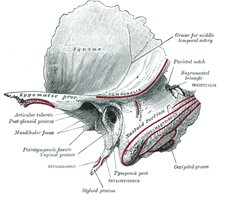
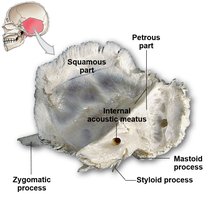
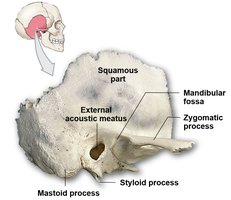
The temporal bones form part of the lateral walls of the cranium and house structures of the ear.
Zygomatic process: Articulates with the zygomatic bone.
Mastoid process: Muscle attachment; contains air cells.
Styloid process: Ligament and tendon attachment.
Petrous part: Contains inner ear structures.
Carotid canal, foramen lacerum, external/internal acoustic meatus: Passageways for nerves and vessels.
Sphenoid Bone
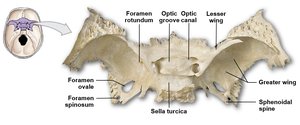
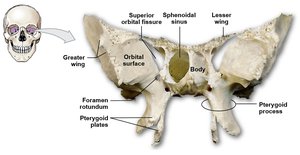
The sphenoid bone forms part of the cranial floor and connects cranial and facial bones.
Sphenoid sinus: Air-filled cavity within the bone.
Sella turcica: Encloses the pituitary gland.
Lesser and greater wings: Extend from the body of the sphenoid.
Pterygoid processes: Muscle attachment sites.
Optic canal, foramen rotundum, ovale, spinosum: Passageways for nerves and vessels.
Ethmoid Bone
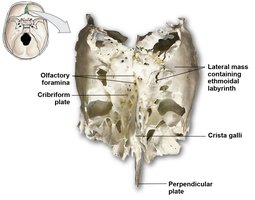
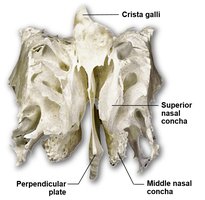
The ethmoid bone forms the anterolateral floor of the cranium, the roof of the nasal cavity, and part of the nasal septum and medial orbital wall.
Ethmoid sinuses: Network of air cells opening into the nasal cavities.
Cribriform plate: Contains olfactory foramina for nerve passage.
Crista galli: Attachment for the falx cerebri (dura mater).
Lateral masses: Contain superior and middle nasal conchae.
Perpendicular plate: Forms part of the nasal septum.
Selected Facial Bones
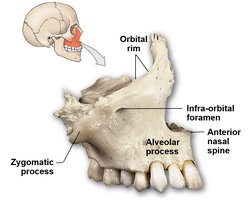
Maxillae
The maxillae support the upper teeth, form the upper jaw and hard palate, and contribute to the orbits and nasal cavity.
Maxillary sinuses: Largest paranasal sinuses.
Alveolar processes: Support upper teeth.
Palatine processes: Form the anterior hard palate.
Infra-orbital foramen: Passage for nerves and vessels.
Palatine Bones
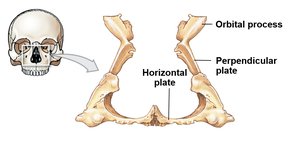
The palatine bones form the posterior part of the hard palate and contribute to the floor of the orbits.
Horizontal plate: Posterior hard palate.
Perpendicular plate: Extends vertically to the orbit.
Nasal Bones, Vomer, and Inferior Nasal Conchae
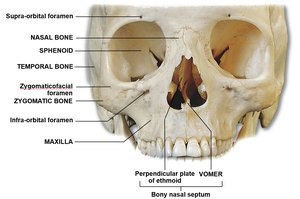
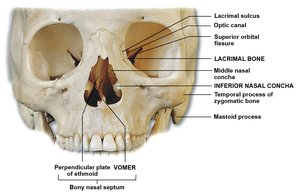
The nasal bones support the bridge of the nose. The vomer forms the inferior part of the nasal septum, and the inferior nasal conchae create air turbulence in the nasal cavity.
Mandible
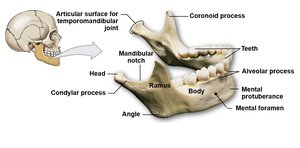
The mandible forms the lower jaw and is the only movable bone of the skull.
Alveolar process: Supports lower teeth.
Body: Horizontal portion.
Ramus: Ascending portion.
Condylar process: Articulates with the temporal bone (TMJ).
Coronoid process: Muscle attachment.
Mandibular foramen: Entrance to the mandibular canal.
Developmental Aspects
Infant Skull and Fontanelles
The infant skull contains fontanelles—fibrous areas between cranial bones that allow for skull distortion during birth and brain growth.
Anterior fontanelle: Largest, located at the junction of frontal and parietal bones.
Posterior, sphenoidal, and mastoid fontanelles: Smaller, close earlier in development.
The Vertebral Column
Structure and Curves
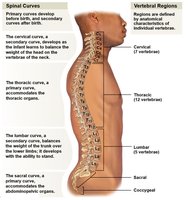
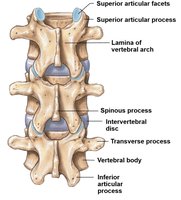
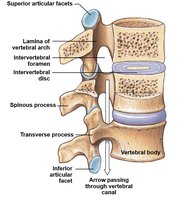
The vertebral column consists of 24 vertebrae, the sacrum, and the coccyx. It supports the head, protects the spinal cord, and transfers weight to the lower limbs.
Primary curves: Thoracic and sacral, present at birth.
Secondary curves: Cervical and lumbar, develop after birth.
Intervertebral discs: Pads of fibrocartilage between vertebrae for shock absorption.
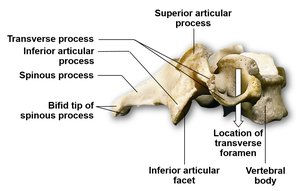
Cervical Vertebrae
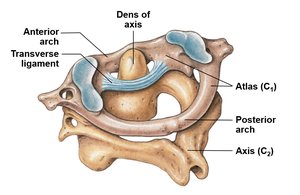
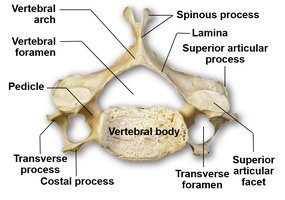
There are seven cervical vertebrae (C1–C7). The atlas (C1) and axis (C2) are specialized for head movement.
Atlas (C1): Supports the skull; allows "yes" movement.
Axis (C2): Has the dens (odontoid process); allows "no" movement.
Vertebra prominens (C7): Has a prominent spinous process.
Thoracic Vertebrae
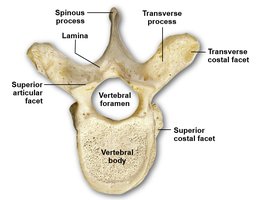
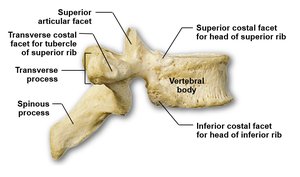
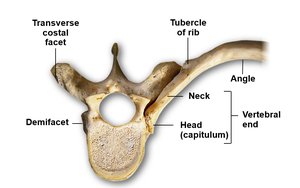
The twelve thoracic vertebrae (T1–T12) articulate with the ribs and have costal facets for rib attachment.
T1–T9: Superior and inferior costal facets.
T10–T12: Single costal facet.
T1–T10: Transverse costal facets.
Lumbar Vertebrae
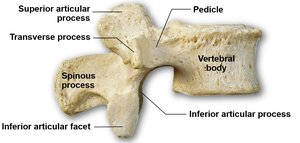
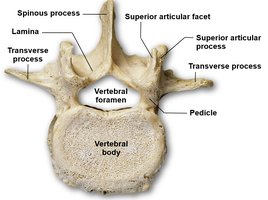
The five lumbar vertebrae (L1–L5) are large, lack costal facets, and have spatulated spinous processes and triangular vertebral foramina.
Sacrum
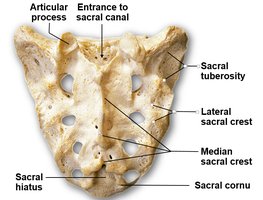
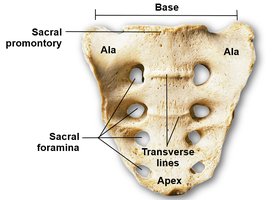
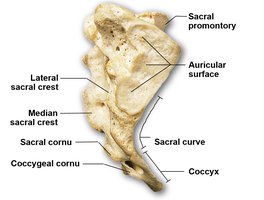
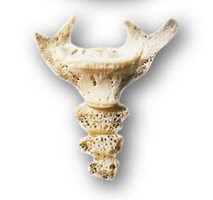
The sacrum consists of five fused vertebrae and forms the posterior wall of the pelvis. It protects pelvic organs and provides attachment for muscles.
Sacral canal: Passage for sacral nerves.
Sacral foramina: Exit points for nerves.
Auricular surface: Articulates with the pelvic girdle.
Sacral promontory: Anterior bulge at the base.
Coccyx
The coccyx (tailbone) is formed by the fusion of three to five coccygeal vertebrae and serves as an attachment point for ligaments and muscles of the pelvic floor.
Thoracic Cage
Ribs
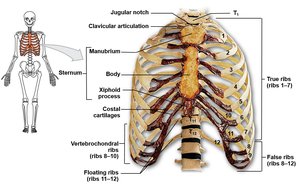
The ribs are elongated, curved bones that articulate with the thoracic vertebrae and protect the thoracic organs.
True ribs (1–7): Attach directly to the sternum via costal cartilages.
False ribs (8–12): Do not attach directly to the sternum.
Vertebrochondral ribs (8–10): Attach to the cartilage of rib 7.
Floating ribs (11–12): No anterior attachment.
Rib and Thoracic Vertebrae Articulations
Sternum
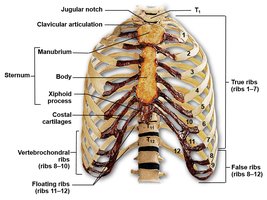
The sternum (breastbone) forms the anterior midline of the thoracic wall and consists of three parts:
Manubrium: Articulates with clavicles and first ribs.
Body: Main part, attaches to costal cartilages.
Xiphoid process: Inferior tip, attaches to diaphragm and abdominal muscles.
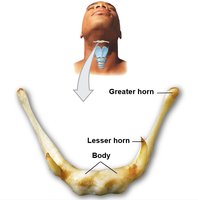
Hyoid Bone
The hyoid bone is a U-shaped bone in the neck that supports the larynx and serves as an attachment for muscles of the tongue, pharynx, and larynx.
Greater horns: Muscle attachment for tongue movement.
Lesser horns: Attach to stylohyoid ligaments.
References
Clemente, Carmine D. Anatomy: A Regional Atlas of the Human Body. Philadelphia: Wolters Kluwer/Lippincott Williams & Wilkins Health, 2011.
Martini, Frederic, Nath, Judi, and Bartholomew. Fundamentals of Anatomy and Physiology. Boston, MA: Benjamin Cummings, 2012.
Mescher, Anthony L., and Luiz Carlos Uchôa Junqueira. Junqueira's Basic Histology: Text and Atlas.
