 Back
BackThe Brain: Structure, Lobes, and Functional Regions
Study Guide - Smart Notes
 Tailored notes based on your materials, expanded with key definitions, examples, and context.
The Brain
Overview
The brain is the central organ of the nervous system, responsible for processing sensory information, coordinating movement, and regulating vital functions. This section covers the major anatomical regions of the brain, their subdivisions, and their primary functions.
The Cerebral Hemispheres
The Five Lobes of the Cerebral Hemisphere
The cerebral hemispheres are divided into five distinct lobes, each associated with specific motor and sensory functions:
Frontal Lobe: Located at the front of the brain; responsible for voluntary motor functions, problem-solving, planning, and aspects of speech production (Broca's area).
Parietal Lobe: Positioned behind the frontal lobe; processes somatic sensory information such as touch, temperature, and pain.
Temporal Lobe: Located on the sides of the brain; involved in auditory processing, memory, and language comprehension (Wernicke's area).
Occipital Lobe: Found at the back of the brain; dedicated to visual processing.
Insula: Buried deep within the lateral sulcus; plays a role in taste, visceral sensation, and autonomic control.
Distribution of Motor and Sensory Functions:
Motor functions are primarily located in the precentral gyrus of the frontal lobe (primary motor cortex).
Somatic sensory functions are mainly processed in the postcentral gyrus of the parietal lobe (primary somatosensory cortex).
Special senses (vision, hearing, taste, smell) are processed in the occipital, temporal, and insular lobes, respectively.
Major Brain Regions
Diencephalon
The diencephalon is a central core of brain tissue, consisting of several important structures:
Thalamus: Acts as a relay station for sensory information traveling to the cerebral cortex.
Hypothalamus: Regulates homeostatic functions such as hunger, thirst, temperature, and the endocrine system via the pituitary gland.
Epithalamus: Contains the pineal gland, which secretes melatonin and regulates circadian rhythms.
Cerebellum
The cerebellum is located posterior to the brainstem and is responsible for:
Coordinating voluntary movements
Maintaining posture and balance
Fine-tuning motor activity
Brainstem
The brainstem connects the brain to the spinal cord and consists of three main parts:
Midbrain: Involved in visual and auditory reflexes, and motor control.
Pons: Relays signals between the cerebrum and cerebellum; regulates breathing.
Medulla Oblongata: Controls vital autonomic functions such as heart rate, blood pressure, and respiration.
Functional Systems of the Brain
Limbic System
The limbic system is a group of interconnected structures located deep within the brain, involved in:
Emotion regulation (e.g., fear, pleasure, anger)
Memory formation and retrieval
Motivation and behavior
Key components include the hippocampus, amygdala, and cingulate gyrus.
Reticular Formation
The reticular formation is a network of neurons running through the brainstem, responsible for:
Regulating arousal and consciousness
Filtering incoming sensory information
Maintaining alertness and attention
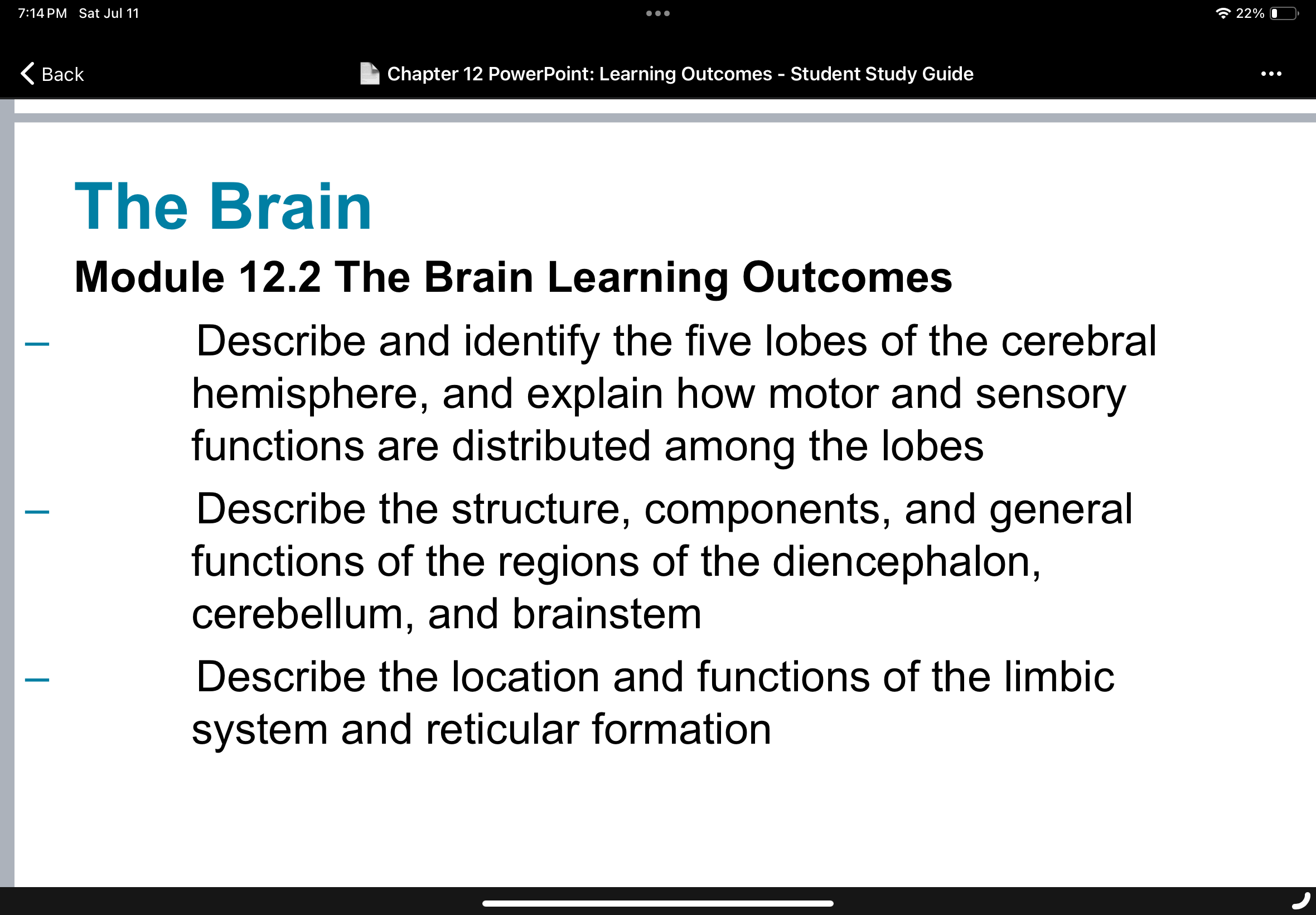
Additional info: The above content expands on the learning outcomes by providing definitions, locations, and functions of the major brain regions and systems, as would be expected in a college-level Anatomy & Physiology course.
