 Back
BackThe Cardiovascular System: Blood Vessels and Circulation
Study Guide - Smart Notes
 Tailored notes based on your materials, expanded with key definitions, examples, and context.
The Cardiovascular System: Blood Vessels
I. Blood Vessels
Blood vessels form a network of pipes around the heart, transporting blood throughout the body. The structure and function of these vessels are essential for maintaining circulatory health.
A. Vessel Layers
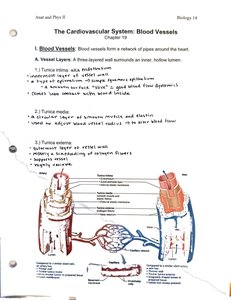
A three-layered wall surrounds an inner, hollow lumen in blood vessels:
Tunica intima: The innermost layer, composed of endothelium and subendothelial connective tissue. It provides a smooth surface for blood flow and regulates vessel function.
Tunica media: The middle layer, made of smooth muscle and elastic fibers. It controls vessel diameter and blood pressure through vasoconstriction and vasodilation.
Tunica externa: The outer layer, consisting of collagen fibers. It protects and reinforces the vessel, anchoring it to surrounding tissues.
II. Types of Blood Vessels
B. Arteries
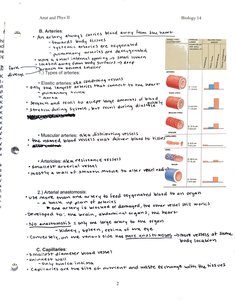
Arteries carry blood away from the heart. They are classified based on their size and function:
Elastic arteries: Large arteries (e.g., aorta) that absorb pressure fluctuations and maintain blood flow during diastole.
Muscular arteries: Medium-sized arteries that distribute blood to specific organs.
Arterioles: Small arteries that regulate blood flow into capillary beds.
C. Capillaries
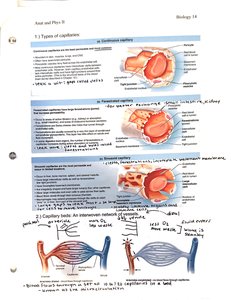
Capillaries are the smallest blood vessels, facilitating exchange of gases, nutrients, and waste between blood and tissues. They form extensive networks called capillary beds.
Continuous capillaries: Most common, with tight junctions limiting permeability.
Fenestrated capillaries: Have pores for increased permeability, found in kidneys and intestines.
Sinusoidal capillaries: Large gaps for passage of cells and proteins, found in liver and spleen.
D. Veins
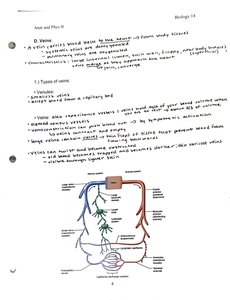
Veins carry blood toward the heart. They have thinner walls and larger lumens than arteries, often containing valves to prevent backflow.
Venules: Small veins that collect blood from capillary beds.
Medium and large veins: Transport blood back to the heart, aided by skeletal muscle contraction and valves.
Physiology of Circulation
A. Definitions
Understanding blood flow dynamics is crucial for cardiovascular health:
Blood flow: The volume of blood moving through vessels per unit time.
Blood pressure: The force exerted by blood against vessel walls.
Resistance: Opposition to blood flow, mainly due to vessel diameter, length, and viscosity.
B. Factors Affecting Blood Flow
Blood viscosity: Thickness of blood; increased viscosity raises resistance.
Vessel length: Longer vessels increase resistance.
Vessel diameter: Smaller diameter increases resistance; vasodilation decreases resistance.
C. Blood Pressure Regulation
Arterial pressure: Highest in arteries, decreases as blood moves through the system.
Capillary pressure: Lower than arterial pressure, allowing exchange of substances.
Venous pressure: Lowest, aided by valves and muscle contractions.
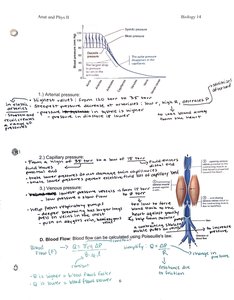
D. Blood Flow Calculation
Blood flow can be calculated using the formula: , where is blood flow, is pressure difference, and is resistance.
Atherosclerosis and Blood Pressure Regulation
E. Atherosclerosis
Atherosclerosis is the narrowing of arteries due to plaque buildup, leading to reduced blood flow and increased risk of cardiovascular disease.
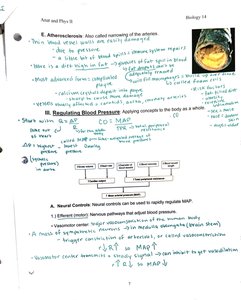
III. Regulating Blood Pressure
Blood pressure is regulated by neural and hormonal mechanisms to maintain homeostasis.
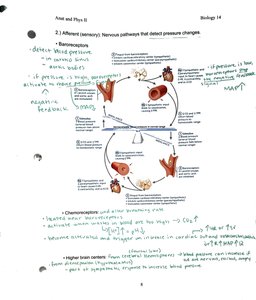
Neural control: Baroreceptors and chemoreceptors detect changes in pressure and chemical composition, adjusting vessel diameter and heart rate.
Hormonal control: Hormones such as adrenaline and angiotensin II influence blood pressure.
Blood Pressure Disorders
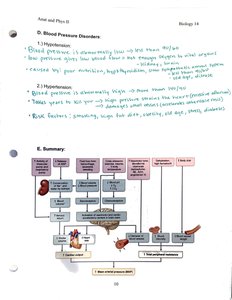
D. Blood Pressure Disorders
Hypotension: Abnormally low blood pressure, leading to inadequate tissue perfusion.
Hypertension: Abnormally high blood pressure, increasing risk of heart disease, stroke, and other complications.
Tissue Perfusion
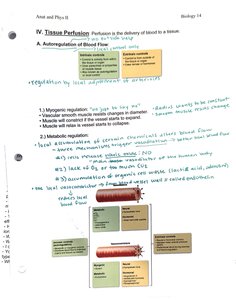
IV. Tissue Perfusion
Perfusion is the delivery of blood to tissues, regulated by local and systemic mechanisms.
A. Autoregulation of Blood Flow
Myogenic regulation: Vessels respond to changes in pressure by constricting or dilating.
Metabolic regulation: Local changes in metabolites (e.g., CO2, O2) influence vessel diameter.
Shear stress: Increased blood flow causes endothelial cells to release vasodilators.
Additional info: These notes provide a comprehensive overview of blood vessel structure, function, and regulation, suitable for exam preparation in an anatomy and physiology college course.
