 Back
The Cell Cycle and DNA Structure: Foundations of Cell Reproduction
Study Guide - Smart Notes
 Tailored notes based on your materials, expanded with key definitions, examples, and context.
The Cell Cycle
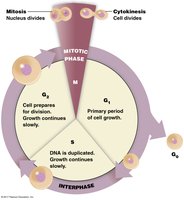
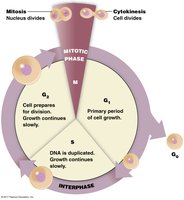
Overview of the Cell Cycle
The cell cycle is a series of events that cells undergo as they grow and divide. This process is essential for growth, development, and tissue repair in multicellular organisms. In actively dividing human cells, the cycle takes approximately 18–24 hours to complete.
Two Main Phases:
Interphase: Period of cell growth and DNA replication.
Mitotic Phase (M phase): Division of the nucleus (mitosis) and cytoplasm (cytokinesis).
Interphase: Subdivisions
Interphase is the longest phase of the cell cycle and is subdivided into three stages:
G1 Phase (First Gap):
Occurs immediately after cell division and before DNA replication.
Primary period of cell growth; cell is at its smallest size at the start.
Most cellular growth occurs here (approx. 6–9 hours).
S Phase (Synthesis):
DNA replication occurs, resulting in duplicated chromosomes.
Growth continues but at a slower rate (approx. 7–8 hours).
G2 Phase (Second Gap):
Cell continues to grow and prepares for division (approx. 6–9 hours).
G0 Phase
The G0 phase is a non-dividing, non-growing state that most cells in the body enter. This is a healthy and normal condition for many cell types.
Some cells, such as neurons and osteocytes, remain in G0 permanently after adolescence.
Other cells can re-enter the cell cycle and begin dividing again if needed.
Mitotic Phase
The mitotic phase is much shorter than interphase, lasting about 30–45 minutes. It consists of two main processes:
Mitosis: The duplicated DNA is divided into two sets, and the nucleus divides.
Cytokinesis: The cytoplasm divides, resulting in two new daughter cells.
DNA Structure and Organization
DNA: The Genetic Material
Deoxyribonucleic acid (DNA) is the hereditary material found in the nucleus of every cell. It consists of approximately 3 billion pairs of nucleotides, which are organized as base pairs (adenine-thymine and cytosine-guanine) in a double helix structure.
Base pairs: The rungs of the DNA ladder, consisting of A-T and C-G pairs.
Function: DNA stores genetic information necessary for the synthesis of proteins and cell function.
Chromosomes
DNA is packaged into structures called chromosomes within the nucleus of eukaryotic cells. Chromosomes help organize and manage the long DNA molecules.
Humans: 46 chromosomes (23 pairs)
Other species:
Blue whale: 44 chromosomes (22 pairs)
Fruit fly: 8 chromosomes (4 pairs)
Chromatin and Chromosome Condensation
During interphase, chromosomes are not visible under a microscope because they exist as long, thin strands called chromatin. Chromatin consists of DNA wound around proteins called histones, which help compact and organize the DNA.
During S phase, chromatin is duplicated.
In late G2 and the mitotic phase, chromatin condenses to form visible chromosomes.
Chromosomes During Mitosis
Before nuclear division, chromosomes condense and become visible as pairs of identical sister chromatids joined at a region called the centromere.
Sister chromatids: Identical copies of a chromosome, joined together before cell division.
Centromere: The region where sister chromatids are held together.
Genes
A gene is a short segment of DNA that contains the instructions (code) for making one or more proteins. Genes are the smallest functional units of DNA.
Humans have approximately 20,000–21,000 genes distributed across their 46 chromosomes.
Each gene is located at a specific position (locus) on a chromosome.
Summary Table: Key Phases of the Cell Cycle
Phase | Main Events | Duration (approx.) |
|---|---|---|
G1 | Cell growth, preparation for DNA synthesis | 6–9 hours |
S | DNA replication, slow growth | 7–8 hours |
G2 | Preparation for mitosis, continued growth | 6–9 hours |
M (Mitotic Phase) | Nuclear and cytoplasmic division | 30–45 minutes |
G0 | Non-dividing, resting state | Variable/indefinite |
Key Terms and Definitions
Cell Cycle: The ordered sequence of events in the life of a cell, from its formation to its division into two daughter cells.
Interphase: The phase of the cell cycle during which the cell grows, duplicates its DNA, and prepares for division.
Mitosis: The process of nuclear division in eukaryotic cells.
Cytokinesis: The division of the cytoplasm to form two separate daughter cells.
Chromatin: The complex of DNA and proteins that forms chromosomes within the nucleus.
Chromosome: A structure consisting of DNA and associated proteins that carries genetic information.
Gene: A segment of DNA that codes for a specific protein or function.
Histone: A protein that helps package and organize DNA into chromatin.
Centromere: The region of a chromosome where sister chromatids are joined.
Sister Chromatids: Two identical copies of a chromosome connected by a centromere.
Equations and Notation
Base Pairing Rule: (Adenine pairs with Thymine, Cytosine pairs with Guanine)
Additional info: The cell cycle is tightly regulated by checkpoints that ensure each phase is completed accurately before the next begins. Errors in cell cycle regulation can lead to uncontrolled cell division, as seen in cancer.
