 Back
BackThe Cell Cycle and Mitosis: Structure, Phases, and Significance
Study Guide - Smart Notes
 Tailored notes based on your materials, expanded with key definitions, examples, and context.
The Cell Cycle
Overview of the Cell Cycle
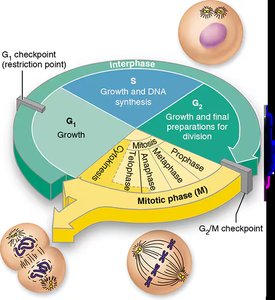
The cell cycle is the sequence of events that a cell undergoes from its formation to its division into two daughter cells. It is essential for growth, tissue repair, and maintenance in multicellular organisms. The cell cycle is divided into two main periods: interphase and the mitotic (M) phase.
Interphase: The longest phase, during which the cell grows, performs its normal functions, and prepares for division.
Mitotic (M) Phase: The period when the cell divides its nucleus (mitosis) and cytoplasm (cytokinesis).
Phases of Interphase
G1 phase (Growth 1): Cell grows and carries out normal metabolic functions.
S phase (Synthesis): DNA is replicated, ensuring each daughter cell will have a complete set of chromosomes.
G2 phase (Growth 2): Further growth and preparation for cell division.
Checkpoints (such as the G1 and G2/M checkpoints) regulate progression through the cycle, ensuring DNA integrity and proper cell size before division.
Cell Division: Mitosis and Cytokinesis
Importance of Cell Division
Cell division is crucial for organismal growth, tissue repair, and replacement of cells. Most cells divide until adulthood, after which only specific cell types (e.g., skin, gut lining) continue to divide regularly. Some cells (e.g., liver cells) can divide if needed, while others (e.g., neurons, cardiac muscle) lose this ability after maturation.
Mitosis: Division of the Nucleus
Mitosis is the process by which a cell divides its duplicated DNA into two identical nuclei. It consists of four main phases:
Prophase
Metaphase
Anaphase
Telophase
Mitosis is usually followed by cytokinesis, the division of the cytoplasm, resulting in two genetically identical daughter cells.
Phases of Mitosis and Cytokinesis
The following sections describe the events of mitosis and cytokinesis, as observed in animal cells.
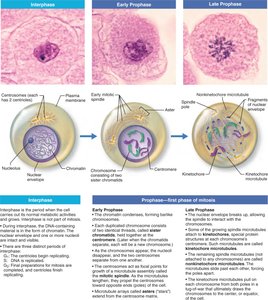
Interphase: Chromatin is uncondensed, and DNA is replicated in preparation for division.
Prophase: Chromatin condenses into visible chromosomes, the nuclear envelope breaks down, and spindle fibers begin to form.
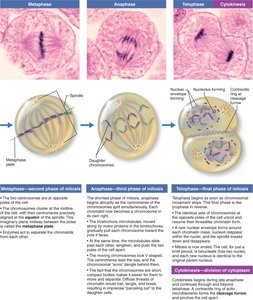
Metaphase: Chromosomes align at the cell's equator, attached to spindle fibers at their centromeres.
Anaphase: Sister chromatids are pulled apart toward opposite poles of the cell.
Telophase: Chromosomes decondense, nuclear envelopes reform around the two sets of chromosomes.
Cytokinesis: The cytoplasm divides, resulting in two separate daughter cells.
Comparison: Mitosis vs. Meiosis
Feature | Mitosis | Meiosis |
|---|---|---|
Number of Divisions | 1 | 2 |
Daughter Cells Produced | 2 | 4 |
Genetic Identity | Identical to parent | Genetically unique |
Function | Growth, repair | Gamete production |
Key Terms and Concepts
Chromatin: The uncondensed form of DNA in the nucleus during interphase.
Chromosome: Condensed DNA structure visible during mitosis.
Centromere: The region where sister chromatids are joined and spindle fibers attach.
Spindle fibers: Microtubules that separate chromosomes during mitosis.
Cytokinesis: Division of the cytoplasm, usually following mitosis.
Summary
The cell cycle ensures the accurate duplication and distribution of genetic material to daughter cells. Mitosis and cytokinesis are tightly regulated processes essential for growth, development, and tissue maintenance in multicellular organisms.
