 Back
The Cell: Plasma Membrane Transport and Cell Cycle/Mitosis
Study Guide - Smart Notes
 Tailored notes based on your materials, expanded with key definitions, examples, and context.
The Cell: Structure and Function
Cytoplasm and Its Components
The cytoplasm is the internal environment of the cell, consisting of the cytosol (fluid portion) and organelles (specialized structures with distinct functions). The cytoplasm is enclosed by the plasma membrane, which separates the cell from its external environment.
Cytosol: The semi-fluid matrix in which organelles are suspended.
Organelles: Structures such as mitochondria, endoplasmic reticulum, and Golgi apparatus, each performing specific cellular functions.
The Plasma Membrane
Structure and Composition
The plasma membrane is a selectively permeable barrier composed primarily of a phospholipid bilayer, proteins, glycolipids, and sterols (such as cholesterol). This structure allows the cell to regulate the movement of substances in and out.
Phospholipids: Molecules with hydrophilic (water-attracting) heads and hydrophobic (water-repelling) tails, forming a bilayer.
Proteins: Integral (embedded within the membrane) and peripheral (attached to the surface) proteins serve as channels, carriers, receptors, and enzymes.
Glycolipids: Lipids with carbohydrate groups, involved in cell recognition.
Sterols (Cholesterol): Help stabilize membrane fluidity and rigidity.
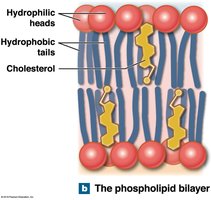
Selective Permeability: The membrane's chemical properties allow some substances to pass freely while restricting others, maintaining cellular homeostasis.
Membrane Transport Mechanisms
Passive Processes
Passive transport does not require cellular energy (ATP). Substances move down their concentration gradients.
Diffusion: Movement of molecules from an area of high concentration to low concentration.
Osmosis: Diffusion of water across a selectively permeable membrane.
Facilitated Diffusion: Movement of solutes across the membrane via carrier proteins.
Active Processes
Active transport requires energy (usually ATP) to move substances against their concentration gradients or to transport large molecules.
Active Transport: Carrier proteins move chemicals against their concentration gradient.
Endocytosis: Uptake of extracellular materials into the cell via vesicles. Types include:
Pinocytosis: "Cell drinking" – uptake of fluids.
Phagocytosis: "Cell eating" – uptake of large particles.
Receptor-mediated endocytosis: Specific uptake via receptor binding.
Exocytosis: Ejection of materials from the cell via vesicles.
The Nucleus and Genetic Material
Nuclear Structure and Function
The nucleus is the control center of the cell, containing DNA. In non-dividing cells, DNA exists as chromatin (loose form). During cell division, DNA condenses into chromosomes.
Chromatin: DNA wrapped around histone proteins (nucleosomes), present when the cell is not dividing.
Chromosomes: Condensed DNA structures visible during cell division.
The Cell Cycle
Phases of the Cell Cycle
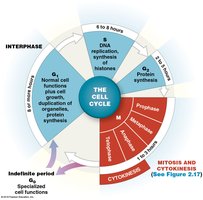
The cell cycle describes the sequence of events in the life of a cell, including growth, DNA replication, and division. Not all cells divide; some remain in a specialized state (G0).
Interphase: The period of cell growth and DNA replication, divided into three phases:
G1 phase: Cell growth and normal functions.
S phase: DNA replication and synthesis of histones.
G2 phase: Preparation for mitosis, protein synthesis.
G0 phase: Cells exit the cycle and perform specialized functions indefinitely.
Mitosis and Cytokinesis
Phases of Mitosis (PMAT)
Mitosis is the process of nuclear division, ensuring that replicated DNA is equally distributed to two identical daughter cells. It consists of four main phases:
Prophase: Chromatin condenses into chromosomes; sister chromatids join; spindle fibers attach at the kinetochore; nuclear envelope disintegrates.
Metaphase: Chromosomes align at the metaphase plate (center of the cell).
Anaphase: Sister chromatids are pulled apart toward opposite poles; each is now called a daughter chromosome.
Telophase: Chromosomes decondense back into chromatin; nuclear envelope reforms.
Cytokinesis is the division of the cytoplasm, beginning in late anaphase and continuing through telophase, resulting in two separate cells.
Summary Table: Membrane Transport Mechanisms
Process | Energy Required? | Direction | Example |
|---|---|---|---|
Diffusion | No | High to Low | Oxygen entering cells |
Osmosis | No | High to Low (water) | Water movement across membranes |
Facilitated Diffusion | No | High to Low | Glucose transport |
Active Transport | Yes (ATP) | Low to High | Sodium-potassium pump |
Endocytosis | Yes (ATP) | Into cell | Phagocytosis of bacteria |
Exocytosis | Yes (ATP) | Out of cell | Secretion of hormones |
Key Equations
Fick's Law of Diffusion:
Where J is the rate of diffusion, D is the diffusion coefficient, and \frac{dC}{dx} is the concentration gradient.
Osmotic Pressure (van't Hoff equation):
Where \Pi is osmotic pressure, i is the van't Hoff factor, M is molarity, R is the gas constant, and T is temperature in Kelvin.
Additional info: The cell cycle is tightly regulated by checkpoints to ensure proper DNA replication and division. Errors in these processes can lead to diseases such as cancer.
