 Back
The Cellular Level of Organization: Structure and Function of Cells
Study Guide - Smart Notes
 Tailored notes based on your materials, expanded with key definitions, examples, and context.
The Cellular Level of Organization
Introduction to Cells
Cells are the fundamental units of life, forming the basis of all living organisms. The study of cells, known as cytology, is essential for understanding anatomy and physiology at the microscopic level.
Cell Theory: All living things are composed of cells; cells arise from preexisting cells; cells are the smallest units that perform vital physiological functions; each cell maintains homeostasis.
Types of Cells: Sex cells (sperm and oocytes) are reproductive, while somatic cells make up the rest of the body.
Generalized Cell Structure
Cells contain various organelles and structures, each with specialized functions necessary for survival and homeostasis.
Plasma Membrane: Separates the cytoplasm from the extracellular fluid, maintaining the internal environment.
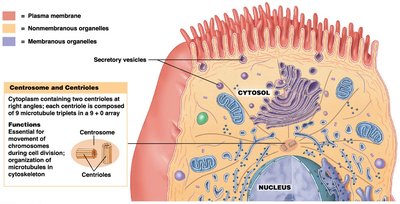
Cytoplasm: Includes cytosol (fluid) and organelles (structures with specific functions).
Nucleus: The control center, containing genetic material (DNA).
Plasma Membrane
Structure and Function
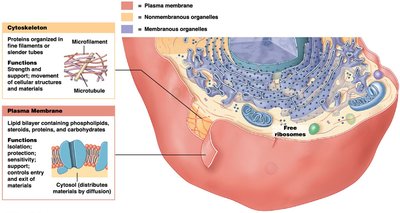
The plasma membrane is a selectively permeable barrier composed primarily of a phospholipid bilayer with embedded proteins and carbohydrates.
Physical Isolation: Acts as a barrier between the cell and its environment.
Regulation: Controls the entry and exit of ions, nutrients, and waste products.
Sensitivity: Detects changes in the extracellular environment.
Structural Support: Anchors cells and tissues.

Membrane Components
Phospholipid Bilayer: Hydrophilic heads face outward; hydrophobic tails face inward, creating a barrier to water-soluble substances.
Proteins: Integral (span the membrane) and peripheral (bound to surfaces); function as channels, carriers, receptors, enzymes, anchors, and identifiers.
Carbohydrates: Glycoproteins, glycolipids, and proteoglycans form the glycocalyx, involved in protection, recognition, and adhesion.

Organelles within the Cytoplasm
Nonmembranous Organelles
Cytoskeleton: Provides structural support and facilitates movement. Includes microfilaments (actin), intermediate filaments, and microtubules (tubulin).
Centrioles: Organize spindle fibers during cell division.
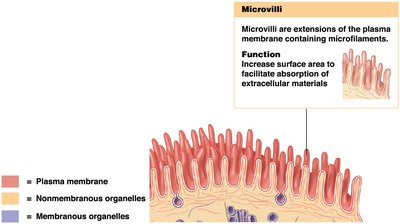
Microvilli: Increase surface area for absorption.
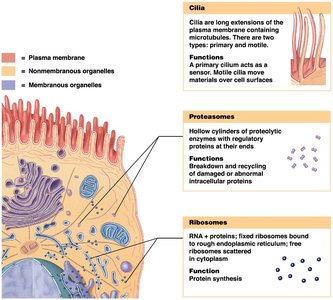
Cilia and Flagella: Move fluids or the cell itself.
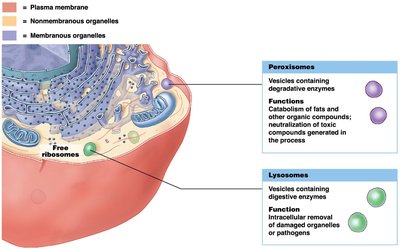
Ribosomes: Sites of protein synthesis; free in cytosol or fixed to rough ER.
Proteasomes: Degrade damaged or abnormal proteins.
Membranous Organelles
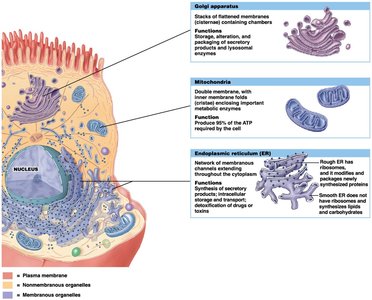
Endoplasmic Reticulum (ER): Network of membranes; rough ER (with ribosomes) synthesizes proteins, smooth ER synthesizes lipids and carbohydrates.
Golgi Apparatus: Modifies, sorts, and packages proteins and lipids for secretion or delivery to other organelles.
Lysosomes: Contain digestive enzymes for intracellular digestion and recycling.
Peroxisomes: Break down fatty acids and neutralize toxic compounds.
Mitochondria: Produce ATP through aerobic respiration.
The Nucleus
Structure and Function
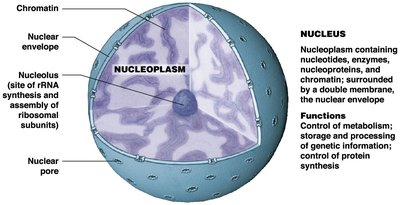
The nucleus is the largest organelle and serves as the cell's control center, housing genetic material and coordinating cellular activities.
Nuclear Envelope: Double membrane with nuclear pores for molecular exchange.
Nucleoplasm: Contains nucleotides, enzymes, and chromatin.
Nucleolus: Site of rRNA synthesis and ribosome assembly.
Chromatin/Chromosomes: DNA-protein complexes; chromatin is loosely coiled in non-dividing cells, chromosomes are tightly coiled during division.
Protein Synthesis
Genetic Code and Protein Production
Protein synthesis is the process by which cells build proteins based on genetic instructions encoded in DNA.
Gene: Segment of DNA coding for a specific protein.
Transcription: DNA is used as a template to synthesize messenger RNA (mRNA).
Translation: mRNA is decoded by ribosomes to assemble amino acids into a polypeptide chain.
DNA Triplet | mRNA Codon | tRNA Anticodon | Amino Acid |
|---|---|---|---|
AAA | UUU | AAA | Phenylalanine |
AAT | UUA | AAU | Leucine |
ACA | UGU | ACA | Cysteine |
CAA | GUU | CAA | Valine |
TAC | AUG | UAC | Methionine |
TCG | AGC | UCG | Serine |
GGC | CCG | GGC | Proline |
CGG | GCC | CGG | Alanine |
Membrane Transport
Diffusion and Osmosis
Cells regulate the movement of substances across their membranes through passive and active processes.
Diffusion: Movement of molecules from high to low concentration.
Osmosis: Diffusion of water across a selectively permeable membrane toward higher solute concentration.
Tonicity: Effect of a solution on cell volume (isotonic, hypotonic, hypertonic).
Carrier-Mediated and Vesicular Transport
Facilitated Diffusion: Passive transport via carrier proteins for molecules too large for channels.
Active Transport: Movement against concentration gradient, requiring ATP (e.g., sodium-potassium pump).
Vesicular Transport: Bulk movement via vesicles (endocytosis, exocytosis).
Cell Life Cycle and Division
Phases of the Cell Cycle
Interphase: Cell grows and DNA replicates (G0, G1, S, G2 phases).
Mitosis: Division of the nucleus (prophase, metaphase, anaphase, telophase).
Cytokinesis: Division of the cytoplasm, producing two daughter cells.
Regulation and Cancer
Regulation: Cell division is controlled by internal and external factors; errors can lead to cancer.
Tumors: Benign (localized) or malignant (invasive, metastatic).
Cancer: Results from mutations in genes regulating cell growth; carcinogens are cancer-causing agents.
Additional info: This summary covers the essential concepts of cell structure, function, and processes as outlined in a typical Anatomy & Physiology college course, with expanded academic context for clarity and exam preparation.
