 Back
BackThe Central Nervous System: Structure, Function, and Integration
Study Guide - Smart Notes
 Tailored notes based on your materials, expanded with key definitions, examples, and context.
The Central Nervous System (CNS)
Overview of CNS Functions
The central nervous system (CNS) consists of the brain and spinal cord and is responsible for integrating sensory information, coordinating movement, maintaining homeostasis, and higher mental functions such as language and learning.
Motor functions: Stimulation of muscle contraction or gland secretion (primarily a function of the peripheral nervous system, PNS).
Sensory functions: Detection of sensations inside and outside the body (also mainly PNS).
Integrative functions: Decision-making processes, including interpretation of sensory information, planning and monitoring movement, maintaining homeostasis, and higher mental functions (exclusive to CNS).
Basic Structure of the Brain and Spinal Cord
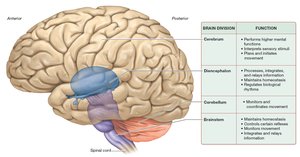
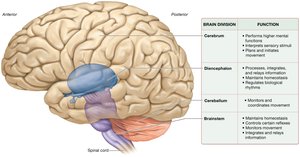
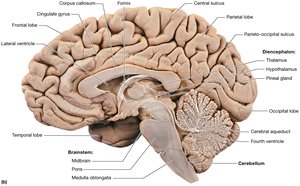
The brain is a soft, whitish-gray organ located in the cranial cavity, continuous with the spinal cord. It is divided into four main regions, each with distinct functions:
Cerebrum: Responsible for higher mental functions, sensation, and movement.
Diencephalon: Processes, integrates, and relays information; regulates homeostasis and biological rhythms.
Cerebellum: Coordinates movement, especially complex activities.
Brainstem: Maintains homeostasis, controls reflexes, and relays information.
Gray and White Matter Organization
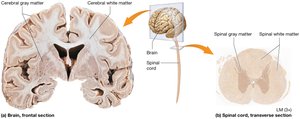
Both the brain and spinal cord contain gray and white matter, but their organization is reversed:
Gray matter: Contains neuron cell bodies, dendrites, and unmyelinated axons; forms the outer cortex of the cerebrum and the central core of the spinal cord.
White matter: Composed of myelinated axons; deep in the brain and superficial in the spinal cord; forms tracts that connect different CNS regions.
Development of the CNS
Neural Tube and Brain Vesicles
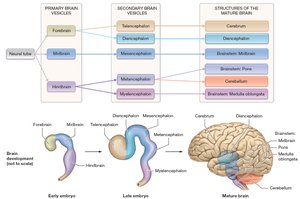
The CNS develops from a hollow neural tube in the embryo. The cranial end forms three primary brain vesicles (forebrain, midbrain, hindbrain), which further divide into five secondary vesicles, giving rise to the mature brain's main divisions.
Forebrain: Telencephalon (cerebral hemispheres) and diencephalon.
Midbrain: Mesencephalon (mature midbrain).
Hindbrain: Metencephalon (pons and cerebellum) and myelencephalon (medulla oblongata).
The Cerebrum
Gross Anatomy and Lobes
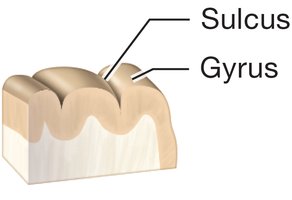
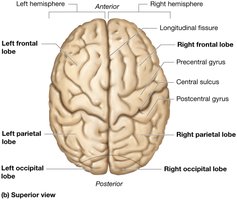
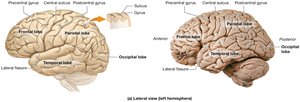
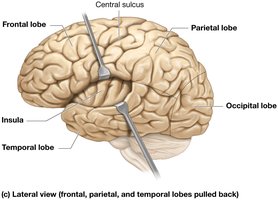
The cerebrum is the largest part of the brain, divided into left and right hemispheres, each with five lobes:
Frontal lobe: Planning, executing movement, behavior, personality.
Parietal lobe: Processing and integrating sensory information, attention.
Temporal lobe: Hearing, language, memory, emotions.
Occipital lobe: Vision processing.
Insula: Taste and visceral functions.
Cerebral Cortex and Functional Areas
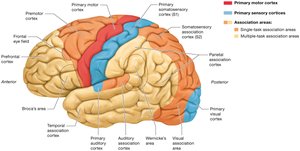
The cerebral cortex is the outer layer of gray matter, responsible for conscious processes. It is divided into three main functional areas:
Primary motor cortex: Plans and executes movement.
Primary sensory cortices: Receive and process sensory input.
Association areas: Integrate information for higher mental functions.
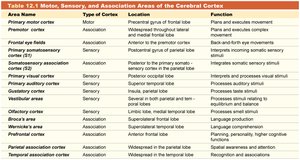
Area Name | Type of Cortex | Location | Function |
|---|---|---|---|
Primary motor cortex | Motor | Precentral gyrus of frontal lobe | Plans and executes movement |
Frontal eye fields | Association | Anterior to premotor cortex | Back-and-forth eye movements |
Somatosensory association cortex (S2) | Association | Posterior to S1 | Integrates somatic sensory stimuli |
Primary somatosensory cortex (S1) | Sensory | Postcentral gyrus of parietal lobe | Processes somatic sensory stimuli |
Primary visual cortex | Sensory | Occipital lobe | Processes visual stimuli |
Primary auditory cortex | Sensory | Superior temporal lobe | Processes auditory stimuli |
Gustatory cortex | Sensory | Insula and parietal lobe | Processes taste stimuli |
Vestibular cortex | Sensory | Parietal and temporal lobe | Processes equilibrium stimuli |
Olfactory cortex | Sensory | Medial temporal lobe | Processes smell stimuli |
Broca’s area | Association | Anterolateral frontal lobe | Language production |
Wernicke’s area | Association | Temporal and parietal lobe | Language comprehension |
Prefrontal cortex | Association | Widespread in frontal lobe | Personality, higher cognition |
Parietal association cortex | Association | Widespread in parietal lobe | Integration, attention |
Temporal association cortex | Association | Widespread in temporal lobe | Recognition, association |
Basal Nuclei and White Matter
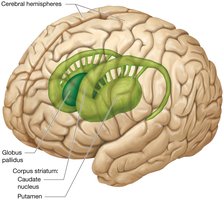
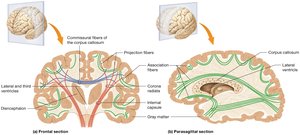
Basal nuclei are clusters of neuron cell bodies deep within each hemisphere, involved in movement regulation. Cerebral white matter consists of commissural, projection, and association fibers, connecting different brain regions.
Limbic System
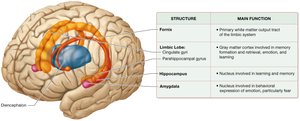
The limbic system is a functional system involved in memory, learning, emotion, and behavior. It includes the limbic lobe, hippocampus, amygdala, and associated pathways.
The Diencephalon
Major Components and Functions
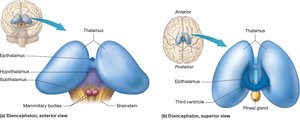
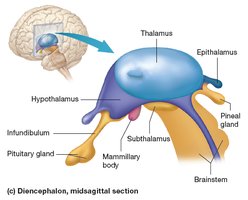
The diencephalon is located at the center of the brain and consists of four main components:
Thalamus: Main relay station for sensory data to the cerebral cortex; regulates cortical activity.
Hypothalamus: Regulates autonomic functions, endocrine activity, body temperature, hunger, and thirst; closely linked to the pituitary gland.
Epithalamus: Contains the pineal gland, which secretes melatonin for sleep/wake regulation.
Subthalamus: Functionally connected with basal nuclei to control movement.
The Cerebellum
Structure and Function
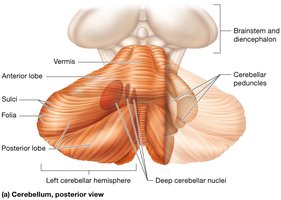
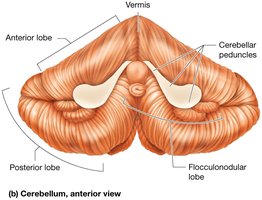
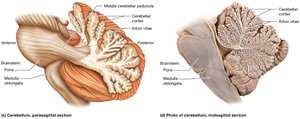
The cerebellum is located posterior and inferior to the cerebrum and is divided into two hemispheres and three lobes (anterior, posterior, flocculonodular). It coordinates movement and maintains balance.
The Brainstem
Subdivisions and Functions
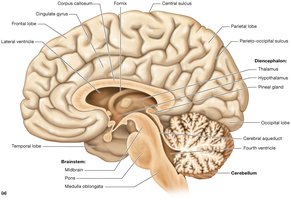
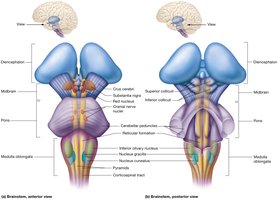
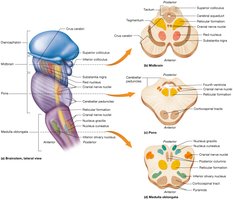
The brainstem is vital for survival and consists of three subdivisions: midbrain, pons, and medulla oblongata. It controls basic homeostatic functions, reflexes, and relays information between the brain and spinal cord.
Reticular Formation
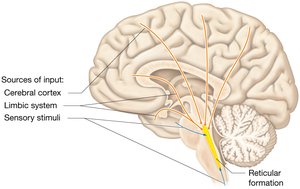
The reticular formation is a network of over 100 nuclei in the brainstem, involved in regulating respiration, blood pressure, sleep/wake cycles, pain perception, and consciousness.
Integration and Higher Functions
Homeostasis and the CNS
The CNS, particularly the hypothalamus and reticular formation, is essential for maintaining homeostasis, including regulation of body temperature, blood pressure, and vital functions through the autonomic nervous system (ANS).
Sleep and Wakefulness
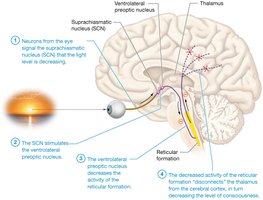
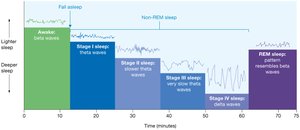
Sleep is regulated by the hypothalamus and follows a circadian rhythm. The process involves the suprachiasmatic nucleus, pineal gland, and reticular formation. Sleep stages can be monitored by EEG, showing characteristic brain waves for each stage.
Cognition and Language
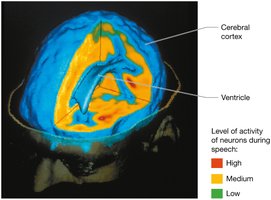
Cognitive functions such as attention, recognition, and planning are localized in association areas of the cerebral cortex. Language production and comprehension are primarily managed by Broca’s and Wernicke’s areas, respectively.
Learning and Memory
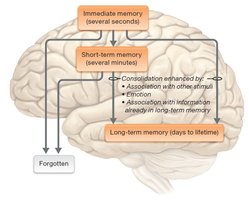
Memory is classified as declarative (fact) or nondeclarative (skills), and by duration (immediate, short-term, long-term). The hippocampus is critical for forming new declarative memories, while long-term storage occurs in the cerebral cortex.
Protection of the CNS
Cranial Meninges
The brain is protected by three layers of meninges: dura mater, arachnoid mater, and pia mater. These layers provide structural support, contain blood vessels, and help circulate cerebrospinal fluid (CSF).
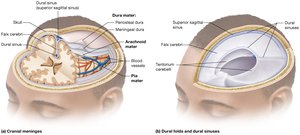
Cerebrospinal Fluid (CSF) and Ventricles
CSF is produced by the choroid plexuses in the brain's ventricles. It cushions the brain, removes waste, and maintains a stable environment. The ventricles are interconnected cavities that allow CSF circulation throughout the CNS.
Blood-Brain Barrier
The blood-brain barrier is formed by endothelial cells with tight junctions, astrocytes, and basal laminae. It restricts the passage of harmful substances from the blood into the brain, while allowing essential nutrients to pass.
The Spinal Cord
Structure and Function
The spinal cord relays information between the brain and body and processes some reflexes. It is protected by meninges and contains both gray and white matter, organized into horns and funiculi, respectively.
Ascending and Descending Tracts
Ascending tracts carry sensory information to the brain, while descending tracts transmit motor commands from the brain to the body. Major tracts include the posterior columns, spinothalamic tracts, and corticospinal tracts.
Sensory and Motor Integration
Somatic and Special Senses
General somatic senses include touch, pain, temperature, and proprioception, processed by specific pathways and cortical regions. Special senses (vision, hearing, taste, smell, balance) have dedicated processing pathways involving the thalamus and cerebral cortex.
Voluntary Movement
Voluntary movement is coordinated by the motor cortex, basal nuclei, cerebellum, and spinal cord. Upper motor neurons initiate movement, while lower motor neurons execute it. The basal nuclei and cerebellum modulate and refine motor activity.
Clinical Correlations
Locked-in syndrome: Damage to motor tracts in the pons results in paralysis with preserved awareness.
Parkinson’s disease: Degeneration of dopamine-secreting neurons in the substantia nigra leads to movement difficulties.
Dementia: Progressive loss of cognitive function, with various causes including Alzheimer’s disease and vascular dementia.
