Back
BackThe Central Nervous System: Structure, Protection, and Function
Study Guide - Smart Notes
 Tailored notes based on your materials, expanded with key definitions, examples, and context.
The Central Nervous System (CNS)
Overview of CNS Functions
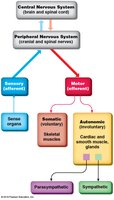
The central nervous system (CNS) is responsible for integrating sensory information, making decisions, and coordinating motor output. It consists of the brain and spinal cord, which together process and relay information throughout the body.
Sensory Functions: Detection of sensations from inside and outside the body.
Integrative Functions: Decision-making processes, including analysis and interpretation of sensory input.
Motor Functions: Stimulation of muscle contractions and glandular secretions.
Peripheral Nervous System (PNS): Performs sensory and motor functions, while integrative functions are exclusive to the CNS.
Basic Structure of the Brain
Major Regions of the Brain
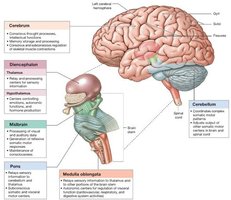
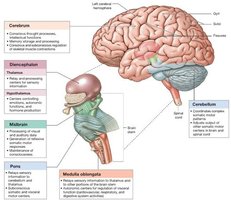
The adult human brain contains nearly 97% of the body's neural tissue and is divided into several major regions, each with specialized functions.
Cerebrum: Largest part; interprets sensory information and controls higher mental functions. Divided into right and left hemispheres by the longitudinal fissure. The surface layer is the neural (cerebral) cortex, which is highly folded to increase surface area (gyri, sulci, fissures).
Cerebellum: Second largest region; coordinates movement, evaluates sensory input, and is involved in timekeeping. Divided into hemispheres by the vermis, with a cortex of gray matter and internal white matter called the arbor vitae.
Brainstem: Relays information between the spinal cord and higher brain regions; controls basic life-sustaining functions. Includes the midbrain, pons, and medulla oblongata. The diencephalon (thalamus, hypothalamus, epithalamus) is functionally associated with the brainstem.
Gray Matter and White Matter
The brain consists of gray matter (neuron cell bodies, dendrites, and synapses) and white matter (myelinated axons). Internal passageways and chambers are filled with cerebrospinal fluid (CSF).
Gray Matter: Found in the cerebral cortex and basal nuclei.
White Matter: Deep to the cortex, surrounds basal nuclei, and forms tracts connecting different brain regions.
Protection and Support of the Brain
Physical Protection
Bones of the Cranium: Provide a rigid protective case.
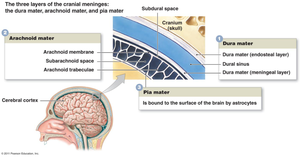
Cranial Meninges: Three connective tissue layers (dura mater, arachnoid mater, pia mater) that protect the brain from trauma and stabilize its position.
Cerebrospinal Fluid (CSF): Cushions the brain, provides buoyancy, and transports nutrients and waste.
Cranial Meninges
The meninges are three layers of connective tissue that surround the brain and spinal cord, providing protection and structural support.
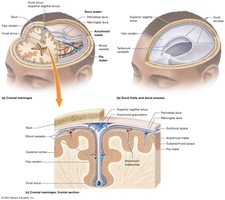
Dura Mater: Outermost, tough, and fibrous; consists of periosteal and meningeal layers. Venous sinuses between layers drain blood from the brain.
Arachnoid Mater: Middle, smooth layer; does not dip into brain crevices. The subarachnoid space beneath contains CSF.
Pia Mater: Innermost, delicate layer; adheres to the brain surface and enters sulci.
Dural Folds
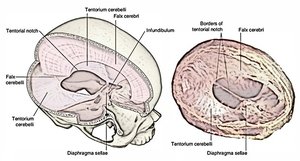
Folds of the inner dura mater extend into brain fissures, stabilizing and supporting the brain.
Falx cerebri: Between cerebral hemispheres
Tentorium cerebelli: Separates cerebellum and cerebrum
Falx cerebelli: Divides cerebellar hemispheres below the tentorium
Cerebrospinal Fluid (CSF)
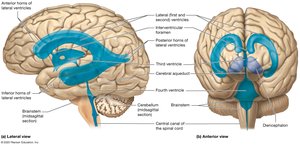
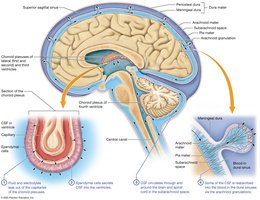
CSF circulates around and bathes all exposed surfaces of the CNS, interchanging with interstitial fluid of the brain. It is produced by ependymal cells in the ventricles and reabsorbed into venous sinuses via arachnoid granulations.
Composition: Water, ions, glucose, some WBCs, little protein, and wastes.
Functions: Cushions neural structures, provides buoyancy, transports nutrients and waste.
Production: About 500 mL/day, constantly drained into the bloodstream.
Blood Supply and Barriers
Blood Supply: The brain receives nutrients and oxygen via internal carotid and vertebral arteries; blood is drained by internal jugular and vertebral veins.
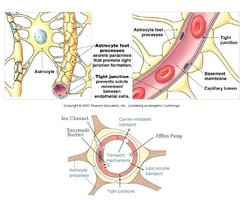
Blood-Brain Barrier (BBB): Formed by tight junctions between endothelial cells, astrocytes regulate permeability. Lipid-soluble substances diffuse freely; water and ions require channels; large molecules use active transport.
Blood-CSF Barrier: Specialized ependymal cells with tight junctions limit pathogen entry from blood to CSF.
Breaks in BBB: Occur in the hypothalamus, pituitary gland, pineal gland, and choroid plexus for hormone secretion and CSF production.
Major Brain Regions and Their Functions
Cerebrum
The cerebrum is the largest brain region, responsible for conscious thought, intellectual functions, and voluntary motor activity. It is divided into lobes by sulci and fissures.
Lobes: Frontal, parietal, temporal, occipital, and insula.
Gray Matter: Outer cortex and basal nuclei.
White Matter: Association fibers (within hemisphere), commissural fibers (between hemispheres, e.g., corpus callosum), and projection fibers (to/from lower CNS).
Functional Areas of the Cerebral Cortex
Primary Motor Cortex: Precentral gyrus; initiates voluntary movement.
Premotor Area: Plans movements.
Primary Somatosensory Cortex: Postcentral gyrus; receives sensory input (touch, pressure, pain, temperature).
Somatosensory Association Area: Interprets sensory input.
Special Sensory Cortices: Visual (occipital), auditory (temporal), olfactory (temporal), gustatory (insula), and orbitofrontal (smell/taste integration).
Integrative Areas: Wernicke’s area (language comprehension), Broca’s area (speech production), prefrontal cortex (personality, decision-making).
Limbic System
The limbic system is a functional grouping involved in emotion, motivation, and memory. It includes the limbic lobe, amygdala, hippocampus, thalamus, hypothalamus, and parts of the brainstem.
Functions: Establishes emotional states, motivational drives, and facilitates memory storage and retrieval.
Hippocampus: Organizes new information into memory; transfers to cerebral cortex for long-term storage.
Cerebral Cortex: Involved in long-term memory storage.
Diencephalon
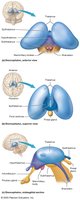
The diencephalon links the cerebrum with the brainstem and consists of the thalamus, hypothalamus, and epithalamus (including the pineal gland).
Thalamus: Relays and processes sensory information; part of the limbic system (emotion, memory).
Hypothalamus: Major control center for the endocrine and autonomic nervous systems; regulates hormone production, thermoregulation, hunger, thirst, and emotional responses.
Pituitary Gland: Major endocrine gland controlled by the hypothalamus via the infundibulum; forms the hypothalamic-pituitary axis.
Epithalamus: Contains the pineal gland, which secretes melatonin.
Brainstem
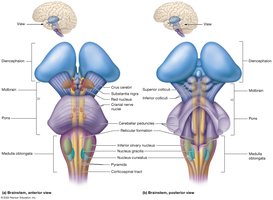
The brainstem connects the cerebrum and cerebellum to the spinal cord and is essential for basic life functions.
Midbrain (Mesencephalon): Visual and auditory reflexes, motor output, and consciousness regulation (substantia nigra).
Pons: Relays signals between cerebellum and brainstem; involved in sensory and motor functions, sleep, respiration, and posture.
Medulla Oblongata: Connects brain to spinal cord; regulates autonomic functions (heart rate, blood pressure, digestion), and contains nuclei for cranial nerves.
Cerebellum
The cerebellum coordinates voluntary movements, adjusts postural muscles, and compares intended movement with actual performance to reduce motor error. It also plays a role in sensory evaluation, timekeeping, and impulse control.
Folia: Highly folded cortex.
Arbor Vitae: Internal white matter.
Purkinje Cells: Large, branched neurons in the cortex.
Spinal Cord Anatomy and Protection
External Structure
The spinal cord is located within the vertebral cavity, extending from the foramen magnum to the L1/L2 vertebrae. It serves as a major reflex center and pathway between the brain and peripheral nervous system.
Conus Medullaris: Tapered end of the spinal cord.
Filum Terminale: Filamentous continuation anchoring the cord.
Cauda Equina: Bundle of lumbar, sacral, and coccygeal nerve roots.
Spinal Meninges
Dura Mater: Outermost, tough, elastic; forms the dural sac and root sheaths. Epidural space is present between vertebrae and dura mater.
Arachnoid Mater: Delicate, encloses the subarachnoid space (contains CSF), pressed against dura by CSF pressure.
Pia Mater: Delicate, adheres to spinal cord and nerve roots; forms denticulate ligaments for stabilization.
Internal Structure
Gray Matter: Butterfly-shaped, contains anterior (motor), posterior (sensory), and lateral (autonomic) horns. Central canal filled with CSF.
White Matter: Organized into ascending (sensory) and descending (motor) tracts, bilaterally symmetrical.
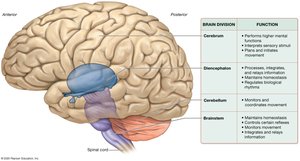
Summary Table: Major Brain Divisions and Functions
Brain Division | Function |
|---|---|
Cerebrum | Performs higher mental functions, interprets sensory stimuli, plans and initiates movement |
Diencephalon | Processes, integrates, and relays information; maintains homeostasis; regulates biological rhythms |
Cerebellum | Monitors and coordinates movement |
Brainstem | Maintains homeostasis, controls certain reflexes, monitors movement, integrates and relays information |