 Back
BackThe Cerebellum: Structure and Function
Study Guide - Smart Notes
 Tailored notes based on your materials, expanded with key definitions, examples, and context.
The Central Nervous System
The Cerebellum
The cerebellum is a major region of the brain involved in the coordination of voluntary movements, balance, and posture. It integrates sensory input and motor commands to ensure smooth and precise skeletal muscle activity.
Processes information from the cerebral motor cortex, proprioceptors, and visual and equilibrium pathways. This allows the cerebellum to monitor and adjust motor activity based on sensory feedback.
Provides "instructions" to the cerebral motor cortex and subcortical motor centers, resulting in smooth, coordinated skeletal muscle movements. The cerebellum acts as a central hub for refining motor commands before they are executed.
Responsible for balance and posture. By integrating input from the vestibular system and proprioceptors, the cerebellum maintains equilibrium and proper body alignment during movement.
Example: When walking on an uneven surface, the cerebellum helps adjust your muscle activity to maintain balance and prevent falls.
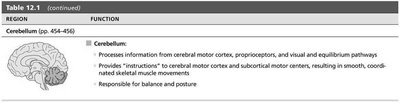
Region | Function |
|---|---|
Cerebellum | Processes information from motor cortex, proprioceptors, and equilibrium pathways. Provides instructions for smooth, coordinated movements. Responsible for balance and posture. |
