 Back
BackThe Chemical Level of Organization: Foundations for Anatomy and Physiology
Study Guide - Smart Notes
 Tailored notes based on your materials, expanded with key definitions, examples, and context.
The Chemical Level of Organization
Introduction to Chemistry in Anatomy and Physiology
Understanding chemistry is essential for studying anatomy and physiology because physiological processes are driven by chemical reactions. The foundational levels of biological organization—atoms, molecules, and macromolecules—are all chemical in nature.
Atom: The smallest unit of an element, retaining its properties.
Molecule: Two or more atoms bonded together.
Macromolecule: Large, complex molecules (e.g., proteins, carbohydrates, DNA, fats) formed from smaller molecules.
Matter is anything that occupies space and has mass. Mass is the amount of matter in an object, while weight is the force of gravity on that mass. Volume is the space matter occupies.
States of Matter
Matter exists in three states, all of which are interchangeable through the addition or removal of heat:
Solid: Definite shape and volume (e.g., teeth, bones).
Liquid: Definite volume, no definite shape (e.g., blood).
Gas: No definite shape or volume (e.g., air we breathe).
Forms of Energy in the Body
Energy is the mover of matter and exists in several forms within the body:
Chemical Energy: Stored in chemical bonds; released or absorbed in reactions.
Electrical Energy: Movement of charged particles.
Mechanical Energy: Directly involved in moving matter.
Radiant Energy: Energy traveling in waves (e.g., light, UV rays).
Adenosine Triphosphate (ATP) is the primary energy currency in living systems. Energy conversions are inefficient, with heat always being released, which helps maintain body temperature.
Elements and Atoms
Elements in the Human Body
Elements are pure substances made of one type of atom and cannot be broken down by chemical means. The human body is primarily composed of four elements:
Oxygen (O): 65%
Carbon (C): 18.6%
Hydrogen (H): 9.7%
Nitrogen (N): 3.2%
Other important elements include calcium, phosphorus, potassium, sodium, chlorine, magnesium, iron, and iodine. Trace elements are present in very small amounts but are essential for health.
Atomic Structure
Atoms are composed of subatomic particles:
Protons (+): Positively charged, found in the nucleus.
Neutrons (0): Neutral, found in the nucleus.
Electrons (−): Negatively charged, orbit the nucleus in electron shells.
The atomic number is the number of protons in an atom. The atomic mass (or mass number) is the sum of protons and neutrons. Isotopes are atoms of the same element with different numbers of neutrons.
Electron Shells and Stability
Electrons occupy shells around the nucleus. The arrangement of electrons determines an atom's chemical properties and reactivity:
First shell: Holds up to 2 electrons.
Second shell: Holds up to 8 electrons.
Third shell: Holds up to 18 electrons.
Atoms are most stable when their outermost shell is full (usually 8 electrons, except for the first shell). Atoms with incomplete outer shells are reactive and seek stability by gaining, losing, or sharing electrons.
The Periodic Table
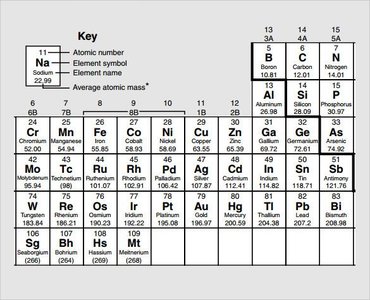
The periodic table organizes elements by atomic number (number of protons). Columns (groups) indicate the number of electrons in the outer shell, while rows (periods) indicate the number of electron shells.
Chemical Bonds and Molecules
Types of Chemical Bonds
Chemical bonds are forces that hold atoms together in molecules and compounds. The three main types are:
Ionic Bonds: Formed by the transfer of electrons from one atom to another, creating charged ions (cations and anions) that attract each other. Example: NaCl (table salt).
Covalent Bonds: Formed when two atoms share electrons. Can be nonpolar (equal sharing) or polar (unequal sharing, creating partial charges).
Hydrogen Bonds: Weak bonds between a hydrogen atom and an electronegative atom (e.g., in water molecules).
Molecules, Compounds, and Mixtures
Molecule: Two or more atoms bonded together (e.g., H2O).
Compound: Molecule containing two or more different elements (e.g., CO2).
Mixture: Two or more substances physically combined, not chemically bonded.
Chemical Reactions
Types of Chemical Reactions
Synthesis (Anabolic): Building larger molecules from smaller ones (A + B → AB).
Decomposition (Catabolic): Breaking down molecules into smaller units (AB → A + B).
Exchange: Both synthesis and decomposition occur (AB + CD → AD + CB).
Metabolism is the sum of all chemical reactions in the body.
Energy in Chemical Reactions
Kinetic Energy: Energy of motion.
Potential Energy: Stored energy.
Exergonic Reactions: Release energy (catabolic, oxidative).
Endergonic Reactions: Absorb energy (anabolic).
All chemical bonds are reversible, and reactions can reach equilibrium.
Factors Affecting Reaction Rates
Temperature: Higher temperature increases reaction rate.
Particle Size: Smaller particles react faster.
Concentration: Higher concentration increases reaction rate.
Catalysts/Enzymes: Speed up reactions without being consumed.
Water and Solutions
Importance of Water
Water is the most abundant and essential compound in the body, making up about two-thirds of body weight. Its roles include:
Lubrication
Reactivity
Heat Capacity
Solubility
Solution: Uniform mixture of two or more substances. Solvent: The dissolving medium (usually water). Solute: The dissolved substance.
Electrolytes are substances that dissociate into ions in water and conduct electricity (e.g., NaCl).
Acids, Bases, Salts, and pH
Acids and Bases
Acid: Releases hydrogen ions (H+) in solution; proton donor.
Base: Accepts hydrogen ions; proton acceptor.
Salt: Formed when acids and bases react; dissociates into ions other than H+ or OH−.
pH is a measure of hydrogen ion concentration, defined as:
pH 0–7: Acidic
pH 7: Neutral (e.g., blood)
pH 7–14: Basic (alkaline)
Acidosis: Blood pH below 7.35. Alkalosis: Blood pH above 7.45.
Buffers help maintain pH homeostasis by removing or releasing H+ as needed.
Organic Compounds
Major Classes of Organic Compounds
Proteins: Made of amino acids; contain C, H, O, N. Functions include structure, enzymes, and transport.
Carbohydrates: Sugars and starches; main energy source. General formula: CnH2nOn.
Lipids: Fats, oils, cholesterol; insoluble in water; major energy source and component of cell membranes.
Nucleic Acids: DNA and RNA; store and transfer genetic information.
Protein Denaturation
Proteins can lose their structure and function when exposed to high heat or acidity, a process called denaturation (e.g., cooking an egg).
Nucleic Acids
DNA (Deoxyribonucleic Acid): Stores genetic information in the nucleus.
RNA (Ribonucleic Acid): Involved in protein synthesis; found outside the nucleus.
Nucleic acids are made of nucleotides, which include a sugar, phosphate, and nitrogenous base. The bases are:
Purines: Adenine (A), Guanine (G)
Pyrimidines: Cytosine (C), Thymine (T, DNA only), Uracil (U, RNA only)
Base pairing in DNA: Adenine pairs with Thymine, Guanine pairs with Cytosine.
