 Back
The Chemical Level of Organization: Foundations for Anatomy & Physiology
Study Guide - Smart Notes
 Tailored notes based on your materials, expanded with key definitions, examples, and context.
The Chemical Level of Organization
Introduction to Chemistry in Anatomy & Physiology
Chemistry is the science that explores the structure of matter, including atoms, molecules, and the chemical bonds that form increasingly complex structures. Understanding chemistry is essential for grasping physiological processes at the molecular and cellular levels.
Matter: Anything that occupies space and has mass; composed of atoms.
Atoms: The smallest stable units of matter, which join to form chemicals with unique characteristics.
Atoms and Atomic Structure
Subatomic Particles
Atoms are composed of three primary subatomic particles:
Protons: Positively charged, 1 mass unit.
Neutrons: Neutral, 1 mass unit.
Electrons: Negatively charged, very low mass.
Atomic Structure
Atomic Number: Number of protons in the nucleus; defines the element.
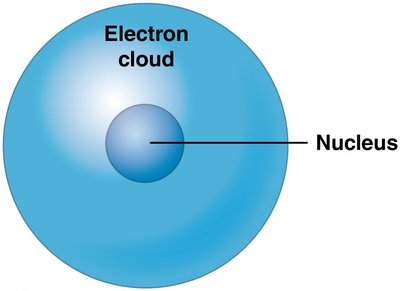
Nucleus: Central region containing protons and neutrons.
Electron Cloud: Spherical area around the nucleus containing electrons.
Electron Shell: Two-dimensional representation of the electron cloud.
Principal Elements in the Human Body
The human body is composed primarily of a few key elements, each with specific physiological roles.
Element | % Body Weight | Significance |
|---|---|---|
Oxygen (O) | 65 | Component of water, essential for respiration |
Carbon (C) | 18.6 | Found in all organic molecules |
Hydrogen (H) | 9.7 | Component of water and most compounds |
Nitrogen (N) | 3.2 | Found in proteins, nucleic acids |
Calcium (Ca) | 1.8 | Bones, teeth, nerve impulses, muscle contraction |
Phosphorus (P) | 1.0 | Bones, teeth, nucleic acids, energy compounds |
Potassium (K) | 0.4 | Membrane function, nerve impulses, muscle contraction |
Sodium (Na) | 0.2 | Blood volume, nerve impulses, muscle contraction |
Chlorine (Cl) | 0.2 | Blood volume, water absorption |
Magnesium (Mg) | 0.06 | Cofactor for enzymes |
Sulfur (S) | 0.04 | Proteins |
Iron (Fe) | 0.007 | Oxygen transport, energy capture |
Iodine (I) | 0.0002 | Thyroid hormones |
Isotopes and Atomic Weight
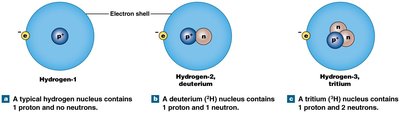
Isotopes: Atoms of the same element with different numbers of neutrons (different mass numbers).
Radioisotopes: Unstable isotopes that decay, emitting radiation; decay rate is measured as half-life.
Atomic Weight: Average mass of all isotopes of an element, weighted by their abundance.
Electrons and Energy Levels
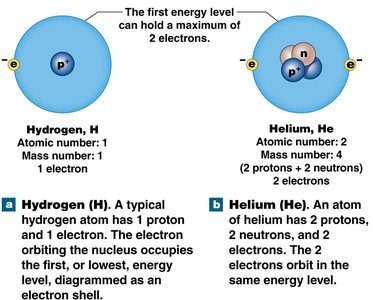
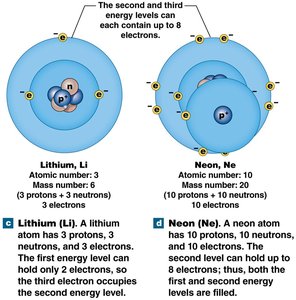
Electrons occupy energy levels (shells) around the nucleus.
Lower shells fill first; the outermost shell (valence shell) determines chemical bonding.
Molecules and Compounds
Chemical Bonds
Atoms combine by forming chemical bonds, resulting in molecules and compounds.
Molecule: Two or more atoms joined by strong bonds.
Compound: Two or more atoms of different elements joined by strong or weak bonds.
Molecular Weight: Sum of atomic weights of all atoms in a molecule or compound.
Chemical Notation
Symbols represent elements and their quantities.
Subscripts indicate the number of atoms in a molecule.
Superscripts indicate ionic charge.
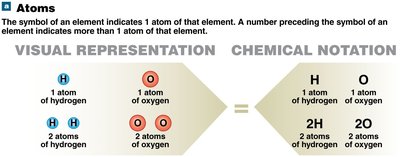
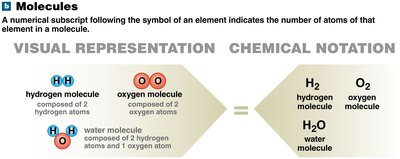
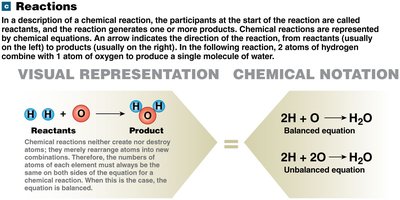
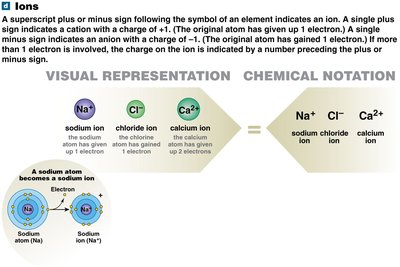
Types of Chemical Bonds
Ionic Bonds: Formed by the transfer of electrons from one atom (donor) to another (acceptor), resulting in oppositely charged ions (cations and anions) that attract each other.
Covalent Bonds: Formed by sharing electrons between atoms. Can be single, double, or triple bonds.
Hydrogen Bonds: Weak attractions between a slightly positive hydrogen atom and a slightly negative atom in another molecule.
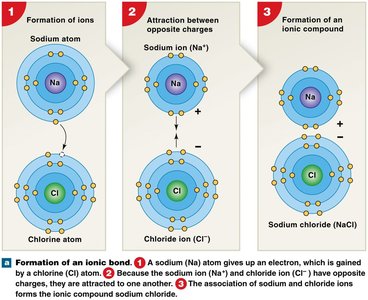
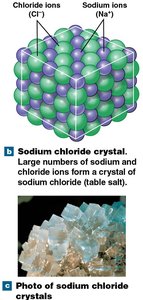

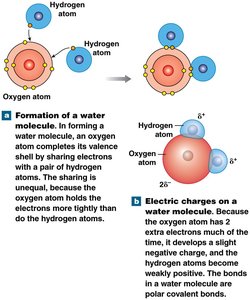
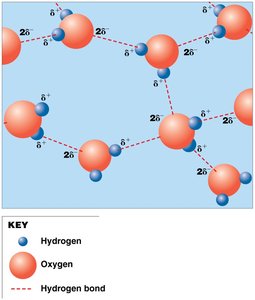
States of Matter
Solid: Definite shape and volume.
Liquid: Definite volume, shape changes to fit container.
Gas: No definite shape or volume.
Chemical Reactions
Types of Chemical Reactions
Decomposition (Catabolism): Breaks chemical bonds; e.g., hydrolysis.
Synthesis (Anabolism): Forms chemical bonds; e.g., dehydration synthesis.
Exchange: Involves decomposition followed by synthesis.
Reversible: Can proceed in both directions to reach equilibrium.
Energy in Reactions
Kinetic Energy: Energy of motion.
Potential Energy: Stored energy.
Chemical Energy: Potential energy stored in chemical bonds.
Enzymes
Role of Enzymes in Metabolism
Enzymes: Protein catalysts that lower activation energy, allowing biochemical reactions to occur rapidly under physiological conditions.
Activation Energy: The minimum energy required to start a reaction.
Exergonic Reactions: Release energy.
Endergonic Reactions: Absorb energy.
Inorganic and Organic Compounds
Classification
Inorganic Compounds: Do not contain both carbon and hydrogen (e.g., water, oxygen, carbon dioxide, salts).
Organic Compounds: Contain carbon and hydrogen (e.g., carbohydrates, lipids, proteins, nucleic acids).
Nutrients: Essential molecules obtained from food.
Metabolites: Molecules made or broken down in the body.
Properties of Water
Importance of Water
Accounts for up to two-thirds of body weight.
Acts as a universal solvent, reactant, lubricant, and has a high heat capacity.
Forms solutions with solutes (dissolved substances).
Properties of Aqueous Solutions
Water is polar, facilitating dissociation and ionization of compounds.
Hydration spheres form around ions and polar molecules, keeping them in solution.
Electrolytes
Inorganic ions that conduct electricity in solution.
Electrolyte balance is vital for physiological function.
Hydrophilic vs. Hydrophobic Compounds
Hydrophilic: Water-loving; includes ions and polar molecules.
Hydrophobic: Water-fearing; includes nonpolar molecules, fats, and oils.
Colloids and Suspensions
Colloid: Solution with large molecules (e.g., blood plasma).
Suspension: Contains large particles that settle out (e.g., whole blood).
pH and Homeostasis
pH Scale
pH: Negative logarithm of hydrogen ion concentration (moles/L).
Neutral pH: 7.0 (pure water).
Acidic pH: < 7.0 (high H+ concentration).
Basic (Alkaline) pH: > 7.0 (low H+ concentration).
Blood pH: 7.35–7.45.
Acids, Bases, and Salts
Definitions and Roles
Acid: Proton donor; adds H+ to solution.
Base: Proton acceptor; removes H+ from solution.
Salt: Dissociates into cations and anions other than H+ and OH−.
Buffers: Stabilize pH by neutralizing strong acids or bases; e.g., carbonic acid–bicarbonate buffer system.
Monomers and Polymers
Macromolecules
Macromolecules are formed by joining monomer subunits into polymers.
Functional groups determine the chemistry of organic molecules.
Carbohydrates
Structure and Function
Organic molecules containing C, H, and O in a 1:2:1 ratio.
Include monosaccharides (simple sugars), disaccharides, and polysaccharides.
Monosaccharides: Glucose, fructose, galactose.
Disaccharides: Sucrose, maltose (formed by dehydration synthesis).
Polysaccharides: Glycogen, starch, cellulose (energy storage and structural roles).
Lipids
Types and Functions
Mainly hydrophobic molecules (fats, oils, waxes).
Types: Fatty acids, eicosanoids, glycerides, steroids, phospholipids, glycolipids.
Fatty acids: Saturated (no double bonds) or unsaturated (one or more double bonds).
Eicosanoids: Derived from arachidonic acid; include prostaglandins and leukotrienes.
Glycerides: Mono-, di-, and triglycerides (energy storage, insulation, protection).
Steroids: Four-ring structure (cholesterol, hormones, bile salts).
Phospholipids and glycolipids: Structural components of cell membranes.
Proteins
Structure and Function
Most abundant organic molecules; contain C, H, O, N.
Made of 20 amino acids (monomers) joined by peptide bonds.
Functions: Support, movement, transport, buffering, metabolic regulation, coordination/control, defense.
Structure: Primary (sequence), secondary (hydrogen bonds), tertiary (3D folding), quaternary (multiple polypeptides).
Fibrous (structural) and globular (functional) proteins.
Enzymes: Catalysts with specificity, saturation limits, and regulation.
Cofactors (ions/molecules) and coenzymes (vitamins) assist enzyme function.
Denaturation: Loss of structure/function due to heat or pH changes.
Glycoproteins and proteoglycans: Large molecules with roles in mucus production and fluid viscosity.
Nucleic Acids
Structure and Function
Store and process genetic information (DNA and RNA).
Monomers: Nucleotides (pentose sugar, phosphate group, nitrogenous base).
DNA: Double helix, complementary base pairing (A-T, C-G).
RNA: Single strand, types include mRNA, tRNA, rRNA; uracil replaces thymine.
Characteristic | RNA | DNA |
|---|---|---|
Sugar | Ribose | Deoxyribose |
Nitrogenous Bases | A, G, C, U | A, G, C, T |
Number of Nucleotides | Fewer than 100 to ~50,000 | More than 45 million |
Shape | Single strand | Double helix |
Function | Protein synthesis | Genetic information storage |
High-Energy Compounds
ATP and Energy Transfer
High-energy compounds are derived from nucleotides (e.g., ATP).
Phosphorylation: Addition of a phosphate group, producing high-energy bonds.
ATP (adenosine triphosphate): Main energy currency of the cell; formed from ADP and phosphate.
ATPase: Enzyme that catalyzes ATP breakdown to ADP, releasing energy for cellular processes.
