 Back
BackThe Chemical Level of Organization: Study Notes for Human Anatomy & Physiology I
Study Guide - Smart Notes
 Tailored notes based on your materials, expanded with key definitions, examples, and context.
The Chemical Level of Organization
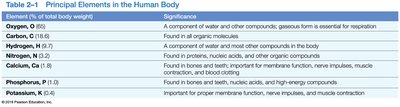
Principal Elements in the Human Body
The human body is composed of a variety of elements, each with specific roles in physiological processes. Understanding these elements is fundamental to grasping the chemical basis of anatomy and physiology.
Element | Significance |
|---|---|
Oxygen (O) | Component of water and other compounds; essential for respiration |
Carbon (C) | Found in all organic molecules |
Hydrogen (H) | Component of water and most other compounds in the body |
Nitrogen (N) | Found in proteins, nucleic acids, and other organic compounds |
Calcium (Ca) | Important for membrane function, nerve impulses, muscle contraction, and blood clotting |
Phosphorus (P) | Found in bones and teeth; high-energy compounds |
Potassium (K) | Important for membrane function, nerve impulses, and muscle contraction |
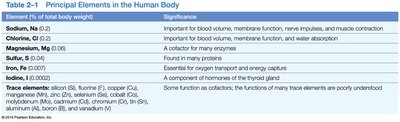
Sodium (Na) | Important for blood volume, membrane function, nerve impulses, and muscle contraction |
Chlorine (Cl) | Important for blood volume, membrane function, and water absorption |
Magnesium (Mg) | Cofactor for many enzymes |
Sulfur (S) | Found in many proteins |
Iron (Fe) | Essential for oxygen transport and energy capture |
Iodine (I) | Component of hormones of the thyroid gland |
Trace elements | Some function as cofactors; many are poorly understood |
Chemical Bonds and Molecules
Chemical bonds are the forces that hold atoms together in molecules. The type of bond determines the properties and behavior of the molecule.
Covalent bonds: Atoms share electrons. Can be non-polar (equal sharing) or polar (unequal sharing).
Ionic bonds: Electrical attraction between ions (cations and anions).
Hydrogen bonds: Weak electrical attractions between δ+ on hydrogen and δ- on oxygen or nitrogen in polar covalent bonds.
Example: Water molecules are held together by polar covalent bonds and form hydrogen bonds with each other.
Properties of Water
Water is essential for life due to its unique properties, which arise from its molecular structure and hydrogen bonding.
High heat capacity: Water absorbs and retains heat, helping regulate body temperature.
Universal solvent: Water dissolves many substances, facilitating chemical reactions and transport.
Hydrophilic molecules: Interact with water (polar bonds, ions).
Hydrophobic molecules: Do not interact with water (non-polar bonds).
Electrolytes
Electrolytes are inorganic molecules whose ions conduct electrical current in solution. They are vital for physiological functions such as muscle contraction and nerve impulses.
Examples: NaCl dissociates into Na+ and Cl-.
Physiologically important ions: Na+, Cl-, K+, Ca2+, Mg2+, PO43-, H+, OH-.
Salts, Acids, Bases, and pH
Acids, bases, and salts are important for maintaining the chemical balance of body fluids.
Salt: An electrolyte whose cation is not hydrogen and whose anion is not hydroxide.
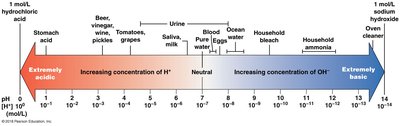
Acid: Releases hydrogen ions (H+) into solution.
Base: Removes hydrogen ions from solution.
Buffer: Removes or replaces hydrogen ions to maintain pH stability.
pH: Measures the concentration of hydrogen ions in solution. Normal blood pH is 7.35–7.45.
Inorganic vs. Organic Compounds
Compounds in the body are classified as inorganic or organic based on their composition.
Inorganic compounds: Generally do not include both carbon and hydrogen (e.g., H2O, CO2, O2, salts).
Organic compounds: Include carbon and usually hydrogen; may also contain N, P, S, Fe, and other elements.
Organic Compounds
Carbohydrates
Carbohydrates are organic molecules composed of carbon, hydrogen, and oxygen in a 1:2:1 ratio. They serve as energy sources and structural components.
Monosaccharides: Simple sugars (e.g., glucose, fructose, galactose).
Disaccharides: Two monosaccharides joined (e.g., sucrose, lactose).
Polysaccharides: Chains of simple sugars (e.g., starch, glycogen, cellulose).
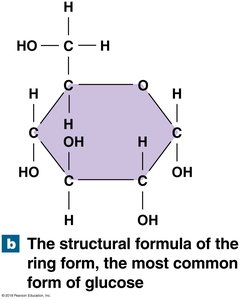
Example: Glucose (C6H12O6) is the most common monosaccharide.
Building and Breaking Down Complex Carbohydrates
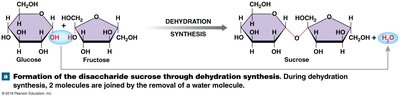
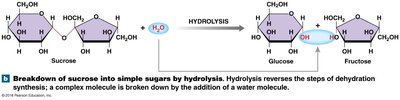
Carbohydrates are synthesized and broken down through dehydration synthesis and hydrolysis.
Dehydration synthesis: Joins two molecules by removing a water molecule.
Hydrolysis: Breaks down a molecule by adding a water molecule.
Carbohydrate Storage
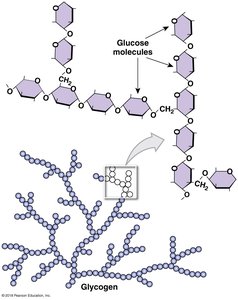
Glucose molecules are stored in the body as glycogen, primarily in skeletal muscles and the liver.
Lipids
Lipids are hydrophobic molecules such as fats, oils, and waxes. They are important for energy storage, insulation, and cell membrane structure.
Fatty acids: Long chains of carbon and hydrogen with a carboxyl group; can be saturated (no double bonds) or unsaturated (one or more double bonds).
Eicosanoids: Derived from arachidonic acid; include leukotrienes and prostaglandins.
Triglycerides: Glycerol plus three fatty acids; function in energy, protection, and insulation.
Phospholipids and glycolipids: Structural lipids with hydrophilic heads and hydrophobic tails; components of plasma membranes.
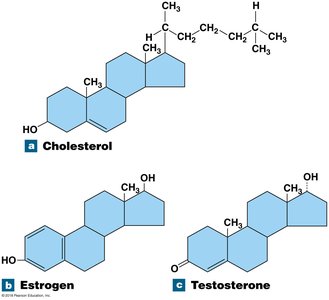
Steroids: Four-ringed carbon structures; include cholesterol, sex hormones, and corticosteroids.
Proteins
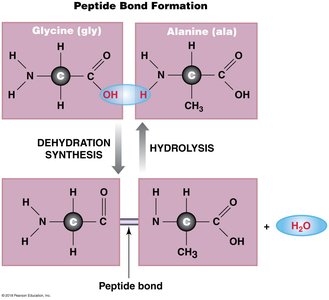
Proteins are chains of amino acids linked by peptide bonds. They perform a wide range of functions in the body.
Amino acids: Contain an amino group, carboxylic group, and a radical group.
Peptide bond: Formed by dehydration synthesis between amino acids.
Protein structure:
Primary: Sequence of amino acids.
Secondary: Alpha helix or beta sheet (hydrogen bonding).
Tertiary: Final 3D structure (hydrogen, covalent, ionic, and hydrophobic interactions).
Quaternary: Two or more tertiary structures bound together.
Protein Functions
Proteins serve structural, contractile, transport, buffering, and enzymatic roles. They are also involved in immune responses (antibodies).
Structural proteins: Provide support (e.g., collagen).
Contractile proteins: Enable movement (e.g., actin, myosin).
Transport proteins: Move substances (e.g., hemoglobin).
Buffering proteins: Maintain pH.
Antibodies: Immune defense.
Enzymes: Catalyze chemical reactions.
Enzymes
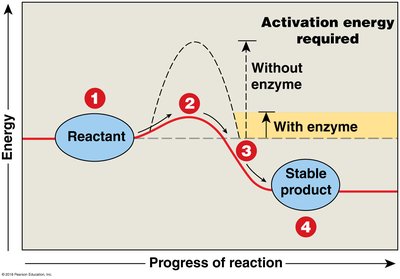
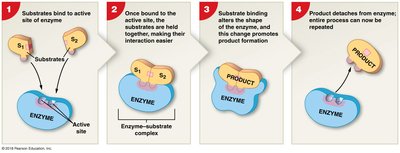
Enzymes are protein catalysts that reduce the activation energy required for chemical reactions, allowing them to occur at physiological temperatures and pH.
Activation energy: The energy required to start a reaction.
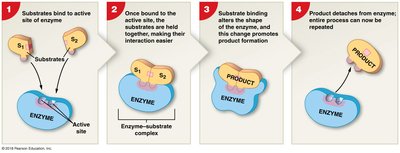
Enzyme-substrate complex: Substrates bind to the active site, facilitating reaction.
Nucleic Acids
Nucleic Acids and Nucleotides
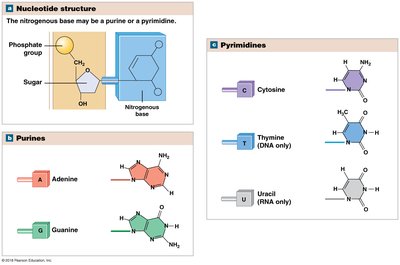
Nucleic acids store and transfer genetic information. They are composed of nucleotides, which consist of a sugar, a nitrogenous base, and one or more phosphate groups.
Purines: Adenine (A), Guanine (G)
Pyrimidines: Cytosine (C), Thymine (T, DNA only), Uracil (U, RNA only)
DNA: Deoxyribonucleic acid (ATGC)
RNA: Ribonucleic acid (AUGC)
Nucleotides: Also serve as high-energy molecules (e.g., ATP, ADP, AMP) and messenger molecules.
Key Equations
Dehydration synthesis:
Hydrolysis:
pH calculation:
