 Back
BackThe Chemical Senses: Smell (Olfaction) and Taste (Gustation)
Study Guide - Smart Notes
 Tailored notes based on your materials, expanded with key definitions, examples, and context.
The Chemical Senses: Smell and Taste
Introduction to Chemical Senses
The chemical senses, smell (olfaction) and taste (gustation), are essential for detecting environmental chemicals and determining whether substances should be consumed or avoided. Both senses rely on chemoreceptors that require chemicals to be dissolved in an aqueous solution for detection.
Smell receptors are activated by chemicals dissolved in nasal fluids.
Taste receptors respond to chemicals dissolved in saliva.
Olfaction: The Sense of Smell
Anatomy of the Olfactory System
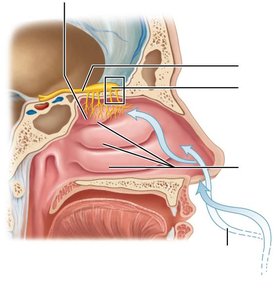
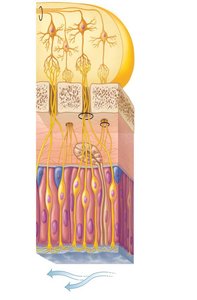
The olfactory epithelium is the organ of smell, located in the roof of the nasal cavity and covering the superior nasal conchae. It contains specialized olfactory sensory neurons, supporting cells, and basal (stem) cells.
Olfactory sensory neurons are bipolar neurons with long, nonmotile cilia (olfactory cilia) that extend into the mucus layer.
Supporting cells provide structural and metabolic support.
Olfactory stem cells regenerate new olfactory neurons every 30–60 days.
Olfactory Receptors and Specificity
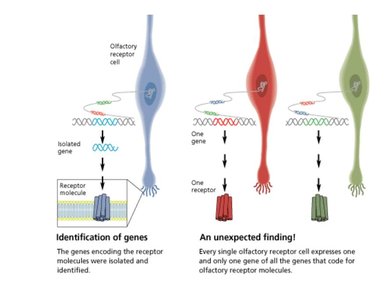
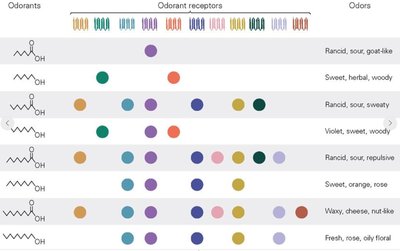
Humans possess approximately 400 functional olfactory receptor genes, each encoding a unique receptor protein. Each olfactory sensory neuron expresses only one type of receptor, but each receptor can bind multiple odorants, and each odorant can activate multiple receptors. This combinatorial coding allows humans to detect thousands of different odors.
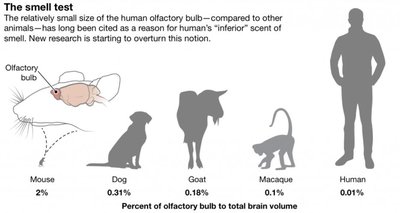
Olfactory neurons with the same receptor type are scattered within a zone but their axons converge on the same glomerulus in the olfactory bulb.
Species differences exist in the number of olfactory receptor genes and neurons, with dogs and mice having many more than humans.
Physiology of Smell: Olfactory Transduction
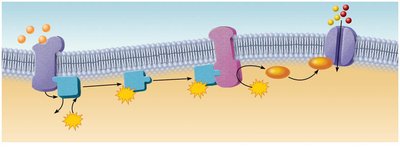
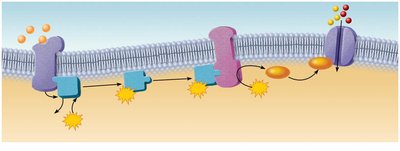
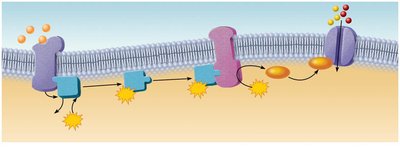
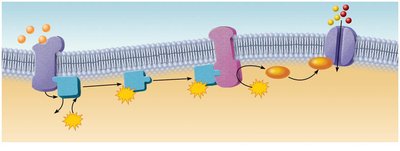
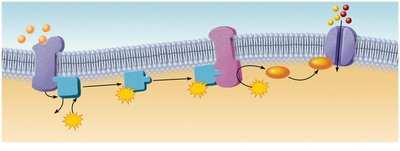
For a substance to be smelled, it must be volatile (gaseous) and dissolve in the mucus covering the olfactory epithelium. The process of olfactory transduction involves several steps:
Odorant binds to its receptor on the olfactory cilia.
The receptor activates a G protein (Golf).
Golf activates adenylate cyclase, which converts ATP to cAMP.
cAMP opens cation channels, allowing Na+ and Ca2+ influx, causing depolarization and generating a receptor potential.
If threshold is reached, an action potential is generated and transmitted to the olfactory bulb.
The Olfactory Pathway
Olfactory nerve filaments synapse with mitral cells in the olfactory bulb, within structures called glomeruli. Mitral cells (second-order neurons) form the olfactory tract, relaying signals to the olfactory cortex, hypothalamus, amygdala, and limbic system, which are involved in odor perception and emotional responses.
Each glomerulus receives input from neurons expressing the same receptor type.
Mitral cells amplify, refine, and relay olfactory signals.
Clinical Considerations
Anosmias: Loss of smell due to head injury, inflammation, or neurological disorders (e.g., Parkinson’s disease).
Phantosmia: Olfactory hallucinations, often associated with temporal lobe epilepsy.
Gustation: The Sense of Taste
Anatomy of Taste Buds
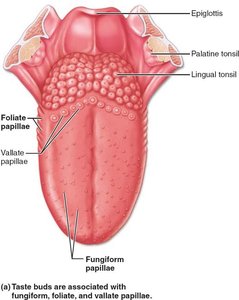
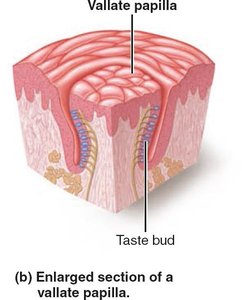
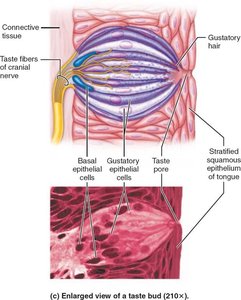
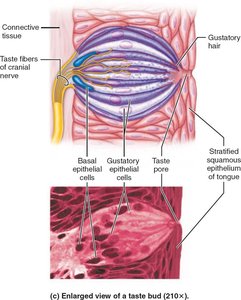
Taste buds are the sensory organs for taste, primarily located on the tongue within papillae (fungiform, foliate, and vallate). Each taste bud contains gustatory epithelial cells (taste receptor cells), basal epithelial cells (stem cells), and supporting cells.
Fungiform papillae: Scattered across the tongue, house most taste buds.
Foliate papillae: Located on the side walls of the tongue.
Vallate papillae: Large, form a "V" at the back of the tongue.
Basic Taste Sensations
There are five basic taste modalities, each associated with different chemicals:
Sweet: Sugars, alcohols, some amino acids
Sour: Hydrogen ions (acids)
Salty: Metal ions (e.g., NaCl)
Bitter: Alkaloids (e.g., quinine, nicotine) and some nonalkaloids
Umami: Amino acids glutamate and aspartate (e.g., meat, cheese)
Taste preferences have homeostatic value, guiding intake of beneficial substances and avoidance of harmful ones.
Physiology of Taste: Taste Transduction
For a chemical to be tasted, it must dissolve in saliva, diffuse into the taste pore, and contact gustatory hairs. The binding of a tastant to a receptor depolarizes the gustatory cell, leading to neurotransmitter release and activation of sensory neurons.
Salty: Na+ influx directly depolarizes the cell.
Sour: H+ ions open cation channels.
Sweet, bitter, umami: Bind to G protein-coupled receptors (gustducin), activating second messenger pathways and causing depolarization.
Other Senses in Taste Perception
Taste perception is influenced by other sensory modalities:
Olfactory input: Smell contributes up to 80% of taste perception.
Touch: Mechanoreceptors detect texture.
Temperature: Thermoreceptors influence taste experience.
Pain: Nociceptors respond to spicy foods (e.g., capsaicin in chili peppers).
Gustatory Pathway
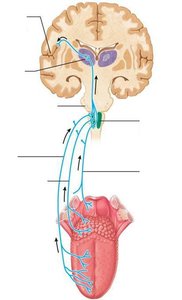
Taste signals are transmitted to the brain via three cranial nerves:
Facial nerve (VII): Anterior two-thirds of the tongue
Glossopharyngeal nerve (IX): Posterior one-third of the tongue and pharynx
Vagus nerve (X): Epiglottis and lower pharynx
These fibers synapse in the solitary nucleus of the medulla, then project to the thalamus and finally to the gustatory cortex in the insula. The hypothalamus and limbic system are also involved, contributing to the emotional aspects of taste.
Summary Table: Comparison of Olfaction and Gustation
Feature | Olfaction (Smell) | Gustation (Taste) |
|---|---|---|
Receptor Location | Olfactory epithelium (nasal cavity) | Taste buds (tongue papillae) |
Stimulus | Volatile chemicals (odorants) | Dissolved chemicals (tastants) |
Receptor Type | Bipolar neurons | Gustatory epithelial cells |
Pathway to Brain | Olfactory nerve → Olfactory bulb → Olfactory cortex | Facial, Glossopharyngeal, Vagus nerves → Solitary nucleus → Thalamus → Gustatory cortex |
Regeneration | Every 30–60 days | Every 7–10 days |
Additional info: The Nobel Prize in Physiology or Medicine 2004 was awarded for discoveries related to odorant receptors and the organization of the olfactory system, highlighting the importance of molecular genetics in sensory physiology.
