 Back
BackThe Chemistry of Life: Foundations for Anatomy & Physiology
Study Guide - Smart Notes
 Tailored notes based on your materials, expanded with key definitions, examples, and context.
Ch. 2 The Chemistry of Life
Atoms: The Smallest Unit of Matter
All matter is composed of atoms, which are the fundamental building blocks of chemical elements. Atoms combine to form all substances, both living and nonliving.
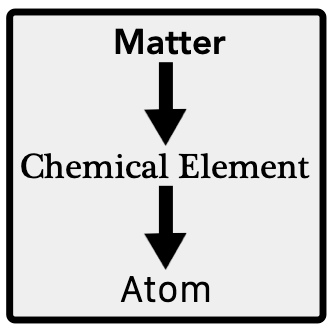
Matter: Anything that occupies space and has mass (e.g., organisms, rocks, water).
Chemical Element: A pure substance made of only one type of atom.
Atom: The smallest unit of an element that retains its properties.
Atomic Structure: Atoms are composed of three subatomic particles:
Protons: Positively charged, located in the nucleus, mass = 1 AMU.
Neutrons: No charge, located in the nucleus, mass = 1 AMU.
Electrons: Negatively charged, orbit the nucleus, mass ≈ 0 AMU.
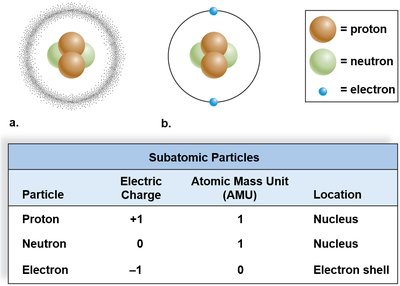
Subatomic Particle | Electric Charge | Atomic Mass Unit (AMU) | Location |
|---|---|---|---|
Proton | +1 | 1 | Nucleus |
Neutron | 0 | 1 | Nucleus |
Electron | -1 | 0 | Electron shell |
Elements of Life and Atomic Properties
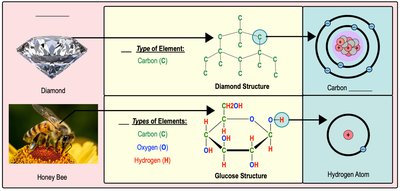
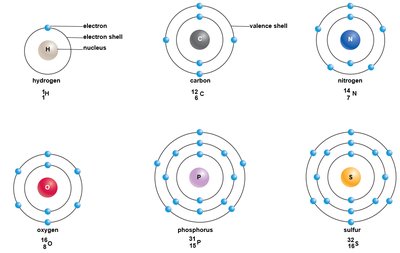
Only a small subset of elements are essential for life, with the majority of living mass composed of Carbon, Hydrogen, Nitrogen, Oxygen, Phosphorus, and Sulfur (CHNOPS).
Atomic Number: Number of protons in the nucleus; defines the element.
Mass Number: Total number of protons and neutrons in the nucleus.
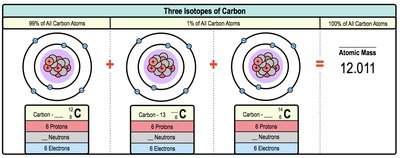
Atomic Mass: Weighted average mass of all isotopes of an element.
Electron Orbitals and Energy Shells
Electrons occupy energy shells (orbitals) around the nucleus. The arrangement of electrons determines chemical reactivity.
Shells closer to the nucleus are lower in energy; distant shells are higher in energy.
Valence Electrons: Electrons in the outermost shell, important for bonding.
1st shell holds up to 2 electrons; 2nd shell up to 8 electrons.
The Octet Rule
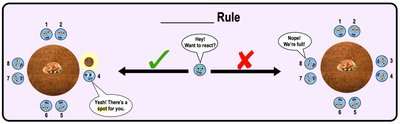
Atoms are most stable when their valence shell is full (usually 8 electrons, except for the first shell which is full at 2).
Atoms with incomplete valence shells are more reactive.
Atoms gain, lose, or share electrons to achieve a full valence shell.
Isotopes
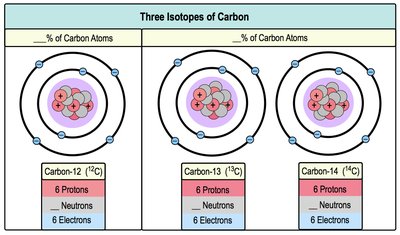
Isotopes are atoms of the same element with different numbers of neutrons, resulting in different mass numbers but identical chemical properties.
Example: Carbon-12, Carbon-13, and Carbon-14 all have 6 protons but differ in neutrons.
Radioactive Isotopes: Unstable isotopes that decay, emitting radiation.
Isotope | Protons | Neutrons | Electrons |
|---|---|---|---|
Carbon-12 | 6 | 6 | 6 |
Carbon-13 | 6 | 7 | 6 |
Carbon-14 | 6 | 8 | 6 |
Chemical Bonds
Chemical bonds are attractive forces that hold atoms together in molecules and compounds.
Molecule: Two or more atoms chemically bonded (e.g., O2).
Compound: Molecule composed of two or more different elements (e.g., H2O).
Intramolecular Bonds: Bonds within a molecule.
Intermolecular Bonds: Bonds between molecules.
Covalent Bonds
Covalent bonds involve the sharing of electron pairs between atoms. They are the strongest type of chemical bond in biological molecules.
Nonpolar Covalent Bonds: Equal sharing of electrons (e.g., O2).
Polar Covalent Bonds: Unequal sharing of electrons, resulting in partial charges (e.g., H2O).
Electronegativity: The tendency of an atom to attract electrons in a bond.
Noncovalent Bonds
Noncovalent bonds do not involve sharing electrons. They include ionic bonds, hydrogen bonds, and van der Waals interactions.
Ionic Bonds: Attraction between oppositely charged ions (cations and anions).
Hydrogen Bonds: Weak attraction between a hydrogen atom and an electronegative atom (F, O, N).
Van der Waals Forces: Weak, transient attractions between molecules.
Water: Structure and Properties
Water is a polar molecule with unique properties essential for life, largely due to its ability to form hydrogen bonds.
Cohesion: Water molecules stick to each other.
Adhesion: Water molecules stick to other substances.
Surface Tension: Difficulty of breaking the surface of water due to cohesion.
High Specific Heat: Water resists temperature changes, helping maintain homeostasis.
High Heat of Vaporization: Large amount of energy required for water to evaporate.
Density: Ice is less dense than liquid water, allowing it to float.
Universal Solvent: Water dissolves many substances due to its polarity.
Acids, Bases, and pH
The concentration of hydrogen ions (H+) in solution determines acidity or basicity, measured by the pH scale.
Acid: Substance that increases H+ concentration in solution.
Base: Substance that decreases H+ concentration (often by releasing OH-).
pH Scale: Ranges from 0 (acidic) to 14 (basic), with 7 being neutral.
Buffers: Substances that minimize changes in pH by accepting or donating H+.
Carbon and Organic Molecules
Carbon is the backbone of organic molecules, capable of forming four covalent bonds and a variety of structures (chains, rings, branches).
Organic Molecules: Contain carbon and hydrogen, often with oxygen, nitrogen, phosphorus, or sulfur.
Hydrocarbons: Molecules made only of carbon and hydrogen.
Functional Groups: Specific groups of atoms that confer chemical reactivity (e.g., hydroxyl, carboxyl, amino, phosphate).
Biomolecules: Monomers and Polymers
Biomolecules are essential organic molecules in living organisms, classified into four main types: carbohydrates, proteins, nucleic acids, and lipids.
Monomers: Small building blocks (e.g., monosaccharides, amino acids, nucleotides).
Polymers: Long chains of monomers (e.g., polysaccharides, polypeptides, nucleic acids).
Dehydration Synthesis: Links monomers by removing water to form polymers.
Hydrolysis: Breaks polymers into monomers by adding water.
Carbohydrates
Carbohydrates are hydrated carbon molecules, serving as energy sources and structural components.
Monosaccharides: Simple sugars (e.g., glucose).
Disaccharides: Two monosaccharides linked together (e.g., maltose).
Polysaccharides: Long chains of monosaccharides (e.g., starch, glycogen, cellulose).
Glycosidic Bonds: Covalent bonds linking monosaccharides.
Functions: Energy storage (starch in plants, glycogen in animals), structural support (cellulose, chitin).
Proteins
Proteins are polymers of amino acids, performing a vast array of functions in cells.
Amino Acids: Monomers with a central carbon, amino group, carboxyl group, and variable R-group.
Peptide Bonds: Covalent bonds linking amino acids.
Levels of Structure:
Primary: Sequence of amino acids.
Secondary: Alpha-helices and beta-sheets (hydrogen bonding).
Tertiary: 3D folding of a single polypeptide.
Quaternary: Association of multiple polypeptides.
Denaturation: Loss of protein structure (and function) due to environmental changes.
Chaperone Proteins: Assist in proper folding or refolding of proteins.
Nucleic Acids
Nucleic acids store and transmit genetic information. They are polymers of nucleotides.
Nucleotide: Composed of a phosphate group, pentose sugar (ribose or deoxyribose), and nitrogenous base.
DNA: Double helix, stores genetic information, bases: A, T, C, G.
RNA: Single-stranded, involved in protein synthesis, bases: A, U, C, G.
Phosphodiester Bonds: Link nucleotides in a chain.
Lipids
Lipids are hydrophobic molecules, diverse in structure and function, and do not form true polymers.
Fats (Triglycerides): Glycerol + 3 fatty acids (energy storage).
Phospholipids: Glycerol + 2 fatty acids + phosphate group (major component of cell membranes, amphipathic).
Steroids: Four fused carbon rings (e.g., cholesterol).
Waxes: Fatty acids bound to long-chain alcohols (protection, water loss prevention).
Energy and Thermodynamics
Energy is the capacity to do work. Biological systems obey the laws of thermodynamics.
Potential Energy: Stored energy (e.g., chemical bonds).
Kinetic Energy: Energy of motion.
First Law: Energy cannot be created or destroyed, only transformed.
Second Law: Energy transformations increase entropy (disorder); some energy is lost as heat.
Chemical Reactions and Enzymes
Chemical reactions involve making or breaking bonds. Enzymes are biological catalysts that speed up reactions by lowering activation energy.
Reactants: Starting materials.
Products: Resulting materials.
Endergonic Reactions: Require energy input.
Exergonic Reactions: Release energy.
ATP: Main energy currency of the cell; hydrolysis releases energy for cellular work.
Enzyme-Substrate Complex: Temporary association during catalysis.
Cofactors and Coenzymes: Non-protein helpers for enzyme function.
Enzyme Inhibition: Competitive (active site) or noncompetitive (allosteric site) inhibition regulates enzyme activity.
*Additional info: This summary expands on the provided notes with academic context, definitions, and examples to ensure completeness and clarity for college-level study.*
