 Back
The Chemistry of Life: Foundations for Anatomy & Physiology
Study Guide - Smart Notes
 Tailored notes based on your materials, expanded with key definitions, examples, and context.
Ch. 2 The Chemistry of Life
Atoms: The Smallest Unit of Matter
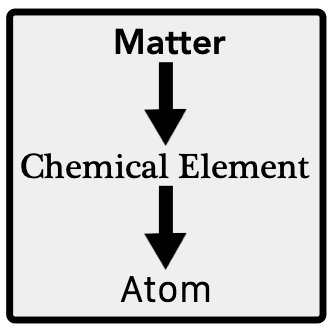
All matter, which includes everything that takes up space and has mass, is composed of chemical elements. Each element is a pure substance made of only one type of atom, and atoms are the smallest unit of an element, and thus, of matter itself. Atoms make up both living and nonliving matter.
Matter: Anything that occupies space and has mass (e.g., organisms, rocks, water).
Chemical Element: A pure substance consisting of only one type of atom.
Atom: The smallest unit of an element that retains its properties.
Atomic Structure
Atoms are composed of three subatomic particles, each with distinct properties:
Protons: Positively charged particles found in the nucleus; each has a mass of 1 atomic mass unit (AMU).
Neutrons: Neutral particles (no charge) also found in the nucleus; each has a mass of 1 AMU.
Electrons: Negatively charged particles with almost no mass, found in orbitals (energy shells) around the nucleus.
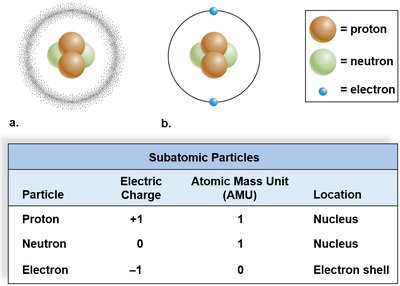
Subatomic Particle | Electric Charge | Atomic Mass Unit (AMU) | Location |
|---|---|---|---|
Proton | +1 | 1 | Nucleus |
Neutron | 0 | 1 | Nucleus |
Electron | -1 | 0 | Electron shell |
Elements of Life
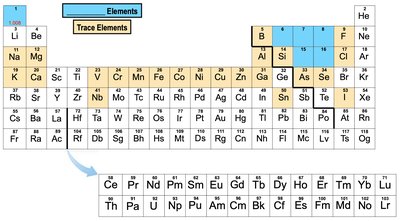
Only a small subset of all known elements are found in living organisms. The periodic table arranges these elements based on their chemical properties. Approximately 97% of the mass of most living organisms is composed of six elements: Carbon, Hydrogen, Nitrogen, Oxygen, Phosphorus, and Sulfur (CHNOPS).
Major Elements: Required in large amounts for life (e.g., CHNOPS).
Trace Elements: Required in minute amounts but essential for function.
Atomic Properties
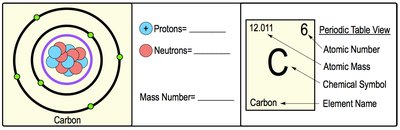
Each atom has unique properties that distinguish one element from another:
Atomic Number: The number of protons in the nucleus; defines the element.
Mass Number: The sum of protons and neutrons in the nucleus.
Atomic Mass: The average total mass of all atoms of an element, accounting for isotopes.
Electron Orbitals & Energy Shells
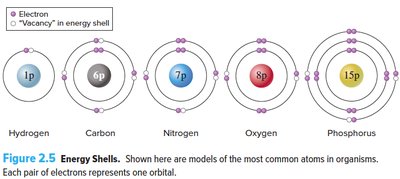
Electrons occupy orbitals, which are three-dimensional regions around the nucleus. These are visualized as energy shells:
Shells closer to the nucleus are lower in energy; distant shells are higher in energy.
Valence Electrons: Electrons in the outermost shell, important for chemical reactivity.
The first shell holds up to 2 electrons; the second up to 8; subsequent shells hold more.
The Octet Rule
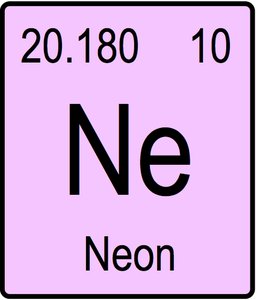
Atoms are most stable when their valence shell is full (usually 8 electrons, except for the first shell which is full at 2). Atoms with incomplete valence shells are more reactive.
Atoms will gain, lose, or share electrons to achieve a full valence shell (the octet rule).
Isotopes
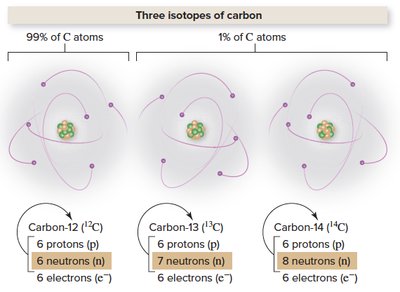
Isotopes are atoms of the same element with the same number of protons but different numbers of neutrons, resulting in different mass numbers. The atomic mass of an element is the weighted average of all its isotopes.
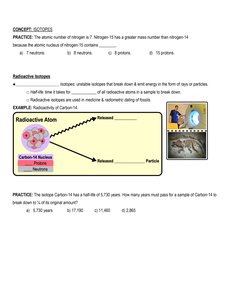
Radioactive Isotopes: Unstable isotopes that decay, releasing energy and particles.
Chemical Bonding
Chemical bonds are attractive forces that hold atoms together in molecules and compounds. Bonds can be intramolecular (within a molecule) or intermolecular (between molecules).
Molecule: Two or more atoms chemically bonded (e.g., O2).
Compound: Molecule composed of two or more different elements (e.g., H2O).
Chemical Formula: Indicates the types and numbers of atoms in a molecule (e.g., C6H12O6).
Ionic Bonding
Ionic bonds form between oppositely charged ions (cations and anions) due to the transfer of electrons. This transfer allows both atoms to achieve full valence shells.
Anion: Negatively charged ion (gains electrons).
Cation: Positively charged ion (loses electrons).
Ionic Bond: Electrical attraction between cations and anions.
Covalent Bonding
Covalent bonds involve the sharing of electron pairs between atoms. There are two main types:
Nonpolar Covalent Bond: Equal sharing of electrons (atoms have similar electronegativities).
Polar Covalent Bond: Unequal sharing of electrons (atoms have different electronegativities), resulting in partial charges (δ+ and δ−).
Hydrogen Bonding
Hydrogen bonds are weak interactions between a highly electronegative atom (F, O, or N) and a hydrogen atom covalently bonded to another electronegative atom. While individually weak, they are collectively strong and crucial for the properties of water and biological macromolecules.
Hydrogen bonds are responsible for water's unique properties and the structure of DNA and proteins.
Chemical Reactions
Chemical reactions involve the making and breaking of chemical bonds, transforming reactants into products. They are classified based on energy requirements:
Endergonic Reactions: Require an input of energy.
Exergonic Reactions: Release energy.
Introduction to Energy
Energy is the ability to perform work. In biological systems, energy exists as potential (stored) or kinetic (motion) energy.
Potential Energy: Stored energy available to do work (e.g., chemical bonds in glucose).
Kinetic Energy: Energy of motion (e.g., movement of molecules).
Thermodynamics in Biology
Thermodynamics is the study of energy transfers. Biological systems exchange both energy and matter with their surroundings, and the principles of thermodynamics govern all chemical processes in living organisms.
System: The part of the universe being studied.
Surroundings: Everything outside the system.
Enzymes
Enzymes are biological catalysts that speed up chemical reactions by lowering the activation energy (EA) required for the reaction to proceed. They are not consumed in the reaction and are highly specific for their substrates.
Activation Energy (EA): The minimum energy required to start a reaction.
Enzymes lower EA, increasing reaction rates.
Environmental factors such as temperature, pH, and substrate concentration affect enzyme activity.
Denaturation (loss of structure) leads to loss of enzyme function.
Water: Structure and Properties
Water is a small, polar molecule with two hydrogen atoms and one oxygen atom (H2O). Its polarity and ability to form hydrogen bonds give rise to several emergent properties essential for life:
Cohesion & Adhesion: Water molecules stick to each other (cohesion) and to other substances (adhesion).
High Specific Heat: Water resists temperature changes, aiding in homeostasis.
High Heat of Vaporization: Requires significant energy to change from liquid to gas.
Density: Ice is less dense than liquid water, allowing it to float and insulate aquatic life.
Universal Solvent: Water dissolves many substances, facilitating chemical reactions in cells.
Acids, Bases, and the pH Scale
The concentration of hydrogen ions (H+) in solution affects biological processes. Acids increase [H+], while bases decrease it. The pH scale (0–14) measures the acidity or basicity of a solution:
Acid: Donates H+ to solution (pH < 7).
Base: Accepts H+ or donates OH− (pH > 7).
Buffer: Substance that minimizes changes in pH by accepting or donating H+.
Carbon and Organic Molecules
Carbon is the most abundant element in living systems (excluding water) and forms the backbone of organic molecules, including carbohydrates, proteins, nucleic acids, and lipids. Carbon's ability to form four covalent bonds allows for a diversity of molecular structures.
Hydrocarbons: Molecules made of only carbon and hydrogen.
Functional Groups: Reactive groups of atoms that define the properties of organic molecules (e.g., hydroxyl, carboxyl, amino, phosphate).
Biomolecules: Monomers and Polymers
Biomolecules are essential organic molecules in living organisms, classified into four main groups:
Carbohydrates: Sugars and polymers of sugars; main functions are energy storage and structural support.
Proteins: Polymers of amino acids; functions include catalysis, structure, transport, and signaling.
Nucleic Acids: Polymers of nucleotides; store and transmit genetic information (DNA, RNA).
Lipids: Hydrophobic molecules; include fats, oils, phospholipids, steroids, and waxes.
Monomers are linked by dehydration synthesis (removal of water) to form polymers, and polymers are broken down by hydrolysis (addition of water).
Carbohydrates
Carbohydrates are hydrated carbon molecules, often fitting the formula Cn(H2O)n. They are classified by size:
Monosaccharides: Single sugar units (e.g., glucose).
Disaccharides: Two covalently linked monosaccharides.
Polysaccharides: Long chains (>20) of monosaccharides (e.g., starch, glycogen, cellulose).
Monosaccharides are linked by glycosidic bonds (formed via dehydration synthesis) and broken down by hydrolysis.
Lipids
Lipids are hydrophobic biomolecules that do not form polymers. They include:
Fats and Oils (Triglycerides): Glycerol linked to three fatty acids.
Phospholipids: Major component of cell membranes; amphipathic (hydrophilic head, hydrophobic tails).
Steroids: Four fused carbon rings (e.g., cholesterol).
Waxes: Fatty acids bound to long-chain alcohols; used for protection and water retention.
Proteins
Proteins are polymers of amino acids linked by peptide bonds. They have four levels of structure:
Primary: Sequence of amino acids.
Secondary: Alpha-helices and beta-sheets formed by hydrogen bonding.
Tertiary: Overall 3D shape of a polypeptide.
Quaternary: Association of multiple polypeptide chains.
Protein function depends on structure; denaturation (loss of structure) leads to loss of function. Chaperone proteins assist in proper folding.
Nucleic Acids
Nucleic acids (DNA and RNA) are polymers of nucleotides, each consisting of a phosphate group, a pentose sugar, and a nitrogenous base. DNA stores genetic information in a double helix; RNA is usually single-stranded and involved in protein synthesis.
Phosphodiester Bonds: Link nucleotides in a chain.
Nitrogenous Bases: Purines (adenine, guanine) and pyrimidines (cytosine, thymine, uracil).
Base pairing in DNA: A with T, C with G; in RNA, A with U.
Additional info: This summary covers the foundational chemistry necessary for understanding biological structure and function, as required for introductory anatomy and physiology courses.
