 Back
BackCh2 The Chemistry of Life: Foundations for Anatomy & Physiology
Study Guide - Smart Notes
 Tailored notes based on your materials, expanded with key definitions, examples, and context.
The Chemistry of Life CH2
Introduction
Chemistry forms the foundation of human anatomy and physiology, as all biological structures and functions are governed by chemical principles. Understanding the chemical level of organization is essential for comprehending how the body operates, from the strength of bones to cellular communication.
Atoms and Elements
Basic Concepts
Atoms are the smallest units of matter that retain their original properties. Elements are substances composed of identical atoms and cannot be broken down by chemical means. Matter is anything that has mass and occupies space.
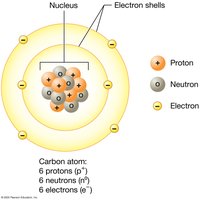
Atom: Composed of protons (positive), neutrons (neutral), and electrons (negative).
Element: Defined by the atomic number (number of protons).
Chemistry: Study of matter and its interactions.
Atomic Structure
Protons and neutrons reside in the atomic nucleus.
Electrons surround the nucleus in electron shells.
Atoms are electrically neutral when protons equal electrons.
Electron shells: 1st shell holds 2 electrons, 2nd holds 8, 3rd holds 18 (satisfied with 8).
Elements in the Human Body
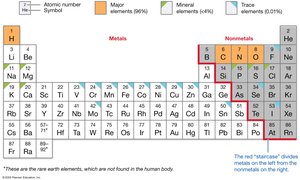
Four major elements make up 96% of body mass: Oxygen (O), Carbon (C), Hydrogen (H), Nitrogen (N).
Mineral elements and trace elements are also essential for physiological functions.
Isotopes and Radioactivity
Isotope: Atom with same number of protons but different number of neutrons.
Radioisotopes: Unstable isotopes that release energy as radiation, used in nuclear medicine.
Nuclear Medicine Applications
Cancer radiation therapy damages and kills cancer cells.
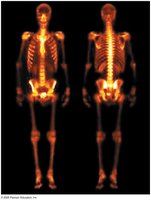
Radiotracers help visualize organ activity and structure.
Iodine-131 treats thyroid disorders.
Matter Combined: Mixtures and Chemical Bonds
Mixtures
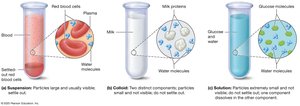
Mixtures are physical combinations of elements or compounds, while molecules are chemical combinations.
Suspensions: Liquid mixed with visible solid particles that settle out.
Colloids: Liquid mixed with small, invisible solid particles that remain dispersed.
Solutions: One substance dissolves in another, forming a translucent mixture.
Chemical Bonds
Chemical bond: Attractive force between atoms.
Molecule: Two or more atoms of the same element bonded.
Compound: Two or more atoms of different elements bonded.
Macromolecule: Very large compound composed of many atoms.
Valence Electrons and Stability
Bonds form when valence electrons interact.
Octet Rule: Atoms are most stable with 8 electrons in the valence shell.
Duet Rule: Atoms with 5 or fewer electrons are stable with 2 electrons in the first shell.
Ions and Ionic Bonds
Formation and Properties
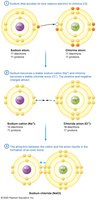
Ionic bonds form when electrons are transferred between a metal and a nonmetal, resulting in charged ions.
Cation: Positively charged ion.
Anion: Negatively charged ion.
Opposite charges attract, forming salts.
Covalent Bonds
Formation and Types
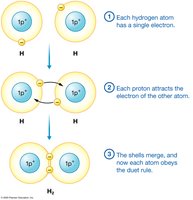
Covalent bonds are formed by sharing electrons between nonmetal atoms and are the strongest type of chemical bond.
Single, double, or triple bonds depending on the number of shared electron pairs.
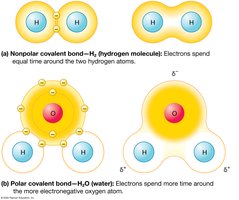
Nonpolar covalent bond: Electrons shared equally.
Polar covalent bond: Electrons shared unequally, creating dipoles.
Hydrogen Bonds
Properties and Biological Importance
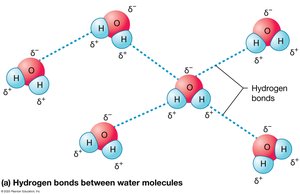
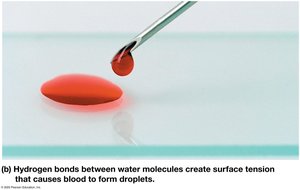
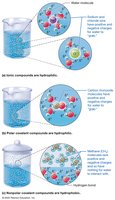
Hydrogen bonds are weak attractions between partially positive and negative atoms in polar molecules, crucial for water's properties and protein structure.
Responsible for surface tension in water.
Stabilize protein and nucleic acid structures.
Chemical Notation and Reactions
Chemical Equations
Reactants: Starting substances.
Products: Substances produced.
Reversible reactions:
Irreversible reactions:
Energy in Chemical Reactions
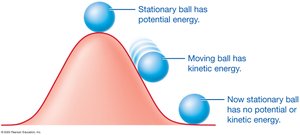
Potential energy: Stored energy.
Kinetic energy: Energy in motion.
Chemical energy: Energy in chemical bonds.
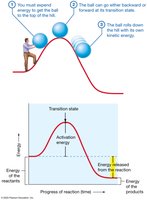
Endergonic reactions: Require energy input.
Exergonic reactions: Release energy.
Homeostasis and Types of Chemical Reactions
Fundamental Reaction Types
Catabolic reactions: Break down larger substances (exergonic).
Exchange reactions: Transfer atoms or electrons.
Anabolic reactions: Build new chemical bonds (endergonic).
Redox reactions: Electron exchange; oxidation (loss), reduction (gain).
Reaction Rates and Enzymes
Activation Energy
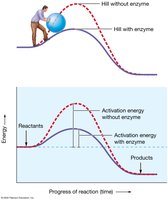
Energy required for reactants to collide and react.
Catalysts lower activation energy.
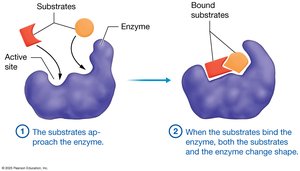
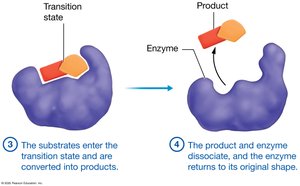
Enzymes are biological catalysts.
Enzyme Properties and Mechanism
Highly specific for substrates.
Contain an active site for substrate binding.
Not permanently altered in reactions.
Increase reaction rates dramatically.
Enzyme Deficiencies
Clinical Examples
Tay-Sachs Disease: Deficiency of hexosaminidase; fatal neurodegeneration.
SCIDS: Deficiency of adenosine deaminase; severe immune deficiency.
Phenylketonuria: Deficiency of phenylalanine hydroxylase; can cause mental retardation if untreated.
Inorganic Compounds: Water, Acids, Bases, and Salts
Water
Makes up 50-65% of body mass.
Absorbs and carries heat, cushions, protects, and lubricates.
Primary solvent for hydrophilic substances.
Acids and Bases
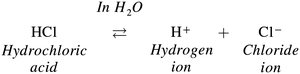
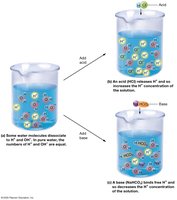
Acids: Proton donors; increase hydrogen ion concentration.
Bases: Proton acceptors; decrease hydrogen ion concentration.
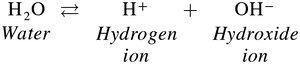
Water can dissociate:
pH Scale
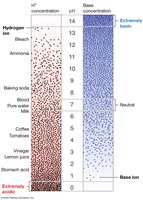
pH is the negative logarithm of hydrogen ion concentration.
pH 7 is neutral; below 7 is acidic; above 7 is basic.
Buffers
Resist changes in pH.
Major buffer: carbonic acid–bicarbonate system.
Blood pH must remain between 7.35 and 7.45.

Salts and Electrolytes
Salts are ionic compounds that dissociate in water.
Electrolytes conduct electricity and are essential for organ function.
Organic Compounds
Hydrocarbons
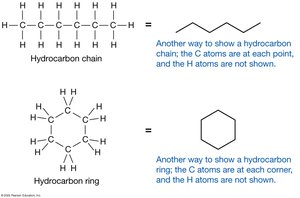
Contain only carbon and hydrogen; form chains and rings.
Monomers and Polymers
Monomers are single subunits; polymers are chains of monomers.
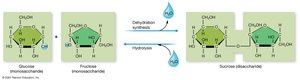
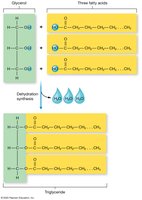
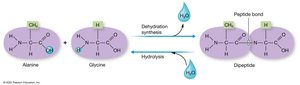
Dehydration synthesis links monomers; hydrolysis splits polymers.
Carbohydrates
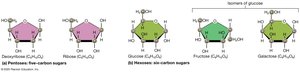
Made of C, H, O; ratio 1:2:1; polar and hydrophilic.
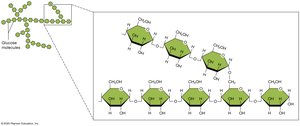
Monosaccharides (simple sugars), disaccharides, polysaccharides.
Glycoproteins and glycolipids aid cell communication.
Lipids
Made of C, H, and some O; nonpolar and hydrophobic.
Includes fatty acids, triglycerides, phospholipids, steroids.
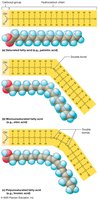
Fatty acids: saturated (no double bonds), monounsaturated (one double bond), polyunsaturated (multiple double bonds).
Phospholipids
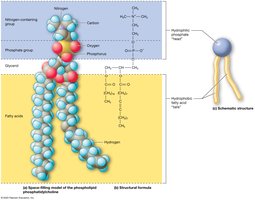
Glycerol backbone, two fatty acids, phosphate group.
Amphiphilic: polar head, nonpolar tails.
Main structural component of cell membranes.
Steroids
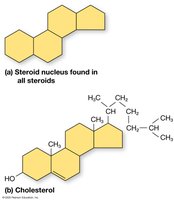
Four-ring hydrocarbon nucleus.
Cholesterol forms basis for other steroids.
Includes bile acids, estrogen, testosterone.
Proteins
Made of C, H, O, N, and other elements.
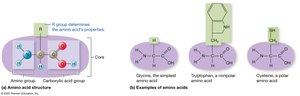
Monomers are amino acids (21 types).
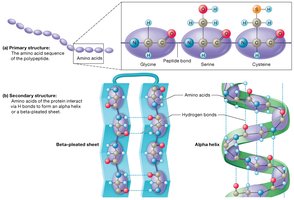
Peptide bonds link amino acids.
Four levels of structure: primary, secondary (alpha helix, beta sheet), tertiary, quaternary.
Fibrous (structural) and globular (functional) proteins.
Protein Denaturation
Loss of shape due to heat, pH, or chemicals.
Denatured proteins cannot function properly.
Nucleotides and Nucleic Acids
Made of C, H, O, N, P; includes DNA and RNA.
Monomers are nucleotides: nitrogenous base, five-carbon sugar, phosphate group.
Purines: adenine, guanine; pyrimidines: cytosine, thymine, uracil.
Adenosine Triphosphate (ATP)
Main source of chemical energy for cells.
Hydrolysis releases energy for cellular work.
DNA and RNA
DNA: double helix, deoxyribose sugar, A-T and G-C base pairing.
RNA: single strand, ribose sugar, uracil replaces thymine.
Genes are segments of DNA coding for proteins.
Summary Table: Organic Compounds
Compound | Monomer | Main Functions |
|---|---|---|
Carbohydrates | Monosaccharides | Fuel, structure, cell communication |
Lipids | Fatty acids | Fuel, membranes, hormones |
Proteins | Amino acids | Structure, enzymes, defense, communication |
Nucleic Acids | Nucleotides | Genetic code, energy (ATP) |
Additional info: This chapter provides foundational chemical concepts essential for understanding all subsequent topics in anatomy and physiology, including cell structure, metabolism, and organ system function.
