 Back
BackThe Cranial and Spinal Nerves: Structure, Function, and Sensory Receptors
Study Guide - Smart Notes
 Tailored notes based on your materials, expanded with key definitions, examples, and context.
The Cranial Nerves
Overview of the Twelve Cranial Nerves
The cranial nerves are twelve pairs of nerves that emerge directly from the brain and brainstem, each with specific sensory, motor, or mixed functions. They are traditionally numbered I to XII and are essential for sensory and motor functions of the head and neck.
Olfactory nerves (I): Sensory nerves responsible for the sense of smell. They originate from the olfactory bulbs in the nasal lining, pass through the cribriform plate of the ethmoid bone, and terminate in the cerebral centers for interpretation.
Optic nerves (II): Sensory nerves associated with vision. They transmit visual information from the retina to the occipital lobe via the optic chiasma and optic tract.
Oculomotor nerves (III): Motor nerves that raise the eyelid, move the eye, adjust the amount of light entering the eye (via the iris), and focus the lens. They also have parasympathetic fibers.
Trochlear nerves (IV): Motor nerves that innervate muscles responsible for certain eye movements.
Trigeminal nerves (V): The largest cranial nerves, arising from the pons. They are mixed nerves with three major branches: ophthalmic, maxillary, and mandibular. They provide sensory input from the face and motor control for mastication.
Trigeminal neuralgia: A condition causing severe facial pain.
Abducens nerves (VI): Motor nerves that control lateral eye movement.
Facial nerves (VII): Mixed nerves involved in taste sensation, facial expression, and stimulation of tear and salivary glands. Damage can cause Bell’s palsy. (Parasympathetic)
Vestibulocochlear nerves (VIII): Sensory nerves with two branches:
Vestibular branch: Maintains equilibrium.
Cochlear branch: Responsible for hearing.
Glossopharyngeal nerves (IX): Mixed nerves, predominantly sensory, associated with taste and swallowing. (Parasympathetic)
Vagus nerves (X): Mixed nerves with extensive autonomic (parasympathetic) functions, including speech, swallowing, and regulation of thoracic and abdominal organs.
Accessory nerves (XI): Motor nerves that innervate muscles of the soft palate, pharynx, larynx, and some neck muscles.
Hypoglossal nerves (XII): Motor nerves controlling tongue movements for speaking, chewing, and swallowing.
Parasympathetic branches are found in: Oculomotor (III), Facial (VII), Glossopharyngeal (IX), and Vagus (X) nerves.
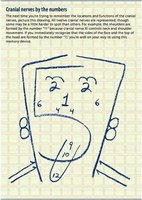
Mnemonic Devices
On Occasion Our Trusty Truck Almost Fails, Very Good Vehicle Any How: A mnemonic to remember the order of cranial nerves.
Some Say Marry Money, But My Brother Says Big Brains Matter More: A mnemonic to remember the sensory (S), motor (M), or both (B) functions of each cranial nerve.
The Spinal Nerves
Grouping and Numbering of Spinal Nerves
Spinal nerves are grouped and numbered according to the region of the spinal cord from which they arise. Each nerve is paired and numbered sequentially.
Cervical: 8 pairs
Thoracic: 12 pairs
Lumbar: 5 pairs
Sacral: 5 pairs
Coccygeal: 1 pair
Sensory Processing: Sensation and Perception
Definitions
Sensation: Awareness of changes in the internal and external environment, detected by sensory receptors.
Perception: The conscious interpretation of the meaning of a stimulus, which occurs in the brain.
Receptor Potentials and Adaptation
Stimulus energy is converted into a graded potential called a receptor potential, which may be a depolarization or hyperpolarization.
Adaptation: A decrease in sensitivity to a constant stimulus, resulting in reduced receptor responsiveness and a decline in the frequency of receptor potentials.
Some receptors (e.g., for pressure, touch, and smell) adapt quickly, while nociceptors (pain receptors) and proprioceptors (position receptors) do not adapt, providing ongoing protection and awareness of body position.
Types of Sensory Receptors
Classification by Stimulus Type
Mechanoreceptors: Respond to touch, pressure, vibration, stretch, and itch.
Thermoreceptors: Sensitive to temperature changes.
Photoreceptors: Respond to light energy (located in the retina of the eye).
Chemoreceptors: Respond to chemical stimuli.
Nociceptors: Sensitive to pain-causing stimuli.
Proprioceptors: Respond to stretch in skeletal muscles, tendons, joints, and ligaments, providing information about body position.
Specialized Receptors
Meissner’s (tactile) corpuscles: Detect discriminative touch.
Pacinian (lamellated) corpuscles: Detect deep pressure and vibration.
Ruffini endings: Detect deep, continuous pressure.
Muscle spindles: Detect muscle stretch.
Golgi tendon organs: Detect stretch in tendons.
Joint kinesthetic receptors: Detect stretch in articular capsules of joints.
Neuronal Regeneration
Regeneration in the Peripheral and Central Nervous Systems
Mature neurons are amitotic (do not divide).
If the cell body of a damaged peripheral nerve is intact, the axon can regenerate.
In the CNS, oligodendrocytes produce growth-inhibiting proteins that prevent axon regeneration, limiting recovery after injury.
Key Equations and Concepts
Graded potential: A change in membrane potential that varies in size, not all-or-none.
Depolarization: (membrane potential becomes less negative)
Hyperpolarization: (membrane potential becomes more negative)
Example: If a mechanoreceptor in the skin is stimulated by pressure, it generates a receptor potential that, if strong enough, triggers an action potential in the associated sensory neuron, leading to the sensation of touch.
Additional info: The cranial nerves are often tested clinically to assess neurological function, and their impairment can indicate specific brain or nerve injuries.
