 Back
BackThe Digestive System and Body Metabolism: Structure, Function, and Processes
Study Guide - Smart Notes
 Tailored notes based on your materials, expanded with key definitions, examples, and context.
The Digestive System
Overview and Functions
The digestive system is responsible for breaking down food, absorbing nutrients, and eliminating waste. It consists of the alimentary canal and accessory digestive organs, each playing a specific role in the digestive process.
Ingestion: Taking in food through the mouth.
Digestion: Mechanical and chemical breakdown of food into nutrient molecules.
Absorption: Movement of nutrients into the bloodstream.
Defecation: Elimination of indigestible substances as feces.
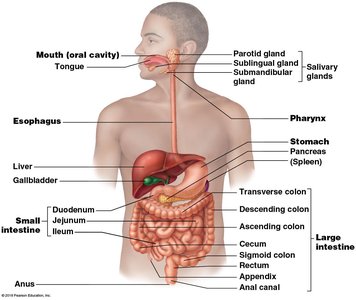
Anatomy of the Digestive System
The digestive system is divided into two main groups of organs:
Alimentary canal (gastrointestinal tract): A continuous, coiled, hollow tube including the mouth, pharynx, esophagus, stomach, small intestine, large intestine, and anus. These organs ingest, digest, absorb, and defecate.
Accessory digestive organs: Teeth, tongue, salivary glands, pancreas, liver, and gallbladder. These assist in digestion by producing enzymes, bile, or physically breaking down food.
Organs of the Alimentary Canal
Mouth (Oral Cavity)
The mouth is the entry point for food and is lined with a mucous membrane. It contains several structures that aid in the initial breakdown of food.
Lips (labia): Protect the anterior opening.
Cheeks: Form the lateral walls.
Hard and soft palate: Form the roof of the mouth.
Uvula: Fleshy projection of the soft palate.
Vestibule: Space between lips and teeth/gums.
Tongue: Mixes food with saliva, initiates swallowing, and contains taste buds.
Tonsils: Palatine and lingual tonsils provide immune defense.


Pharynx
The pharynx serves as a passageway for food, fluids, and air. It is divided into the oropharynx and laryngopharynx, which direct food toward the esophagus.
Muscle layers: Longitudinal outer and circular inner layers propel food by peristalsis.
Esophagus
The esophagus is a muscular tube (~10 inches long) that connects the pharynx to the stomach. It conducts food by peristalsis and serves as a passageway for food only.
Layers of the Alimentary Canal
The walls of the alimentary canal (from esophagus to large intestine) are composed of four layers (tunics):
Mucosa: Innermost, moist membrane with epithelium, connective tissue (lamina propria), and a thin muscle layer. Lines the lumen.
Submucosa: Soft connective tissue with blood vessels, nerves, lymphoid tissue, and lymphatic vessels.
Muscularis externa: Smooth muscle with inner circular and outer longitudinal layers.
Serosa: Outermost layer with fluid-producing cells; includes the visceral and parietal peritoneum.

Stomach
The stomach is a C-shaped organ on the left side of the abdominal cavity. It receives food from the esophagus and empties into the small intestine.
Regions: Cardia, fundus, body, pylorus.
Rugae: Internal folds of mucosa present when the stomach is empty.
Lesser and greater omentum: Extensions of the peritoneum that support and protect abdominal organs.


Small Intestine
The small intestine is the major digestive organ, responsible for most nutrient absorption. It extends from the pyloric sphincter to the ileocecal valve and is subdivided into the duodenum, jejunum, and ileum.
Structural modifications: Villi, microvilli, and circular folds increase surface area for absorption.
Enzymes and bile: Pancreatic enzymes and bile enter the duodenum to aid digestion.
Large Intestine
The large intestine absorbs water and eliminates feces. It is larger in diameter but shorter than the small intestine and is subdivided into the cecum, appendix, colon (ascending, transverse, descending, sigmoid), rectum, and anal canal.
Anal sphincters: Internal (involuntary) and external (voluntary) sphincters control defecation.
Accessory Digestive Organs
Teeth
Teeth mechanically break down food. Humans have two sets: deciduous (baby) teeth and permanent teeth. Teeth are classified by shape and function: incisors (cutting), canines (tearing), premolars and molars (crushing and grinding).
Structure: Crown (enamel, dentin, pulp cavity), root (cement, periodontal membrane).
Salivary Glands
Three pairs of salivary glands (parotid, submandibular, sublingual) secrete saliva, which moistens food, begins starch digestion (salivary amylase), and contains antibacterial agents.
Pancreas
The pancreas produces digestive enzymes and alkaline fluid to neutralize stomach acid. It also produces hormones (insulin and glucagon) for blood sugar regulation.
Liver and Gallbladder
The liver produces bile, which emulsifies fats. Bile is stored and concentrated in the gallbladder and released into the duodenum when needed.
Digestive Processes and Controls
Essential Processes of the GI Tract
Ingestion: Placing food in the mouth.
Propulsion: Moving food through the digestive tract (peristalsis).
Mechanical breakdown: Chewing, churning, and segmentation.
Chemical digestion: Enzymatic breakdown of food into building blocks.
Absorption: Movement of nutrients into blood or lymph.
Defecation: Elimination of indigestible substances as feces.
Nutrition and Metabolism
Major Nutrients
Carbohydrates: Main energy source; found in plants, fruits, and vegetables.
Lipids: Triglycerides, saturated and unsaturated fats, cholesterol.
Proteins: Complete (animal sources) and incomplete (plant sources).
Vitamins and minerals: Essential for enzyme function and metabolic processes.
Water: Vital for all cellular processes.
Metabolism
Metabolism includes all chemical reactions in the body. It is divided into:
Catabolism: Breakdown of substances to release energy (ATP).
Anabolism: Building larger molecules from smaller ones.
Carbohydrate Metabolism
Glucose is the primary fuel for ATP production. Cellular respiration involves glycolysis, the citric acid cycle, and the electron transport chain:
Glycolysis: Occurs in the cytosol; splits glucose into pyruvic acid and yields ATP.
Citric acid cycle: Occurs in mitochondria; produces CO2, water, and a small amount of ATP.
Electron transport chain: Produces most ATP via oxidative phosphorylation.
Equation for cellular respiration:
$ \text{C}_6\text{H}_{12}\text{O}_6 + 6\text{O}_2 \rightarrow 6\text{CO}_2 + 6\text{H}_2\text{O} + 36\text{ATP} $
Fat and Protein Metabolism
Fat metabolism: Fats are used for energy when carbohydrates are scarce. Excessive fat breakdown leads to acidosis.
Protein metabolism: Proteins are used for energy mainly when other fuels are unavailable. Ammonia is produced and converted to urea in the liver.
The Liver's Role in Metabolism
The liver is central to metabolism, performing glycogenesis, glycogenolysis, gluconeogenesis, and detoxification. It produces bile, cholesterol, and blood proteins, and regulates blood glucose levels.
Body Energy Balance and Temperature Regulation
Energy Balance
Energy intake: Energy from food oxidation.
Energy output: Heat, work, and energy storage.
Basal metabolic rate (BMR): Heat produced at rest.
Total metabolic rate (TMR): Total kilocalories needed for all activities.
Body Temperature Regulation
The hypothalamus maintains body temperature through heat loss (radiation, sweating) and heat-promoting (vasoconstriction, shivering) mechanisms. Fever is a controlled increase in body temperature due to infection or other causes.
Developmental Aspects
The alimentary canal forms early in development. Newborns rely on reflexes for feeding, and digestive efficiency changes with age. Common digestive problems include gastroenteritis, appendicitis, ulcers, and gallbladder issues. Metabolic rate decreases with age, and conditions like obesity and diabetes become more common.
