 Back
The Digestive System: Structure, Function, and Processes
Study Guide - Smart Notes
 Tailored notes based on your materials, expanded with key definitions, examples, and context.
Overview of Digestive Processes
Digestive System Functions
The digestive system processes food through a series of coordinated activities to extract nutrients and eliminate waste. These activities include ingestion, propulsion, mechanical digestion, chemical digestion, absorption, and defecation.
Ingestion: Taking food into the mouth.
Propulsion: Moving food through the gastrointestinal (GI) tract, primarily by peristalsis (waves of muscular contractions).
Mechanical Digestion: Physically breaking food into smaller pieces (e.g., chewing, churning in the stomach, segmentation in the intestines).
Chemical Digestion: Enzymatic breakdown of complex molecules into absorbable monomers.
Absorption: Transport of nutrients from the GI tract lumen into body tissues.
Defecation: Elimination of indigestible substances as feces.
Chemical Digestion
General Principles
Chemical digestion is a catabolic process in which enzymes break down large food molecules into their monomers, which are small enough to be absorbed. The main chemical reaction is hydrolysis:
Hydrolysis: Addition of a water molecule to break chemical bonds, splitting complex molecules into simpler ones.
Carbohydrate Digestion
Monomers: Monosaccharides (glucose, fructose, galactose) are directly absorbed.
Disaccharides/Polysaccharides: Sucrose, lactose, maltose, and starch must be broken down into monosaccharides.
Enzymes:
Salivary Amylase: Begins starch digestion in the mouth.
Pancreatic Amylase: Continues starch digestion in the small intestine.
Brush Border Enzymes: (e.g., dextrinase, glucoamylase, lactase, maltase, sucrase) complete carbohydrate digestion at the microvilli surface.
Cellulose: Indigestible by humans; provides dietary fiber.
Protein Digestion
Monomers: Amino acids.
Stomach: Pepsin (from gastric glands) initiates protein digestion in acidic conditions.
Small Intestine:
Pancreatic Enzymes: Trypsin, chymotrypsin, carboxypeptidase.
Brush Border Enzymes: Aminopeptidase, dipeptidase, carboxypeptidase.
Lipid Digestion
Site: Small intestine (only location for significant lipid digestion).
Enzymes: Lipases (from pancreas).
Bile Salts: Emulsify fats, breaking large globules into smaller droplets for enzyme action.
Products: Monoglycerides and fatty acids.
Nucleic Acid Digestion
Enzymes: Pancreatic nucleases hydrolyze DNA and RNA into nucleotide monomers; brush border enzymes further break down nucleotides.
Functional Anatomy of the Digestive System
Mouth
Ingestion and Mechanical Digestion: Chewing (mastication) physically breaks down food.
Chemical Digestion: Salivary amylase begins starch digestion.
Saliva Composition: 97% water, electrolytes (Na, K, Cl, phosphate, bicarbonate), salivary amylase, mucin, lysozyme, antibodies.
Control of Salivation:
Intrinsic glands secrete continuously; extrinsic glands activated by food.
Parasympathetic stimulation increases watery saliva; sympathetic stimulation produces thick, mucin-rich saliva.
Deglutition (Swallowing):
Buccal Phase: Voluntary; tongue pushes bolus into oropharynx.
Pharyngeal-Esophageal Phase: Involuntary; controlled by medulla and pons, routes to trachea and nasopharynx are closed.
Esophagus
Connects oral cavity to stomach; no digestion or absorption occurs here.
Propulsion by peristalsis moves bolus to stomach.
Stomach
Performs all digestive processes except ingestion and defecation.
Mechanical Digestion: Churning by smooth muscle layers.
Chemical Digestion: Gastric glands secrete gastric juice containing enzymes and acid.
Mucosal Barrier: Protects stomach lining from self-digestion via mucus, tight junctions, impermeable membranes, and rapid cell renewal.
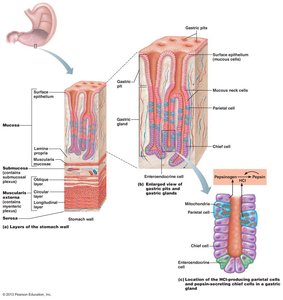
Gastric Gland Cell Types:
Mucous Neck Cells: Secrete acidic mucus.
Parietal Cells: Secrete HCl (activates pepsin, kills bacteria) and intrinsic factor (for vitamin B12 absorption).
Chief Cells: Secrete pepsinogen (inactive pepsin) and gastric lipase.
Enteroendocrine Cells: Release hormones (e.g., gastrin, histamine, serotonin) that regulate digestion.
Regulation of Gastric Secretion
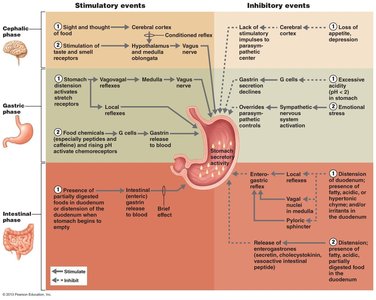
Gastric secretion is regulated by neural and hormonal mechanisms, occurring in three phases: cephalic, gastric, and intestinal.
Cephalic Phase: Triggered by sight, smell, taste, or thought of food; prepares stomach for digestion.
Gastric Phase: Begins when food enters the stomach; distension and food chemicals stimulate secretion of gastric juice, mainly via gastrin.
Intestinal Phase: Has excitatory (intestinal gastrin release) and inhibitory (enterogastric reflex) components; regulates gastric emptying and prevents overfilling of the duodenum.
Gastric Contractile Activity and Emptying
Peristaltic waves mix and propel chyme toward the pyloric valve.
Only small amounts of chyme enter the duodenum at a time.
Gastric emptying is regulated by meal size, composition, and duodenal feedback mechanisms.
Small Intestine
Major site for digestion and absorption.
Receives bile (from liver/gallbladder), pancreatic enzymes, and bicarbonate ions for digestion.
Brunner’s glands in the duodenum secrete alkaline mucus to neutralize acidic chyme.
Most absorption occurs in the duodenum and jejunum; ileum reclaims bile salts.
Nutrients are absorbed via active transport, facilitated diffusion, and cotransport mechanisms.
Absorption Mechanisms
Carbohydrates: Glucose and galactose absorbed via Na+-cotransport; fructose by facilitated diffusion.
Proteins: Amino acids absorbed via Na+-cotransport; short peptides are further digested before absorption.
Lipids: Bile salts form micelles with fatty acids and monoglycerides, which diffuse into epithelial cells, are reassembled into triglycerides, and transported as chylomicrons via lacteals.
Nucleic Acids: Absorbed as pentose sugars, nitrogenous bases, and phosphate ions by active transport.
Vitamins: Fat-soluble vitamins (A, D, E, K) require dietary fat for absorption; water-soluble vitamins absorbed by diffusion; vitamin B12 requires intrinsic factor.
Liver and Gall Bladder
Liver: Produces bile, which emulsifies fats for digestion and absorption.
Gall Bladder: Stores and concentrates bile for release into the small intestine.
Pancreas
Exocrine function: Secretes pancreatic juice (water, enzymes, bicarbonate) into the small intestine for digestion of all macronutrients.
Large Intestine
Absorbs remaining water and electrolytes; forms and stores feces.
Contains numerous goblet cells for mucus secretion, aiding fecal passage and protecting the mucosa.
Bacterial Flora: Ferments indigestible carbohydrates, synthesizes B vitamins and vitamin K.
Motility and Defecation
Haustral contractions and mass movements propel feces toward the rectum.
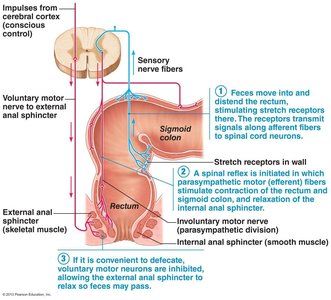
Defecation reflex is initiated by rectal wall stretching, involving both involuntary (internal anal sphincter) and voluntary (external anal sphincter) control.
Summary Table: Digestive Enzymes and Their Actions
Macromolecule | Site of Digestion | Enzymes Involved | End Products |
|---|---|---|---|
Carbohydrates | Mouth, Small Intestine | Salivary amylase, Pancreatic amylase, Brush border enzymes | Monosaccharides |
Proteins | Stomach, Small Intestine | Pepsin, Trypsin, Chymotrypsin, Carboxypeptidase, Brush border enzymes | Amino acids |
Lipids | Small Intestine | Pancreatic lipase, Bile salts (emulsification) | Monoglycerides, Fatty acids |
Nucleic Acids | Small Intestine | Pancreatic nucleases, Brush border enzymes | Nucleotides, Nitrogenous bases, Pentose sugars, Phosphate ions |
Key Equations
General Hydrolysis Reaction:
Additional info: The notes above expand on the original lecture outline, providing definitions, mechanisms, and examples for each digestive process and organ. The included images directly support the explanations of stomach structure, regulation of gastric secretion, and the defecation reflex.
