Back
BackThe Digestive System: Structure, Function, and Chemical Digestion
Study Guide - Smart Notes
 Tailored notes based on your materials, expanded with key definitions, examples, and context.
The Digestive System
Overview of Digestive Organs
The digestive system is composed of two main groups of organs: the alimentary canal and accessory organs. Together, these structures are responsible for the breakdown, absorption, and elimination of food substances.
Alimentary Canal: A continuous tube running from the mouth to the anus, consisting of four basic layers.
Accessory Organs: Organs not part of the alimentary canal but connected to it, aiding in the digestive process (e.g., liver, gallbladder, pancreas).
Digestive Processes
Digestion involves several coordinated processes that ensure the breakdown and absorption of nutrients:
Ingestion: Taking food into the digestive tract.
Secretion: Release of digestive fluids and enzymes.
Propulsion: Movement of food through the tract (e.g., peristalsis).
Mechanical Digestion: Physical breakdown of food (e.g., chewing, churning).
Chemical Digestion: Enzymatic breakdown of macromolecules into absorbable units.
Absorption: Transport of digested nutrients into the blood or lymph.
Defecation: Elimination of indigestible substances as feces.
Stomach
Microscopic Anatomy of the Stomach
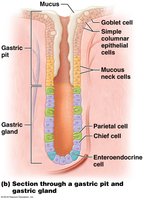
The stomach lining is specialized for secretion and protection. It consists of simple columnar epithelium that secretes mucus, with gastric pits leading to gastric glands containing various secretory cells.
Gastric pits: Indentations in the stomach lining leading to glands.
Gastric glands: Contain cells that produce gastric juice, essential for digestion.
Secretory cells:
Mucous neck cells: Secrete mucus for protection.
Parietal cells: Produce hydrochloric acid (HCl) and intrinsic factor.
Chief cells: Secrete pepsinogen, the precursor to pepsin.
Enteroendocrine cells: Release hormones such as gastrin.
Digestive Processes of the Stomach
The stomach performs both mechanical and chemical digestion, preparing food for further processing in the small intestine.
Mechanical breakdown: Churning of ingested food to form chyme.
Protein digestion: Initiated by pepsin.
Chyme delivery: Regulated release of chyme into the small intestine.
Rennin: Enzyme for milk breakdown in children.
Regulation of Gastric Secretions
Gastric secretions are regulated in three phases:
Cephalic phase: Triggered by the sight, smell, or thought of food (before food enters the stomach).
Gastric phase: Begins when food enters the stomach.
Intestinal phase: Initiated as food leaves the stomach and enters the small intestine.
Gastric Motility and Emptying
The stomach mixes and propels food, regulating the rate at which chyme enters the small intestine.
Gastric motility: Movement and mixing of stomach contents.
Gastric contractile activity: Peristaltic waves move food toward the pylorus.
Gastric emptying: Typically occurs over ~4 hours.
Vomiting: Forceful expulsion of stomach contents, triggered by various factors.
Small Intestines
The small intestine is the primary site for digestion and absorption of nutrients. It receives chyme from the stomach and secretions from accessory organs.
Accessory Organs
Liver
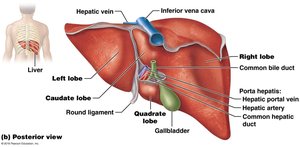
The liver is a vital organ with numerous metabolic and regulatory functions. Its main digestive role is the production of bile, which emulsifies fats to aid in their absorption.
Bile: A yellow-green fluid (500-1000 mL/day) containing bile salts and bilirubin, responsible for fat emulsification and the brown color of feces.
Other Liver Functions
Nutrient metabolism: Processes nutrients absorbed from the digestive tract.
Detoxification: Removes or neutralizes toxins from the blood.
Excretion: Excretes bilirubin and other substances in bile; modifies compounds for renal excretion.
Gallbladder
The gallbladder is a muscular sac that stores and concentrates bile produced by the liver. It releases bile into the small intestine during digestion.
Gallstones: Formed by cholesterol crystallization, potentially blocking bile flow.
Pancreas
The pancreas is located behind the stomach and has both endocrine and exocrine functions. Its exocrine role is to secrete pancreatic juice containing digestive enzymes and bicarbonate ions.
Acinar cells: Produce enzyme-rich pancreatic juice.
Duct cells: Secrete bicarbonate to neutralize stomach acid.
Large Intestines
Structure and Function
The large intestine absorbs water and electrolytes, forms feces, and houses beneficial bacteria (bacterial flora).
Bacterial flora: Ferment indigestible carbohydrates, synthesize vitamins B and K, and inhibit harmful bacteria.
Motility: Involves haustral contractions and mass movements.
Defecation reflex: Triggered by rectal filling, mediated by the parasympathetic nervous system.
Physiology of Chemical Digestion
Overview of Chemical Digestion
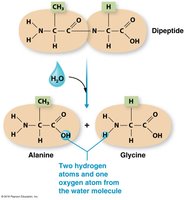
Chemical digestion is a catabolic process in which large food molecules are broken down into smaller, absorbable units by enzymes, primarily through hydrolysis reactions.
Hydrolysis: The addition of water to break chemical bonds in macromolecules.
Enzymes: Biological catalysts that speed up digestion.
Absorption: Occurs after molecules are broken down; food is considered "outside" the body until absorbed.
Chemical Digestion of Carbohydrates
Carbohydrate digestion begins in the mouth and continues in the small intestine. Most dietary carbohydrates are starches, with some simple sugars.
Salivary amylase: Initiates starch digestion in the mouth; inactivated by stomach acid.
Pancreatic amylase: Continues starch digestion in the small intestine.
Absorption: Final products are delivered to the liver for processing.
Chemical Digestion of Proteins
Protein digestion starts in the stomach and is completed in the small intestine.
Pepsin: Formed from pepsinogen in the stomach; begins protein breakdown.
Trypsin: Activated from trypsinogen in the small intestine; continues protein digestion.
End products: Oligopeptides and free amino acids, absorbed and sent to the liver.
Chemical Digestion of Lipids
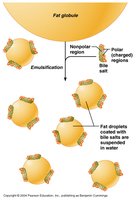
Lipid digestion occurs mainly in the small intestine and requires emulsification by bile salts before enzymatic breakdown by lipases.
Lipases: Enzymes that digest fats into fatty acids and monoglycerides.
Bile salts: Emulsify fats, increasing surface area for enzyme action.
Absorption: Lipid digestion products are not delivered immediately to the liver.