 Back
BackThe Endocrine System: Overview and Comparison with the Nervous System
Study Guide - Smart Notes
 Tailored notes based on your materials, expanded with key definitions, examples, and context.
The Endocrine System: An Introduction
Overview of Body Control Systems
The human body maintains homeostasis and coordinates complex processes through two major control systems: the nervous system and the endocrine system. While both systems are essential for regulation, they differ significantly in their mechanisms, speed, and duration of action.
Nervous System: Utilizes electrical impulses (action potentials) and neurotransmitters for rapid, short-lived, and localized responses.
Endocrine System: Employs hormones—chemical messengers released into the bloodstream—for slower, longer-lasting, and widespread effects.
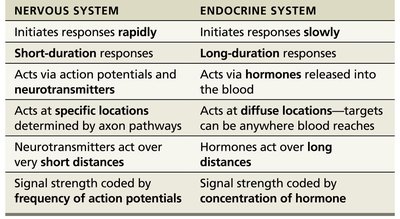
Table Purpose: This table compares the key features of the nervous and endocrine systems, highlighting differences in response time, duration, signaling mechanisms, and target specificity.
Major Endocrine Organs and Their Locations
The endocrine system consists of several ductless glands distributed throughout the body. These glands secrete hormones directly into the surrounding tissue fluid, which then enter the bloodstream to reach distant targets. The major endocrine organs include:
Pituitary gland (base of the brain)
Thyroid gland (anterior neck)
Parathyroid glands (posterior aspect of the thyroid gland)
Adrenal glands (on top of the kidneys)
Pineal gland (deep in the brain)
Hypothalamus (brain; considered a neuroendocrine organ)
Pancreas (abdomen, behind the stomach)
Gonads (ovaries in females, testes in males)
Placenta (temporary organ during pregnancy)
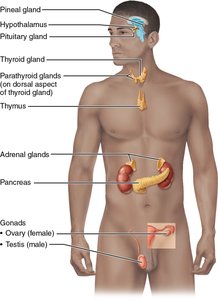
Figure Purpose: This figure illustrates the anatomical locations of the major endocrine organs in the human body.
Types of Glands: Exocrine vs. Endocrine
Glands in the body are classified based on their products and the presence or absence of ducts:
Exocrine glands: Produce nonhormonal substances (e.g., sweat, saliva) and secrete them via ducts to epithelial surfaces.
Endocrine glands: Ductless glands that secrete hormones into the extracellular fluid, which then diffuse into the blood or lymph.
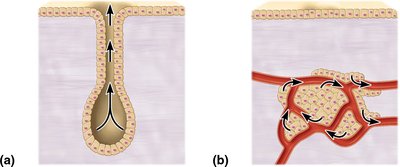
Figure Purpose: This image compares the structure and secretion pathways of exocrine (a) and endocrine (b) glands.
Hormones, Paracrines, and Autocrines: Definitions and Differences
Chemical signaling in the body can be classified by the distance over which the signal acts:
Hormones: Long-distance chemical messengers that travel in the blood or lymph to affect distant target cells throughout the body.
Paracrines: Local chemical messengers that act on neighboring cells within the same tissue (e.g., somatostatin inhibiting insulin release in the pancreas).
Autocrines: Local chemical messengers that act on the same cells that secrete them (e.g., prostaglandins causing smooth muscle contraction in the same cell type).
Note: While some physiologists include paracrines and autocrines as part of the endocrine system, this is not universally accepted.
Major Functions of the Endocrine System
Hormones regulate a wide range of physiological processes, including:
Reproduction
Growth and development
Maintenance of electrolyte, water, and nutrient balance in the blood
Regulation of cellular metabolism and energy balance
Mobilization of body defenses
Summary Table: Nervous vs. Endocrine System
Nervous System | Endocrine System |
|---|---|
Initiates responses rapidly | Initiates responses slowly |
Short-duration responses | Long-duration responses |
Acts via action potentials and neurotransmitters | Acts via hormones released into the blood |
Acts at specific locations (axon pathways) | Acts at diffuse locations (anywhere blood reaches) |
Neurotransmitters act over very short distances | Hormones act over long distances |
Signal strength coded by frequency of action potentials | Signal strength coded by concentration of hormone |
Key Terms
Endocrinology: The scientific study of hormones and endocrine organs.
Hormone: A chemical messenger secreted by endocrine cells into the blood, affecting distant target cells.
Paracrine: A chemical messenger acting locally on neighboring cells.
Autocrine: A chemical messenger acting on the same cell that secretes it.
Example Application
Somatostatin (paracrine): Released by pancreatic cells to inhibit insulin secretion by neighboring cells.
Prostaglandins (autocrine): Released by smooth muscle cells to induce contraction in the same cells.
Self-Check Questions
For each of the following statements, indicate whether it applies more to the endocrine system or the nervous system: rapid; discrete responses; controls growth and development; long-lasting responses.
Which two endocrine glands are found in the neck?
What is the difference between a hormone and a paracrine?
Which gland below is an endocrine gland and which is an exocrine gland? How can you tell?
Additional info: The thyroid and parathyroid glands are the two endocrine glands found in the neck. Endocrine glands lack ducts and secrete hormones into the blood, while exocrine glands have ducts and secrete nonhormonal substances to epithelial surfaces.
