 Back
BackThe Endocrine System: Regulation of Energy Metabolism and Growth
Study Guide - Smart Notes
 Tailored notes based on your materials, expanded with key definitions, examples, and context.
The Endocrine System: Regulation of Energy Metabolism and Growth
Overview of Whole-Body Metabolism
Whole-body metabolism refers to the integrated processes by which the body manages energy intake, utilization, and storage. These processes are tightly regulated to meet the body's energy demands and maintain homeostasis.
Anabolism: The synthesis of large molecules from smaller ones, requiring energy input. Examples include protein synthesis and glycogen formation.
Catabolism: The breakdown of large molecules into smaller ones, releasing energy. Examples include glycolysis and lipolysis.
Regulation of Metabolic Pathways:
Enzyme Regulation: Metabolic pathways are controlled by the concentration and modulation of enzymes.
Compartmentation: Enzymes are localized in specific cells, tissues, or organelles, allowing for specialization and regulation of metabolic processes.
Energy Intake, Utilization, and Storage
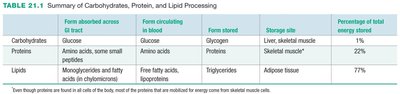
Nutrients are absorbed from the digestive tract and transported in the blood to cells, where they are used for energy, synthesis of new molecules, or storage. The three main classes of nutrients are carbohydrates, proteins, and lipids.
Carbohydrates: Absorbed as monosaccharides (mainly glucose), transported in blood, and used for energy or stored as glycogen.
Proteins: Absorbed as amino acids, dipeptides, and tripeptides, transported in blood as amino acids, used for protein synthesis, or catabolized for energy.
Lipids: Absorbed as triglycerides, transported as lipoproteins, broken down into fatty acids and monoglycerides, used for energy, or stored as triglycerides in adipose tissue.
Class | Form absorbed across GI tract | Form circulating in blood | Form stored | Storage site | Percentage of total energy stored |
|---|---|---|---|---|---|
Carbohydrates | Glucose | Glucose | Glycogen | Liver, skeletal muscle | 1% |
Proteins | Amino acids, some small peptides | Amino acids | Proteins | Skeletal muscle* | 22% |
Lipids | Monoglycerides and fatty acids (in chylomicrons) | Free fatty acids, lipoproteins | Triglycerides | Adipose tissue | 77% |
*Additional info: Even though proteins are found in all cells, most of the proteins that are metabolized for energy come from skeletal muscle cells.
Uptake, Utilization, and Storage of Energy in Carbohydrates
Carbohydrates are primarily absorbed as glucose, which circulates in the blood and enters cells via glucose transporters. Inside cells, glucose can be oxidized for energy, converted to other compounds, or stored as glycogen.
Cellular Respiration: Glucose is oxidized to produce carbon dioxide, water, and energy.
Glycogenesis: Formation of glycogen from glucose for storage.
Glycogenolysis: Breakdown of glycogen to release glucose when needed.
Uptake, Utilization, and Storage of Energy in Proteins
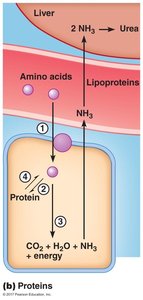
Proteins are absorbed as amino acids, dipeptides, and tripeptides. Amino acids circulate in the blood and enter cells via specific transporters. They are used for protein synthesis or catabolized for energy, producing carbon dioxide, ammonia, and urea.
Protein Synthesis: Amino acids are used to build new proteins.
Proteolysis: Breakdown of proteins to amino acids for energy production.
Urea Cycle: Ammonia produced during amino acid catabolism is converted to urea in the liver for excretion.
Uptake, Utilization, and Storage of Energy in Lipids
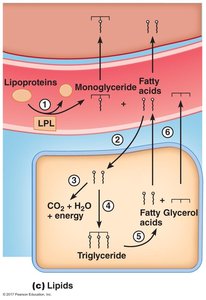
Lipids are absorbed as triglycerides, which are transported in the blood as lipoproteins. Lipoprotein lipase breaks down triglycerides into fatty acids and monoglycerides, which enter cells by diffusion. Fatty acids are used for energy, stored as triglycerides, or exported as needed.
Lipoprotein Lipase (LPL): Enzyme that hydrolyzes triglycerides in lipoproteins to release fatty acids and monoglycerides.
Lipid Storage: Most triglycerides are stored in adipocytes (fat cells).
Lipolysis: Breakdown of triglycerides to fatty acids and glycerol for energy production.
Energy Balance
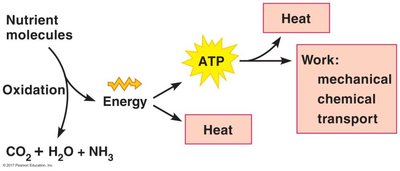
Energy balance is achieved when energy intake equals energy output. Energy is used for cellular work (mechanical, chemical, and transport) and is also lost as heat. The endocrine system plays a key role in regulating energy balance by controlling nutrient pools and storage.
Energy Input: Nutrients consumed in the diet.
Energy Output: Work (40%) and heat (60%).
Cellular Work: Includes mechanical (muscle contraction), chemical (biosynthesis), and transport (active transport across membranes).
Metabolic Rate
Metabolic rate is the rate at which the body expends energy. The basal metabolic rate (BMR) is the minimum energy expenditure required to maintain basic physiological functions at rest. Metabolic rate increases with activity and is influenced by factors such as muscle activity, gender, body surface area, and environmental temperature.
BMR: Measured under standardized conditions (awake, resting, fasting, thermoneutral environment).
MR = BMR + additional energy expenditure
Influencing Factors: Muscle activity, age, gender, body composition, and temperature.
Negative and Positive Energy Balance
Energy balance can be positive or negative depending on the relationship between energy intake and output.
Positive Energy Balance: Energy intake exceeds energy output; excess energy is stored, leading to weight gain.
Negative Energy Balance: Energy output exceeds energy intake; stored energy is used, leading to weight loss.
Equations:
Energy stored = energy intake – energy output
Energy deficit = energy output – energy intake
