 Back
BackThe Endocrine System: Structure, Function, and Regulation
Study Guide - Smart Notes
 Tailored notes based on your materials, expanded with key definitions, examples, and context.
The Endocrine System
Overview of the Endocrine System
The endocrine system is a network of glands and tissues that produce hormones to regulate various physiological processes throughout the body. Unlike the nervous system, which uses electrical signals for rapid communication, the endocrine system relies on chemical messengers (hormones) that travel through the bloodstream to target organs, producing effects that are often slower but longer-lasting.
Hormones: Chemical messengers secreted by endocrine glands into the blood or interstitial fluid.
Target Cells: Cells with specific receptors that bind and respond to particular hormones.
Functions: Regulation of metabolism, growth, development, tissue function, and homeostasis.
Mechanisms of Intercellular Communication
Types of Communication
Cells communicate through several mechanisms, each with distinct characteristics and roles in physiological regulation:
Direct Communication: Exchange of ions and molecules between adjacent cells via gap junctions; rare and highly specialized.
Paracrine Communication: Chemical signals transfer information between cells within a single tissue.
Autocrine Communication: Cells respond to signals they themselves secrete (e.g., prostaglandins).
Endocrine Communication: Endocrine cells release hormones into the bloodstream, affecting distant target cells.
Synaptic Communication: Neurons release neurotransmitters at synapses for rapid, targeted responses.
Classes of Hormones
Chemical Structure and Examples
Hormones are classified based on their chemical structure, which determines their solubility, transport, and mechanism of action:
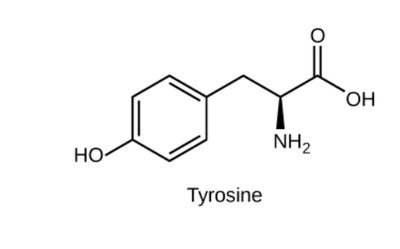
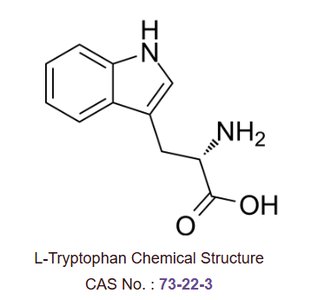
Amino Acid Derivatives (Biogenic Amines): Derived from tyrosine or tryptophan. Examples include thyroid hormones, catecholamines (epinephrine, norepinephrine, dopamine), serotonin, and melatonin.
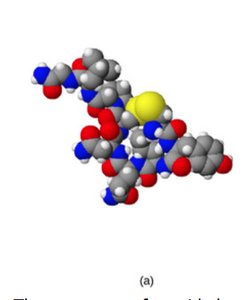
Peptide Hormones: Chains of amino acids, ranging from short peptides (e.g., ADH, OXT) to large proteins (e.g., insulin, growth hormone). Most are synthesized as inactive prohormones.
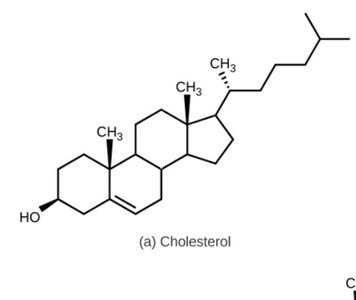
Lipid Derivatives: Includes eicosanoids (from arachidonic acid) and steroid hormones (from cholesterol). Steroid hormones include androgens, estrogens, progesterone, corticosteroids, and calcitriol.
Hormone Transport and Receptor Binding
Transport in Blood
Hormones may circulate freely or be bound to carrier proteins. Free hormones are rapidly inactivated, while bound hormones (e.g., thyroid and steroid hormones) remain functional longer and serve as a reservoir.
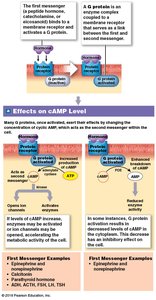
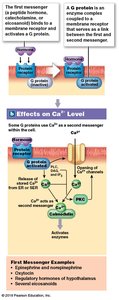
Water-Soluble Hormones: (e.g., peptide hormones, catecholamines) bind to extracellular receptors on target cells because they cannot cross the plasma membrane.
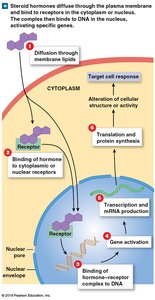
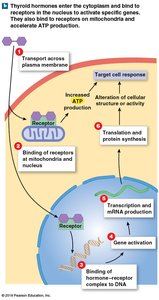
Lipid-Soluble Hormones: (e.g., steroid and thyroid hormones) diffuse across the plasma membrane and bind to intracellular receptors.
Mechanisms of Hormone Action
First Messenger: The hormone that binds to a receptor on the cell surface.
Second Messenger: Intracellular signaling molecules (e.g., cAMP, Ca2+) that amplify the hormone's effect.
Amplification: A single hormone-receptor interaction can generate thousands of second messengers, greatly magnifying the response.
Intracellular Receptors and Gene Regulation
Steroid and thyroid hormones can alter gene expression by binding to intracellular receptors, affecting transcription and protein synthesis. This leads to long-term changes in cell function.
Regulation of Hormone Secretion
Feedback Mechanisms
Hormone secretion is primarily regulated by negative feedback, which maintains homeostasis. Stimuli can be humoral (changes in blood composition), hormonal (other hormones), or neural (nervous system input).
Major Endocrine Organs and Their Hormones
Hypothalamus and Pituitary Gland
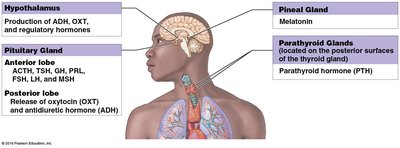
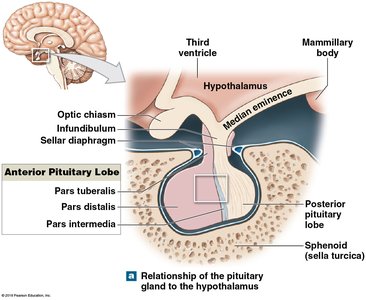
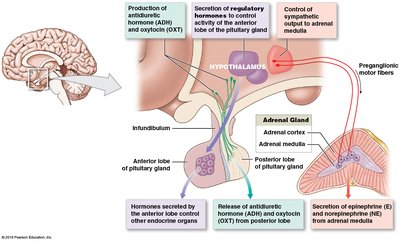
The hypothalamus links the nervous and endocrine systems, controlling the pituitary gland through regulatory hormones and direct neural connections. The pituitary gland (hypophysis) is divided into anterior (adenohypophysis) and posterior (neurohypophysis) lobes, each releasing specific hormones.
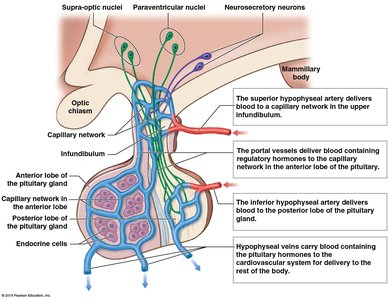
Anterior Pituitary Hormones
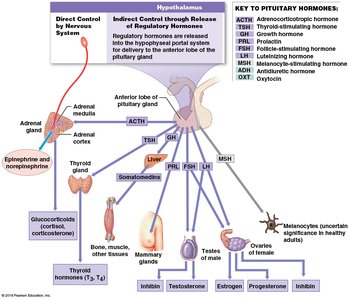
TSH (Thyroid-stimulating hormone): Stimulates thyroid hormone release.
ACTH (Adrenocorticotropic hormone): Stimulates adrenal cortex to release glucocorticoids.
PRL (Prolactin): Stimulates milk production.
GH (Growth hormone): Stimulates growth and metabolism.
FSH (Follicle-stimulating hormone) & LH (Luteinizing hormone): Regulate gonadal function.
MSH (Melanocyte-stimulating hormone): Stimulates melanin production (mainly in certain conditions).
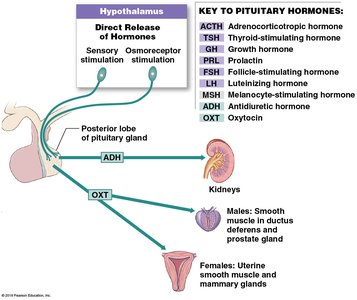
Posterior Pituitary Hormones
ADH (Antidiuretic hormone): Promotes water reabsorption in kidneys.
OXT (Oxytocin): Stimulates uterine contractions and milk ejection.
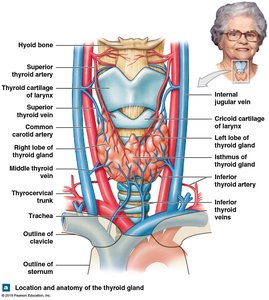
Thyroid Gland
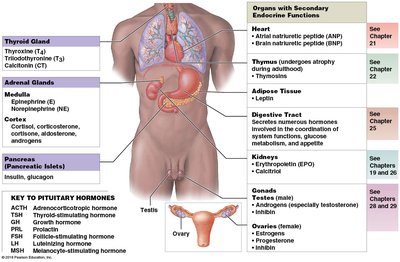
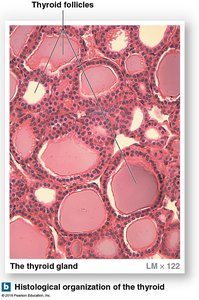
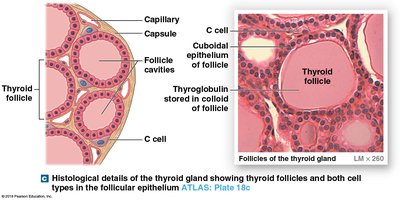
The thyroid gland produces thyroid hormones (T3 and T4) that regulate metabolism, growth, and development. It also secretes calcitonin, which lowers blood calcium levels.
Parathyroid Glands
Located on the posterior surface of the thyroid gland, the parathyroid glands secrete parathyroid hormone (PTH), which increases blood calcium levels by stimulating osteoclasts, enhancing kidney reabsorption, and promoting calcitriol synthesis.
Adrenal Glands
The adrenal glands are located on top of the kidneys and consist of two regions:
Adrenal Cortex: Produces corticosteroids (aldosterone, cortisol, androgens).
Adrenal Medulla: Produces catecholamines (epinephrine and norepinephrine) for the fight-or-flight response.
Pineal Gland
The pineal gland secretes melatonin, which regulates circadian rhythms and reproductive timing.
Pancreas
The pancreas has both exocrine and endocrine functions. The endocrine portion (pancreatic islets) secretes insulin (lowers blood glucose) and glucagon (raises blood glucose).
Other Endocrine Tissues
Heart: Cardiovascular system
Kidneys: Urinary system
Intestines: Digestive system
Thymus: Lymphatic system
Gonads: Reproductive system
Hormones and Growth
Growth Hormone (GH): Essential for growth and metabolism.
Thyroid Hormones: Required for normal development of the nervous and skeletal systems.
Insulin: Permits glucose and amino acid uptake for growth.
PTH and Calcitriol: Promote calcium absorption and bone deposition.
Reproductive Hormones: Influence growth and development of sex-specific tissues.
Aging and the Endocrine System
Decline in reproductive hormones and responsiveness of some endocrine tissues.
Potential effects on behavior, cognition, and metabolism.
