 Back
BackThe Endocrine System: Structure, Function, and Regulation
Study Guide - Smart Notes
 Tailored notes based on your materials, expanded with key definitions, examples, and context.
Endocrine System Overview
Introduction to the Endocrine System
The endocrine system is a complex network of glands and tissues that produce and secrete hormones to regulate various physiological processes. It plays a critical role in maintaining homeostasis, growth, metabolism, and reproduction. Hormones are chemical messengers that travel through the bloodstream to target organs and tissues, eliciting specific responses.
Endocrine glands are ductless and release hormones directly into the bloodstream.
Exocrine glands have ducts and release their products onto epithelial surfaces.
The endocrine system interacts closely with the nervous system to coordinate body functions.
Cell Communication in the Endocrine System
Types of Intercellular Communication
Cells communicate through various mechanisms to coordinate activities and maintain homeostasis. The main types of intercellular communication include:
Direct communication: Via gap junctions allowing small signaling molecules to pass between cells.
Autocrine communication: Cells secrete signals that affect themselves.
Paracrine communication: Signals affect nearby cells in the local environment.
Juxtacrine communication: Signals are bound to the cell membrane and require direct contact with target cells.
Synaptic communication: Neurotransmitters cross synapses to affect adjacent neurons or muscle cells.
Endocrine communication: Hormones are secreted into the bloodstream to affect distant target cells.
Major Endocrine Organs and Hormones
Overview of Major Endocrine Glands
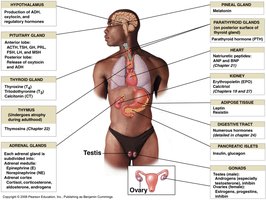
The major endocrine glands include the hypothalamus, pituitary gland, pineal gland, thyroid gland, parathyroid glands, thymus, adrenal glands, pancreas, ovaries, and testes. Each gland produces specific hormones that regulate vital body functions.
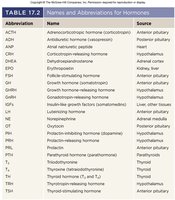
Table: Names and Abbreviations for Hormones
Abbreviation | Name | Source |
|---|---|---|
ACTH | Adrenocorticotropic hormone | Anterior pituitary |
ADH | Antidiuretic hormone | Posterior pituitary |
CRH | Corticotropin-releasing hormone | Hypothalamus |
FSH | Follicle-stimulating hormone | Anterior pituitary |
GH | Growth hormone | Anterior pituitary |
GnRH | Gonadotropin-releasing hormone | Hypothalamus |
LH | Luteinizing hormone | Anterior pituitary |
OT | Oxytocin | Posterior pituitary |
PRL | Prolactin | Anterior pituitary |
TRH | Thyrotropin-releasing hormone | Hypothalamus |
TSH | Thyroid-stimulating hormone | Anterior pituitary |
Hypothalamus and Pituitary Gland
Hypothalamic Control of the Pituitary
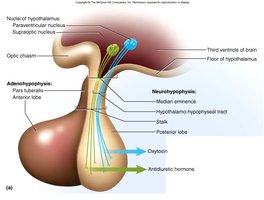
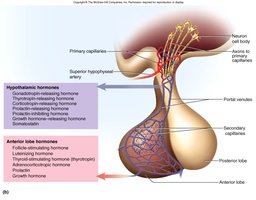
The hypothalamus is a key regulatory center in the brain that controls the pituitary gland through releasing and inhibiting hormones. It also produces oxytocin and antidiuretic hormone (ADH), which are stored and released by the posterior pituitary.
The hypothalamus regulates the anterior pituitary via the hypophyseal portal system.
It controls the posterior pituitary through neuroendocrine reflexes.
Hypothalamic Releasing and Inhibiting Hormones
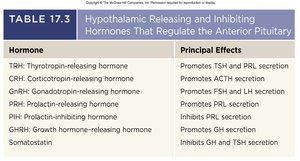
Hormone | Principal Effects |
|---|---|
TRH | Promotes TSH and PRL secretion |
CRH | Promotes ACTH secretion |
GnRH | Promotes FSH and LH secretion |
PRH | Promotes PRL secretion |
PIH | Inhibits PRL secretion |
GHRH | Promotes GH secretion |
Somatostatin | Inhibits GH and TSH secretion |
Pituitary Gland Structure and Function
The pituitary gland, or hypophysis, is divided into the anterior lobe (adenohypophysis) and posterior lobe (neurohypophysis). The anterior lobe produces several trophic hormones that regulate other endocrine glands, while the posterior lobe stores and releases hormones produced by the hypothalamus.
Anterior pituitary hormones: FSH, LH, TSH, ACTH, PRL, GH
Posterior pituitary hormones: ADH, oxytocin
Hormone Mechanisms and Regulation
Hormone Classes and Synthesis
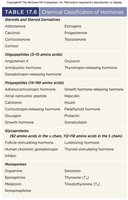
Hormones are classified based on their chemical structure:
Lipid derivatives: Steroid hormones (e.g., cortisol, estrogen) and eicosanoids (e.g., prostaglandins).
Amino acid derivatives: Catecholamines (e.g., epinephrine), thyroid hormones, melatonin.
Peptide hormones: Chains of amino acids (e.g., insulin, ADH, GH).
Hormone Transport and Receptors
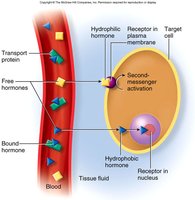
Hormones travel in the blood either freely (hydrophilic hormones) or bound to transport proteins (hydrophobic hormones). Hormones exert their effects by binding to specific receptors on or in target cells.
Hydrophilic hormones bind to cell-surface receptors and often use second messenger systems (e.g., cAMP).
Hydrophobic hormones penetrate the cell membrane and bind to intracellular receptors, directly affecting gene expression.
Hormone Regulation: Feedback Mechanisms
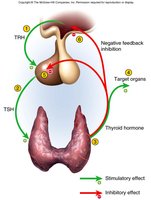
Hormone secretion is tightly regulated by feedback loops:
Negative feedback: Increased hormone levels inhibit further secretion (e.g., thyroid hormone regulation).
Positive feedback: Hormone action stimulates further secretion (e.g., oxytocin during childbirth).
Major Endocrine Disorders
Pituitary Disorders
Hypersecretion of growth hormone: Causes gigantism in children and acromegaly in adults.
Hyposecretion of growth hormone: Results in pituitary dwarfism.
Thyroid Disorders
Hypothyroidism: Congenital or adult onset (myxedema), leading to low metabolic rate, lethargy, and weight gain.
Goiter: Enlargement of the thyroid gland, often due to iodine deficiency.
Graves disease: Autoimmune hyperthyroidism with exophthalmos.
Parathyroid Disorders
Hypoparathyroidism: Can cause fatal tetany due to low blood calcium.
Hyperparathyroidism: Leads to bone fragility and elevated blood calcium.
Adrenal Disorders
Cushing syndrome: Excess cortisol, causing hyperglycemia, muscle loss, and fat redistribution.
Adrenogenital syndrome: Excess adrenal androgens, causing masculinization.
Diabetes Mellitus
Type I: Autoimmune destruction of beta cells, requiring insulin therapy.
Type II: Insulin resistance, often associated with obesity and age.
Symptoms include polyuria, polydipsia, polyphagia, and chronic complications such as neuropathy and cardiovascular disease.
Summary Table: Endocrine Glands and Major Hormones
Gland | Hormone(s) | Main Function(s) |
|---|---|---|
Hypothalamus | Releasing/inhibiting hormones, ADH, oxytocin | Regulates pituitary, water balance, uterine contraction |
Pituitary (anterior) | FSH, LH, TSH, ACTH, PRL, GH | Regulates other endocrine glands, growth, lactation |
Pituitary (posterior) | ADH, oxytocin | Water retention, uterine contraction, milk ejection |
Pineal gland | Melatonin | Regulates circadian rhythms |
Thyroid gland | T3, T4, calcitonin | Metabolism, calcium regulation |
Parathyroid glands | PTH | Increases blood calcium |
Adrenal cortex | Cortisol, aldosterone, androgens | Stress response, electrolyte balance, sex hormones |
Adrenal medulla | Epinephrine, norepinephrine | Fight-or-flight response |
Pancreas | Insulin, glucagon, somatostatin | Blood glucose regulation |
Ovaries | Estrogen, progesterone | Female reproductive function |
Testes | Testosterone | Male reproductive function |
Additional info: This guide integrates and expands upon the provided lecture notes and images, ensuring a comprehensive overview suitable for ANP college students.
