 Back
The Endocrine System: Structure, Function, and Regulation
Study Guide - Smart Notes
 Tailored notes based on your materials, expanded with key definitions, examples, and context.
The Endocrine System
Overview and Major Functions
The endocrine system is one of the body’s two major control systems, working alongside the nervous system to coordinate and integrate the activity of most body cells. It uses hormones—chemical messengers transported in the blood—to influence metabolic activities. Endocrine responses are generally slower but longer-lasting than nervous system responses. The study of hormones and endocrine organs is called endocrinology.
Major processes controlled by the endocrine system:
Reproduction
Growth and development
Maintenance of electrolyte, water, and nutrient balance
Regulation of cellular metabolism and energy balance
Mobilization of body defenses
Comparison of Nervous and Endocrine Systems
The nervous and endocrine systems differ in their signaling mechanisms, speed, and duration of effects.
Feature | Nervous System | Endocrine System |
|---|---|---|
Response initiation | Rapid | Slow |
Duration | Short | Long |
Signal type | Action potentials, neurotransmitters | Hormones in blood |
Target location | Specific (axon pathways) | Diffuse (anywhere blood reaches) |
Distance of action | Short | Long |
Signal strength coding | Frequency of action potentials | Hormone concentration |
Endocrine vs. Exocrine Glands
Exocrine glands: Produce nonhormonal substances (e.g., sweat, saliva); have ducts to carry secretions to membrane surfaces.
Endocrine glands: Produce hormones; ductless; secrete hormones directly into extracellular fluid. Major glands include the pituitary, thyroid, parathyroid, adrenal, and pineal glands. The hypothalamus is a neuroendocrine organ. Other organs with endocrine tissue include the pancreas, gonads, placenta, stomach, intestine, heart, kidneys, skin, thymus, bone, and adipose tissue.
Chemical Messengers
Hormones: Long-distance chemical signals that travel in blood to target cells.
Autocrines: Chemicals that exert effects on the same cells that secrete them.
Paracrines: Locally acting chemicals that affect neighboring cells.
Autocrines and paracrines are local messengers, not considered part of the endocrine system.
Chemical Structure and Classification of Hormones
Hormone Classes
The chemical structure of a hormone determines its solubility in water, which affects its transport, degradation, and receptor interaction.
Amino acid–based hormones: Includes amino acid derivatives, peptides, and proteins. Most are water-soluble (except thyroxine) and cannot cross the plasma membrane.
Steroid hormones: Synthesized from cholesterol; lipid-soluble and can cross the plasma membrane. Includes gonadal and adrenocortical hormones.
Eicosanoids: Sometimes considered hormones, but most classify them as paracrines and autocrines due to their localized effects.
Mechanisms of Hormone Action
Target Cells and Effects
Only cells with specific receptors for a hormone (target cells) are affected. Hormones alter target cell activity by increasing or decreasing the rates of normal cellular processes.
Alter plasma membrane permeability and/or membrane potential by opening or closing ion channels
Stimulate synthesis of enzymes or other proteins
Activate or deactivate enzymes
Induce secretory activity
Stimulate mitosis
Water-Soluble vs. Lipid-Soluble Hormones
Water-soluble hormones (all amino acid–based except thyroid hormone): Act on plasma membrane receptors, usually via G proteins and second messengers; cannot cross the plasma membrane.
Lipid-soluble hormones (steroid and thyroid hormones): Act on intracellular receptors that directly activate genes; can diffuse across the plasma membrane.
Second Messenger Systems
Most amino acid–based hormones exert effects through second-messenger systems. The two main systems are cyclic AMP (cAMP) and PIP2-calcium.
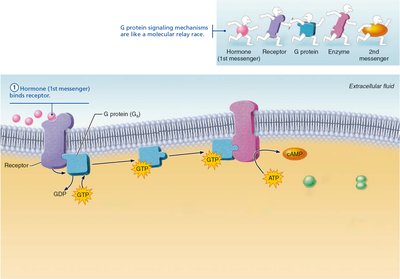
cAMP Signaling Mechanism:
Hormone (first messenger) binds to receptor.
Receptor activates a G protein.
G protein activates (or inhibits) adenylate cyclase.
Adenylate cyclase converts ATP to cAMP (second messenger).
cAMP activates protein kinases that phosphorylate other proteins.
PIP2-Calcium Signaling Mechanism:
Hormone-activated G protein activates phospholipase C.
Phospholipase C splits PIP2 into DAG and IP3.
DAG activates protein kinases; IP3 causes Ca2+ release from intracellular stores.
Calcium ions act as second messengers, often via calmodulin.
Other mechanisms: Some hormones (e.g., insulin) act via tyrosine kinase receptors, not second messengers.
Direct Gene Activation by Lipid-Soluble Hormones
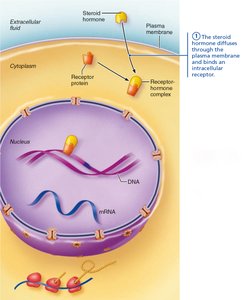
Lipid-soluble hormones and thyroid hormone diffuse into target cells and bind with intracellular receptors. The hormone-receptor complex enters the nucleus, binds to DNA, and initiates transcription to produce mRNA, which is then translated into protein.
Regulation of Hormone Release
Negative Feedback and Stimuli
Blood levels of hormones are controlled by negative feedback mechanisms. Hormone release is triggered by three types of stimuli:
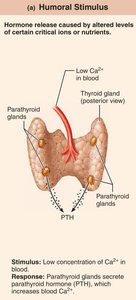
Humoral stimuli: Changing blood levels of ions/nutrients directly stimulate hormone release (e.g., low Ca2+ stimulates PTH release).
Neural stimuli: Nerve fibers stimulate hormone release (e.g., sympathetic fibers stimulate adrenal medulla to secrete catecholamines).
Hormonal stimuli: Hormones stimulate other endocrine organs to release their hormones (e.g., hypothalamic hormones regulate anterior pituitary hormones).

Nervous System Modulation
The nervous system can override or modulate endocrine controls, especially during stress (e.g., overriding insulin to increase blood glucose for fight-or-flight response).
Hormone Activity: Receptors, Half-Life, and Interactions
Target Cell Specificity and Regulation
Target cells must have specific receptors for a hormone.
Degree of activation depends on hormone levels, number of receptors, and receptor affinity.
Up-regulation: Target cells form more receptors in response to low hormone levels.
Down-regulation: Target cells lose receptors in response to high hormone levels.
Half-Life, Onset, and Duration
Hormones circulate either free or bound to plasma proteins (steroids and thyroid hormone are bound; others are free).
Half-life: Time required for hormone level to decrease by half; varies from seconds to a week.
Onset and duration depend on hormone type (water-soluble: rapid onset/short duration; lipid-soluble: slower onset/longer duration).
Interactions of Hormones at Target Cells
Permissiveness: One hormone cannot exert its effects without another hormone present (e.g., reproductive hormones need thyroid hormone).
Synergism: More than one hormone produces the same effect, amplifying the response (e.g., glucagon and epinephrine).
Antagonism: One or more hormones oppose the action of another (e.g., insulin and glucagon).
Summary Table: Lipid- vs. Water-Soluble Hormones
Lipid-soluble hormones | Water-soluble hormones | |
|---|---|---|
Consist of | All steroid hormones and thyroid hormone | All amino acid–based hormones except thyroid hormone |
Sources | Adrenal cortex, gonads, thyroid gland | All other endocrine glands |
Stored in vesicles | No | Yes |
Transport in blood | Bound to plasma proteins | Usually free in plasma |
Half-life | Long (metabolized by liver) | Short (removed by kidneys) |
Receptor location | Inside cell | On plasma membrane |
Mechanism of action | Activate genes, synthesize new proteins | Second-messenger systems |
Additional info:
Equations: For cAMP signaling, the key reaction is
For gene activation:
