Back
The Endocrine System: Structure, Function, and Hormonal Regulation
Study Guide - Smart Notes
 Tailored notes based on your materials, expanded with key definitions, examples, and context.
The Endocrine System
Introduction to Endocrine Glands
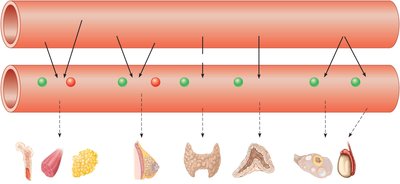
The endocrine system consists of specialized cells, tissues, and organs known as endocrine glands. These glands are ductless and release their secretions, called hormones, directly into the bloodstream to regulate various physiological processes. - Endocrine glands are ductless and utilize the bloodstream for hormone transport. - Hormones are chemical messengers that act on specific target cells with appropriate receptors.
General Characteristics of the Endocrine System
The endocrine and nervous systems both use chemical signals to communicate, but differ in their mechanisms and effects. - Neurons release neurotransmitters into synapses, affecting postsynaptic cells. - Endocrine glands release hormones into the bloodstream, affecting only cells with specific receptors. - Hormones have no effect on cells lacking the appropriate receptor. 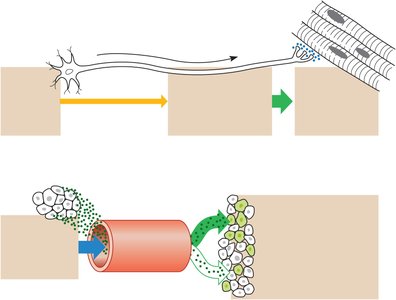
Nervous System | Endocrine System | |
|---|---|---|
Cells | Neurons | Glandular epithelium |
Chemical signal | Neurotransmitter | Hormone |
Specificity of action | Receptors on postsynaptic cell | Receptors on target cell |
Speed of onset | Seconds | Seconds to hours |
Duration of action | Very brief unless neuronal activity continues | May be brief or may last for days even if secretion ceases |
Major Endocrine Glands
The human body contains several major endocrine glands, each with specific functions and hormone products. - Examples include the hypothalamus, pituitary gland, thyroid gland, adrenal glands, pancreas, parathyroid glands, pineal gland, ovaries, and testes. 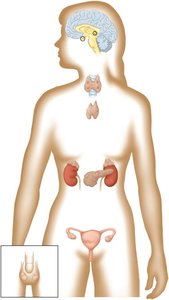
Hormones: Chemistry and Action
Chemistry of Hormones
Hormones are classified based on their chemical structure: - Steroid hormones: Derived from cholesterol; include sex hormones and adrenal cortex hormones. - Non-steroid hormones: Include amines, proteins, and glycoproteins. - Steroid hormones are hydrophobic and can diffuse through cell membranes, while non-steroid hormones are hydrophilic and act via membrane receptors.
Hormone Action: Steroid Hormones
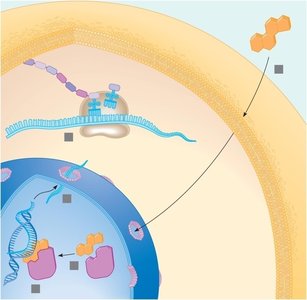
Steroid hormones act by entering target cells and directly influencing gene expression.
Step | Description |
|---|---|
1 | Endocrine gland secretes steroid hormone. |
2 | Steroid hormone diffuses through target cell membrane and enters cytoplasm or nucleus. |
3 | Hormone combines with a receptor molecule in the cytoplasm or nucleus. |
4 | Hormone-receptor complex binds to DNA and promotes transcription of messenger RNA (mRNA). |
5 | mRNA enters the cytoplasm and directs protein synthesis. |
6 | Newly synthesized proteins produce hormone's specific effects. |
Hormone Action: Non-steroid Hormones
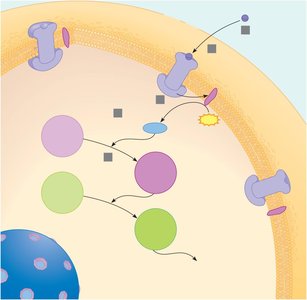
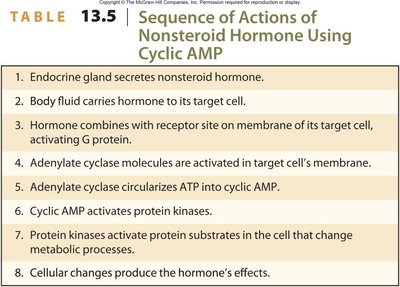
Non-steroid hormones act via membrane-bound receptors and second messenger systems, such as cyclic AMP (cAMP).
Step | Description |
|---|---|
1 | Endocrine gland secretes nonsteroid hormone. |
2 | Body fluid carries hormone to its target cell. |
3 | Hormone combines with receptor site on membrane of its target cell, activating G protein. |
4 | Adenylate cyclase molecules are activated in target cell's membrane. |
5 | Adenylate cyclase circularizes ATP into cyclic AMP. |
6 | Cyclic AMP activates protein kinases. |
7 | Protein kinases activate protein substrates in the cell that change metabolic processes. |
8 | Cellular changes produce the hormone's effects. |
Regulation of Hormonal Secretion
Control of Hormonal Secretions
Hormone secretion is primarily regulated by negative feedback mechanisms, ensuring precise control of hormone levels. - Hormones may be short-lived or persist for days. - Regulation is achieved through feedback from target cells, nervous system input, and changes in plasma substance levels.
Sources of Hormonal Control
There are three main sources of hormonal control: 1. Nervous system stimulation 2. Hormonal stimulation from other endocrine glands 3. Changes in plasma levels of substances
Pituitary Gland (Hypophysis)
Anatomy and Structure
The pituitary gland is located at the base of the brain in the sella turcica and consists of two distinct portions: - Anterior pituitary (adenohypophysis): Controlled by hypothalamic releasing hormones via the hypophyseal portal system. - Posterior pituitary (neurohypophysis): Controlled by hypothalamic nerve impulses. 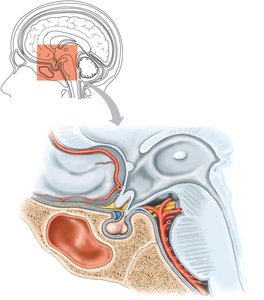
Hormones of the Pituitary Gland
The pituitary gland produces and stores several key hormones, each with specific targets and actions.
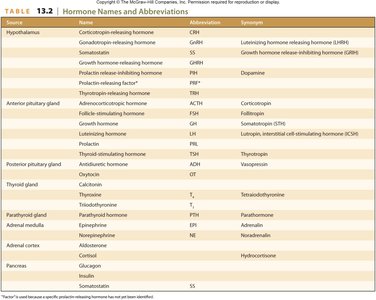
Source | Name | Abbreviation | Synonym |
|---|---|---|---|
Hypothalamus | Corticotropin-releasing hormone | CRH | |
Hypothalamus | Gonadotropin-releasing hormone | GnRH | Luteinizing hormone releasing hormone (LHRH) |
Hypothalamus | Growth hormone-releasing hormone | GHRH | |
Hypothalamus | Growth hormone release-inhibiting hormone | SS | Somatostatin |
Hypothalamus | Prolactin-releasing factor | PRF | |
Hypothalamus | Prolactin release-inhibiting hormone | PIH | Dopamine |
Hypothalamus | Thyrotropin-releasing hormone | TRH | |
Hypothalamus | Corticotropin-releasing hormone | CRH | |
Anterior pituitary gland | Adrenocorticotropic hormone | ACTH | Corticotropin |
Anterior pituitary gland | Follicle-stimulating hormone | FSH | |
Anterior pituitary gland | Growth hormone | GH | Somatotropin |
Anterior pituitary gland | Luteinizing hormone | LH | |
Anterior pituitary gland | Prolactin | PRL | |
Anterior pituitary gland | Thyroid-stimulating hormone | TSH | Thyrotropin |
Posterior pituitary gland | Oxytocin | OT | |
Posterior pituitary gland | Antidiuretic hormone | ADH | Vasopressin |
Anterior Pituitary Hormones
- Growth Hormone (GH): Promotes growth of long bones, increases cell size and division. - Thyroid-Stimulating Hormone (TSH): Stimulates release of T3 and T4 from the thyroid gland. - Adrenocorticotropic Hormone (ACTH): Controls release of hormones from the adrenal cortex, primarily cortisol. - Follicle-Stimulating Hormone (FSH) and Luteinizing Hormone (LH): Target gonads (testes and ovaries). - Prolactin (PRL): Targets mammary glands.
Posterior Pituitary Hormones
- Antidiuretic Hormone (ADH, Vasopressin): Increases water reabsorption in the kidney. - Oxytocin: Stimulates milk let-down from mammary glands and contraction of the uterus.
Summary Table: Sequence of Hormone Actions
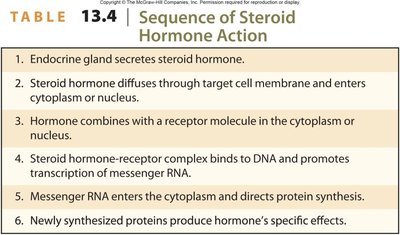
Sequence of Steroid Hormone Action
Step | Description |
|---|---|
1 | Endocrine gland secretes steroid hormone. |
2 | Steroid hormone diffuses through target cell membrane and enters cytoplasm or nucleus. |
3 | Hormone combines with a receptor molecule in the cytoplasm or nucleus. |
4 | Hormone-receptor complex binds to DNA and promotes transcription of messenger RNA. |
5 | Messenger RNA enters the cytoplasm and directs protein synthesis. |
6 | Newly synthesized proteins produce hormone's specific effects. |
Sequence of Actions of Nonsteroid Hormone Using Cyclic AMP
Step | Description |
|---|---|
1 | Endocrine gland secretes nonsteroid hormone. |
2 | Body fluid carries hormone to its target cell. |
3 | Hormone combines with receptor site on membrane of its target cell, activating G protein. |
4 | Adenylate cyclase molecules are activated in target cell's membrane. |
5 | Adenylate cyclase circularizes ATP into cyclic AMP. |
6 | Cyclic AMP activates protein kinases. |
7 | Protein kinases activate protein substrates in the cell that change metabolic processes. |
8 | Cellular changes produce the hormone's effects. |
Key Equations and Concepts
Hormone-Receptor Interaction
The binding of a hormone to its receptor can be represented as:
cAMP Formation
The conversion of ATP to cAMP by adenylate cyclase:
Clinical Relevance
- Hypersecretion of growth hormone in adults leads to acromegaly; in children, it causes giantism. - Hyposecretion during infancy results in pituitary dwarfism.
Summary
The endocrine system is a complex network of glands and hormones that regulate numerous bodily functions through precise chemical signaling. Understanding the chemistry, mechanisms, and regulation of hormone action is essential for comprehending human physiology and disease.