 Back
The Endocrine System: Structure, Function, and Regulation
Study Guide - Smart Notes
 Tailored notes based on your materials, expanded with key definitions, examples, and context.
Overview of the Endocrine System
Introduction to the Endocrine System
The endocrine system is a complex network of glands that synthesize and secrete chemical messengers called hormones. These hormones interact with specific target cells to regulate essential physiological processes, including fluid, electrolyte, and acid-base homeostasis, growth, and metabolic reactions.
Hormones are secreted into the bloodstream and travel to distant target cells.
They help maintain homeostasis by influencing cellular functions throughout the body.
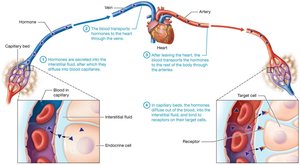
Comparison of Endocrine and Nervous Systems
The endocrine and nervous systems both use chemical signals for cell-to-cell communication but differ in their mechanisms and effects:
Nervous system: Uses neurotransmitters released by neurons for immediate, short-lived effects.
Endocrine system: Uses hormones secreted into the bloodstream for slower, but longer-lasting effects.
Types of Chemical Signals
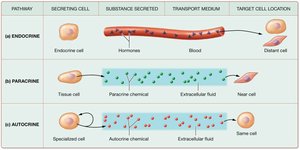
The body uses several types of chemical signals for communication:
Endocrine signals: Hormones secreted into the blood to affect distant target cells.
Paracrine signals: Chemicals secreted into the extracellular space to affect nearby but different cell types.
Autocrine signals: Chemicals that affect the same cell or cell type that secreted them.
Overview of Endocrine Organs
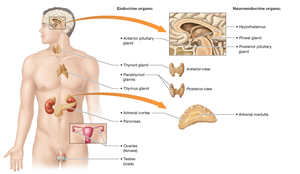
Endocrine glands are distributed throughout the body and regulate other cell types by producing and secreting hormones. They are classified as:
Primary endocrine organs: Only endocrine functions (e.g., anterior pituitary, thyroid, parathyroid, adrenal cortices, pancreas, thymus).
Secondary endocrine organs: Both endocrine and non-endocrine functions (e.g., heart, kidneys, small intestines, testes, ovaries).
Neuroendocrine organs: Composed of nervous tissue but secrete hormones (e.g., hypothalamus, pineal gland, adrenal medulla).
Hormones: Structure, Transport, and Mechanisms
Classes of Hormones
Hormones are classified based on their chemical structure:
Amino-acid hormones: Hydrophilic; include amine, peptide, and protein hormones; bind to plasma membrane receptors.
Steroid hormones: Derived from cholesterol; hydrophobic; bind to intracellular receptors in the cytosol or nucleus.
Hormone Transport Through the Blood
Free hormones: Hydrophilic, travel unbound in plasma (e.g., most amino acid-based hormones).
Bound hormones: Hydrophobic, travel bound to plasma proteins, which extends their half-life and provides a hormone reservoir.
Target Cells and Receptors
Hormones affect only target cells that possess specific protein receptors. Receptor location depends on hormone type:
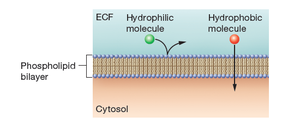
Hydrophilic hormones: Bind to receptors on the plasma membrane (cannot cross the lipid bilayer).
Hydrophobic hormones: Cross the plasma membrane and bind to receptors in the cytosol or nucleus.
Regulation of Receptor Number
Up-regulation: Increase in receptor number in response to low hormone levels, increasing sensitivity.
Down-regulation: Decrease in receptor number in response to high hormone levels, reducing sensitivity.
Mechanisms of Hormone Action
Hydrophilic Hormones
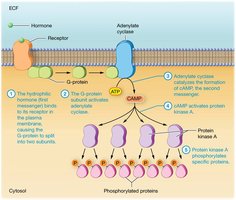
Hydrophilic hormones act via second-messenger systems:
Hormone (first messenger) binds to membrane receptor.
Activates a G-protein, which then activates an enzyme (e.g., adenylate cyclase).
Enzyme catalyzes formation of a second messenger (e.g., cAMP).
Second messenger initiates cellular changes, such as activation of protein kinases.
Hydrophobic Hormones
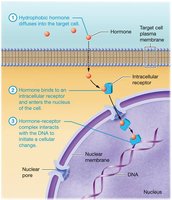
Hydrophobic hormones diffuse through the plasma membrane and bind to intracellular receptors:
Hormone-receptor complex interacts with DNA to alter gene expression, affecting protein synthesis.
Effects of Hormone Actions
Stimulate secretion from endocrine or exocrine cells
Activate or inhibit enzymes
Stimulate or inhibit mitosis/meiosis
Alter membrane potential by opening/closing ion channels
Regulate gene expression
Hormone Interactions
Synergists: Hormones that amplify each other's effects.
Antagonists: Hormones with opposing effects on the same target cells.
Hormone Half-Life and Elimination
Half-life: Time required for hormone concentration to decrease by half in plasma.
Hydrophobic hormones have longer half-lives due to protein binding; hydrophilic hormones are cleared more rapidly.
Hormones are inactivated by target cells, kidneys, or liver.
Regulation of Hormone Secretion
Categories of Regulation
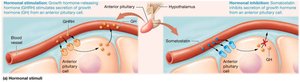
Hormonal stimuli: Hormone release in response to other hormones.
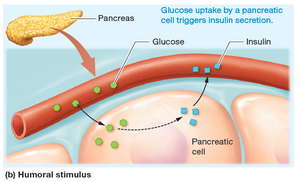
Humoral stimuli: Hormone release in response to changes in blood levels of ions or nutrients.
Neural stimuli: Hormone release in response to neural input.
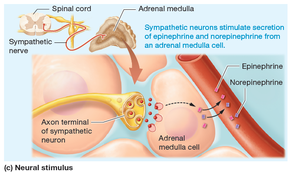
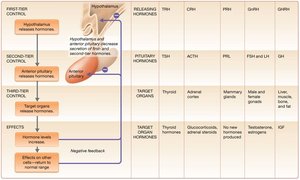
Negative Feedback Loops
Most hormone secretion is regulated by negative feedback loops, which maintain homeostasis:
Stimulus: Physiological variable deviates from normal range.
Receptor: Detects deviation.
Control center: Adjusts hormone secretion.
Effector/response: Hormone triggers response to restore normal range.
Homeostatic range: Feedback decreases hormone secretion as variable returns to normal.
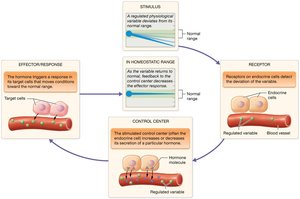
The Hypothalamus and Pituitary Gland
Structure and Function
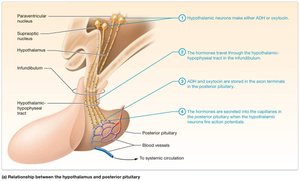
The hypothalamus and pituitary gland are central to endocrine regulation. The hypothalamus is connected to the pituitary gland by the infundibulum and regulates many homeostatic processes.
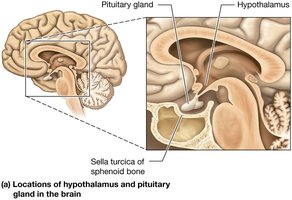
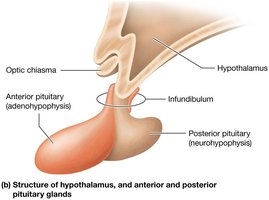
Anterior vs. Posterior Pituitary
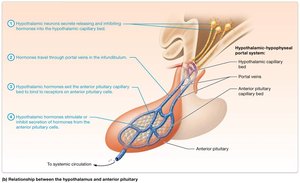
Anterior pituitary (adenohypophysis): Glandular tissue; produces and secretes hormones.
Posterior pituitary (neurohypophysis): Nervous tissue; stores and releases hormones produced by the hypothalamus.
Hypothalamic-Hypophyseal Portal System
This specialized blood supply allows hormones from the hypothalamus to reach the anterior pituitary directly, ensuring efficient regulation.
Hormones of the Hypothalamus and Posterior Pituitary
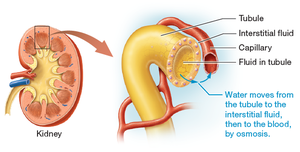
Antidiuretic hormone (ADH): Promotes water retention by kidneys; deficiency causes diabetes insipidus.
Oxytocin: Stimulates uterine contractions and milk ejection; regulated by positive feedback during lactation.
Hormones of the Anterior Pituitary
Thyroid-stimulating hormone (TSH): Stimulates thyroid gland.
Adrenocorticotropic hormone (ACTH): Stimulates adrenal cortex.
Prolactin (PRL): Stimulates milk production.
Luteinizing hormone (LH): Stimulates sex hormone production and ovulation.
Follicle-stimulating hormone (FSH): Stimulates gamete production.
Growth hormone (GH): Stimulates growth and metabolic functions.
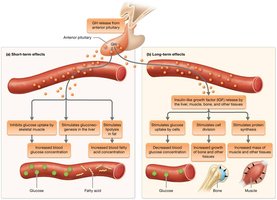
Growth Hormone: Effects and Regulation
Short-term effects: Increases blood glucose and fatty acid levels by promoting fat breakdown and gluconeogenesis.
Long-term effects: Stimulates production of insulin-like growth factor (IGF), promoting protein synthesis, cell division, and growth.
Regulated by growth hormone-releasing hormone (GHRH) and somatostatin from the hypothalamus.
Summary Table: Hormones of the Hypothalamus and Pituitary Gland
Hormone | Source | Target | Main Effect |
|---|---|---|---|
ADH | Posterior pituitary | Kidneys | Water retention |
Oxytocin | Posterior pituitary | Uterus, mammary glands | Uterine contraction, milk ejection |
TSH | Anterior pituitary | Thyroid gland | Stimulates thyroid hormone release |
ACTH | Anterior pituitary | Adrenal cortex | Stimulates cortisol release |
Prolactin | Anterior pituitary | Mammary glands | Milk production |
LH | Anterior pituitary | Gonads | Sex hormone production, ovulation |
FSH | Anterior pituitary | Gonads | Gamete production |
GH | Anterior pituitary | Most tissues | Growth, metabolism |
Additional info: This summary table is synthesized from the content and standard academic sources for clarity.
