 Back
The Endocrine System: Structure, Function, and Hormone Action
Study Guide - Smart Notes
 Tailored notes based on your materials, expanded with key definitions, examples, and context.
The Endocrine System
Overview and Functions
The endocrine system is a network of ductless glands and specialized cells that synthesize and secrete hormones directly into the bloodstream. These hormones act on distant target tissues to regulate and coordinate physiological processes throughout the body. The endocrine system interacts closely with the nervous system to coordinate and integrate the activity of most body cells.
Hormones: Chemical messengers produced by endocrine glands, traveling long distances in the blood to reach target cells.
Endocrine glands: Ductless glands that release hormones directly into the extracellular fluid.
Major processes controlled: Reproduction, growth and development, maintenance of electrolyte, water, and nutrient balance, regulation of cellular metabolism and energy balance, and mobilization of body defenses.
Endocrine vs. Exocrine Glands
Exocrine glands: Produce non-hormonal substances (e.g., saliva, sweat) and have ducts to carry secretions to membrane surfaces.
Endocrine glands: Produce hormones and are ductless, secreting hormones directly into the surrounding extracellular fluid.
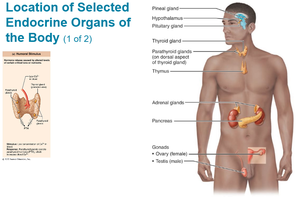
Major endocrine glands: Pituitary, thyroid, parathyroid, adrenal, and pineal glands.
Organs containing endocrine tissue: Pancreas, gonads, placenta.
Other hormone-producing organs/tissues: Stomach, intestine, heart, kidneys, skin, thymus, bone, adipose tissue.
Endocrine System vs. Nervous System
The endocrine and nervous systems both regulate body functions, but differ in their mechanisms and speed of action.
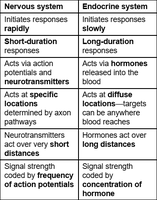
Nervous system: Initiates rapid, short-duration responses via action potentials and neurotransmitters, acting at specific locations over short distances.
Endocrine system: Initiates slow, long-duration responses via hormones released into the blood, acting at diffuse locations over long distances.
Signal strength: Nervous system uses frequency of action potentials; endocrine system uses concentration of hormone.
Chemical Messengers of the Endocrine System
Types of Chemical Messengers
Hormones: Long-distance chemical messengers of the endocrine system, traveling in blood to reach target cells.
Autocrine: Chemicals that exert effects on the same cells that secrete them (e.g., immune cells).
Paracrine: Locally acting chemicals that affect neighboring cells (e.g., histamine).
Note: Autocrine and paracrine signals are not considered part of the endocrine system.
Chemical Structure of Hormones and Their Actions
Main Classes of Hormones
Hormones are classified based on their chemical structure, which determines their mechanism of action.
Amino acid-based hormones: Derived from amino acids; function depends on the specific amino acids.
Steroid hormones: Synthesized from cholesterol; lipid-soluble and can cross the plasma membrane. Includes gonadal and adrenocortical hormones.
Protein/peptide-based hormones: Water-soluble (except thyroxine); cannot cross the plasma membrane and bind to receptors in the cytoplasm.
Mechanisms of Hormone Action
Water-soluble hormones: Act on plasma membrane receptors; cannot cross the plasma membrane; most are coupled via G proteins to second messengers.
Lipid-soluble hormones: (Steroid and thyroid hormones) Act on intracellular receptors that directly activate genes; can cross the plasma membrane.
Intracellular Receptors and Direct Gene Activation
Lipid-soluble hormones and thyroid hormones diffuse into target cells and bind with intracellular receptors. The receptor-hormone complex enters the nucleus and binds to specific regions of DNA, "turning on" genes to initiate DNA transcription and produce mRNA. The mRNA is then translated into specific proteins, which may have metabolic, structural, or extracellular functions.
Target Cell Changes Induced by Hormones
Hormones can cause the following changes in target cells:
Alter plasma membrane permeability and/or membrane potential by opening or closing ion channels
Stimulate synthesis of enzymes or other proteins
Activate or deactivate enzymes
Induce secretory activity
Stimulate mitosis
Regulation of Hormone Release
Stimuli for Hormone Release
Endocrine glands are stimulated to synthesize and secrete hormones in response to one or more of three stimuli:
Humoral: Changing blood levels of ions and nutrients directly stimulate hormone release (e.g., declining Ca2+ concentration stimulates parathyroid glands to secrete parathyroid hormone).
Neural: Nerve fibers can stimulate hormone release (e.g., sympathetic nervous system fibers stimulate adrenal medulla to secrete catecholamines).
Hormonal: Hormones stimulate other endocrine organs to release their hormones (e.g., hypothalamic hormones regulate release of most anterior pituitary hormones).
Hormone Sensitivity and Target Cell Activation
Hormone Concentration and Receptor Sensitivity
Hormones circulate in the bloodstream at very low concentrations (pico- to nanomolar range), but can trigger strong responses due to high sensitivity and specificity of target cell receptors.
Target cells: Must have specific receptors for the hormone to bind.
Example: ACTH receptors are found only on certain cells of the adrenal cortex, but thyroxine receptors are found on nearly all cells of the body.
Factors affecting target cell activation: Blood levels of hormone, relative number of target cell receptors, affinity of binding between hormone and receptor.
Up-regulation: Target cells add receptors in response to persistently low hormone levels, increasing sensitivity.
Down-regulation: Cells remove receptors in response to persistently high hormone levels, desensitizing the target cells.
Summary Table: Nervous vs. Endocrine System
Nervous system | Endocrine system |
|---|---|
Initiates responses rapidly | Initiates responses slowly |
Short-duration responses | Long-duration responses |
Acts via action potentials and neurotransmitters | Acts via hormones released into the blood |
Acts at specific locations determined by axon pathways | Acts at diffuse locations—targets can be anywhere blood reaches |
Neurotransmitters act over very short distances | Hormones act over long distances |
Signal strength coded by frequency of action potentials | Signal strength coded by concentration of hormone |
Key Equations
Hormone concentration:
Receptor binding affinity:
Additional info:
Hormones can act at the cell surface or inside the cell, but must be released before action.
Feedback loops (e.g., hypothalamic-pituitary-target endocrine organ) regulate hormone release.
