 Back
The Endocrine System: Structure, Function, and Regulation
Study Guide - Smart Notes
 Tailored notes based on your materials, expanded with key definitions, examples, and context.
The Endocrine System
Overview and Functions
The endocrine system is a network of ductless glands and specialized cells that synthesize and secrete hormones directly into the bloodstream. These hormones regulate and coordinate physiological processes such as growth, metabolism, reproduction, and homeostasis.
Hormones: Chemical messengers produced by glands, released into the bloodstream to target organs or cells.
Major Functions: Regulation of growth, development, metabolism, reproduction, electrolyte and water balance, and mobilization of body defenses.
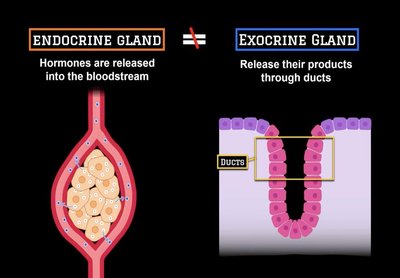
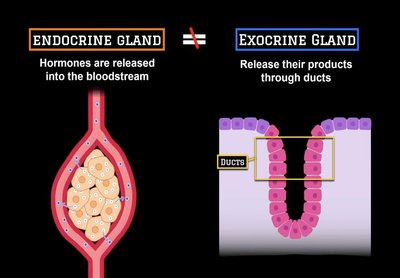
Endocrine vs. Exocrine Glands
Endocrine glands release hormones into the bloodstream, while exocrine glands produce nonhormonal substances (e.g., sweat, saliva) and release them through ducts to membrane surfaces.
Endocrine glands: Ductless; include pituitary, thyroid, parathyroid, adrenal, and pineal glands.
Exocrine glands: Have ducts; release products to cutaneous or mucous membrane surfaces.
Neuroendocrine organ: The hypothalamus links nervous and endocrine systems.
Other hormone-producing organs: Pancreas, gonads, placenta, stomach, intestine, heart, kidneys, skin, thymus, bone, adipose tissue.
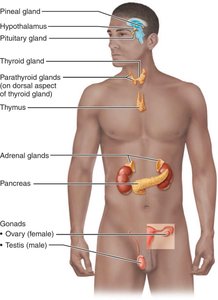
Major Endocrine Organs
The endocrine organs are distributed throughout the body and include both primary glands and organs with secondary endocrine functions.
Pituitary gland
Thyroid gland
Parathyroid glands
Adrenal glands
Pineal gland
Pancreas
Gonads (ovaries and testes)
Hormone Classification and Mechanisms
Chemical Structure of Hormones
The chemical structure of a hormone determines its solubility, transport, degradation, and receptor interaction.
Amino acid–based hormones: Includes amines, peptides, and proteins. Most are water-soluble and act via membrane receptors.
Steroid hormones: Synthesized from cholesterol; lipid-soluble, act via intracellular receptors.
Eicosanoids: Localized effects; often classified as paracrine/autocrine rather than true hormones.
Hormone Action: Second Messengers and Gene Activation
Hormones act on target cells by altering cellular activity.
Water-soluble hormones: Act on plasma membrane receptors, often via G proteins and second messengers (e.g., cAMP).
Lipid-soluble hormones: Diffuse through plasma membrane, bind intracellular receptors, and directly activate genes.
Key Effects of Hormones
Alter membrane permeability and potential
Stimulate synthesis of proteins/enzymes
Activate/deactivate enzymes
Induce secretory activity
Stimulate mitosis
Hormone Release and Regulation
Types of Endocrine Gland Stimuli
Endocrine glands are stimulated to release hormones by three main types of stimuli:
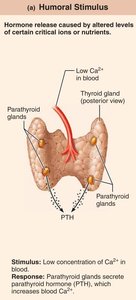
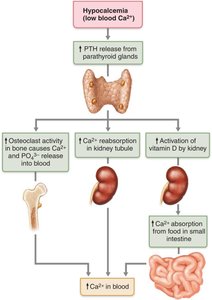
Humoral: Changing blood levels of ions/nutrients (e.g., low Ca2+ stimulates PTH release).
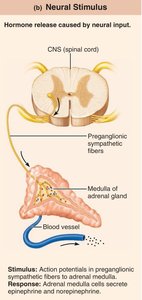
Neural: Nerve fibers stimulate hormone release (e.g., sympathetic fibers stimulate adrenal medulla).
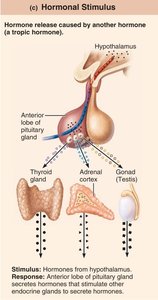
Hormonal: Hormones stimulate other endocrine organs (e.g., hypothalamic hormones regulate pituitary hormones).
Nervous System Interaction
The nervous system can override or modify endocrine controls, especially during stress (e.g., fight-or-flight response).
Adjusts hormone levels as needed
Overrides normal endocrine feedback in emergencies
Hormone Targeting and Regulation
Target Cell Activation
Only cells with specific receptors for a hormone respond to it. Activation depends on:
Blood hormone levels
Number of receptors
Affinity of binding
Receptor Regulation
Up-regulation: Increased receptor number in response to low hormone levels
Down-regulation: Decreased receptor number in response to high hormone levels
Hormone Activity: Half-Life, Onset, and Duration
Transport: Steroid and thyroid hormones are bound to plasma proteins; others circulate freely.
Half-life: Time for hormone level to decrease by half; varies by hormone type.
Onset and duration: Immediate for some hormones, delayed for others; duration ranges from seconds to hours.
Comparison Table: Lipid- vs. Water-Soluble Hormones
Property | Lipid-Soluble Hormones | Water-Soluble Hormones |
|---|---|---|
Consist of | All steroid hormones and thyroid hormone | All amino acid–based hormones except thyroid hormone |
Sources | Adrenal cortex, gonads, thyroid gland | All other endocrine glands |
Stored in vesicles | No | Yes |
Transport in blood | Bound to plasma proteins | Usually free in plasma |
Half-life | Long | Short |
Receptor location | Inside cell | On plasma membrane |
Mechanism of action | Activate genes | Second-messenger systems |
Hypothalamus and Pituitary Gland
Hypothalamus: Structure and Function
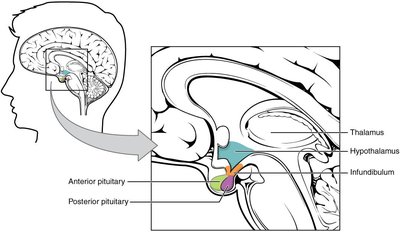
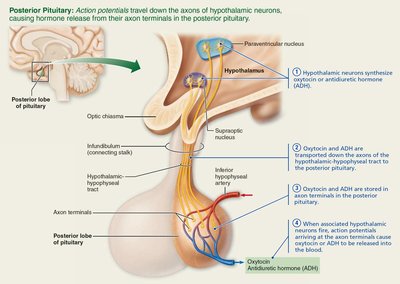
The hypothalamus is a neuroendocrine organ located below the thalamus, directly above the pituitary gland, connected by the infundibulum. It acts as a link between the nervous and endocrine systems, producing tropic hormones that regulate pituitary function. 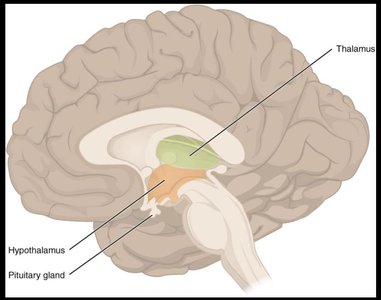
Hypothalamic Hormones
TRH: Stimulates TSH release
CRH: Stimulates ACTH release
GnRH: Stimulates FSH and LH release
GHRH: Stimulates GH release
GHIH (Somatostatin): Inhibits GH release
PIH (Dopamine): Inhibits prolactin release
ADH: Water retention and blood pressure
Oxytocin: Uterine contractions and milk let-down
Pituitary Gland: Structure and Hormones
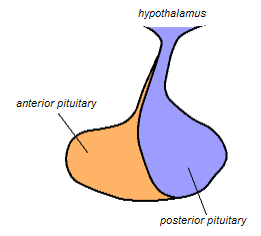
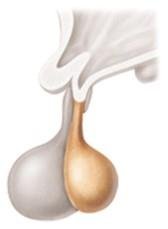
The pituitary gland (hypophysis) is connected to the hypothalamus via the infundibulum and consists of two lobes:
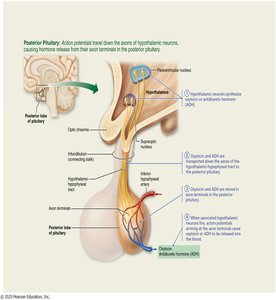
Posterior pituitary (neurohypophysis): Neural tissue; stores and releases oxytocin and ADH.
Anterior pituitary (adenohypophysis): Glandular tissue; manufactures and secretes six hormones.
Posterior Pituitary Hormones
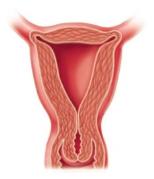
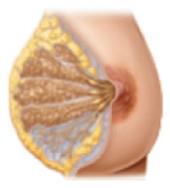
Oxytocin: Stimulates uterine contractions and milk ejection; regulated by positive feedback.
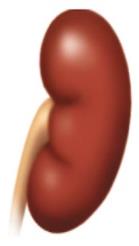
ADH (Antidiuretic hormone/vasopressin): Promotes water reabsorption in kidneys; high concentrations cause vasoconstriction.
Anterior Pituitary Hormones
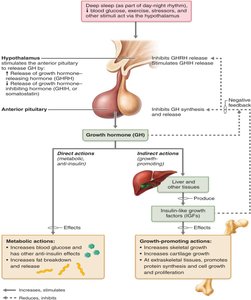
Growth hormone (GH): Direct metabolic effects (glucose-sparing, lipolysis), indirect growth-promoting effects via IGFs.
TSH (Thyroid-stimulating hormone): Stimulates thyroid hormone release.
ACTH (Adrenocorticotropic hormone): Stimulates adrenal cortex to release corticosteroids.
FSH (Follicle-stimulating hormone): Stimulates gamete production.
LH (Luteinizing hormone): Promotes gonadal hormone production.
PRL (Prolactin): Stimulates milk production.
The Thyroid Gland
Location and Structure
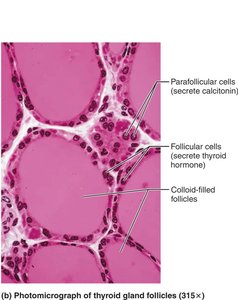
The thyroid gland is a butterfly-shaped organ located on the anterior trachea, just below the larynx. It consists of two lobes connected by an isthmus and contains follicles filled with colloid. 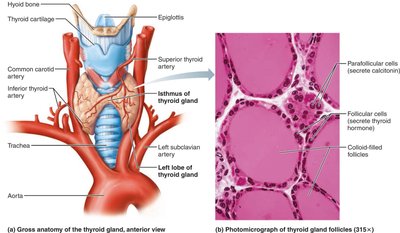
Thyroid Hormone (TH)
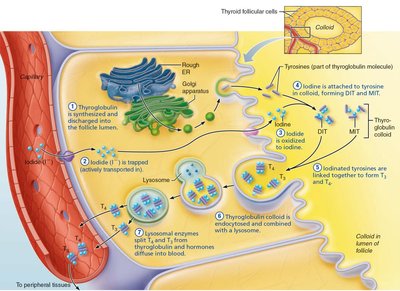
Forms: T4 (thyroxine) and T3 (triiodothyronine)
Effects: Increases basal metabolic rate, regulates growth and development, maintains blood pressure.
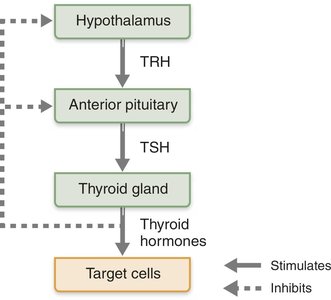
Regulation: Negative feedback via TSH and TRH; increased TH inhibits TSH release.
Thyroid Disorders
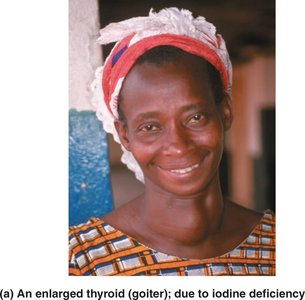
Hypothyroidism: Myxedema, goiter (iodine deficiency), congenital hypothyroidism.
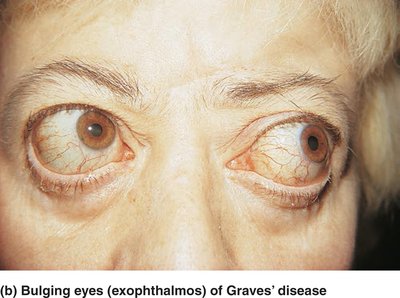
Hyperthyroidism: Graves' disease (autoimmune), exophthalmos, elevated metabolic rate.
Calcitonin
Produced by parafollicular (C) cells in response to high blood Ca2+ levels.
Antagonist to parathyroid hormone (PTH); inhibits osteoclast activity and stimulates Ca2+ uptake into bone.
The Parathyroid Glands
Structure and Function
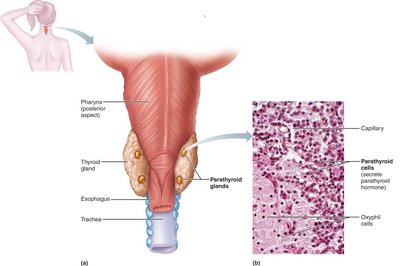
Four small glands embedded in the posterior thyroid; secrete parathyroid hormone (PTH), the primary regulator of blood calcium.
PTH: Increases blood Ca2+ by stimulating osteoclasts, enhancing kidney reabsorption, and activating vitamin D for increased intestinal absorption.
Parathyroid Disorders
Hyperparathyroidism: Excess PTH, bone softening, hypercalcemia, kidney stones.
Hypoparathyroidism: Insufficient PTH, hypocalcemia, neuronal excitability, tetany, convulsions.
The Adrenal Glands
Structure and Hormones
The adrenal glands are pyramid-shaped organs atop the kidneys, consisting of two regions:
Adrenal cortex: Produces corticosteroids (mineralocorticoids, glucocorticoids, gonadocorticoids).
Adrenal medulla: Produces catecholamines (epinephrine, norepinephrine).
Adrenal Cortex Hormones
Mineralocorticoids (Aldosterone): Regulate Na+ and K+ balance, blood volume, and pressure.
Glucocorticoids (Cortisol): Regulate metabolism, stress response, blood glucose, immune suppression.
Gonadocorticoids (Androgens): Contribute to sex characteristics and libido.
Adrenal Medulla Hormones
Catecholamines: Epinephrine and norepinephrine; mediate fight-or-flight response, increase heart rate, blood pressure, and blood glucose.
The Pineal Gland
Melatonin Secretion
The pineal gland secretes melatonin, which regulates circadian rhythms, sleep, and may have antioxidant and antigonadotropic effects.
The Pancreas
Structure and Function
The pancreas is a mixed gland with both exocrine (digestive enzymes) and endocrine (hormones) functions.
Alpha cells: Produce glucagon (raises blood glucose).
Beta cells: Produce insulin (lowers blood glucose).
Pancreatic Hormones
Glucagon: Stimulates glycogenolysis and gluconeogenesis in the liver.
Insulin: Promotes glucose uptake, storage, and utilization; inhibits glycogen breakdown.
Diabetes Mellitus
Type 1: Insulin deficiency
Type 2: Insulin resistance
Symptoms: Polyuria, polydipsia, polyphagia, ketoacidosis
The Gonads and Placenta
Gonadal Hormones
Ovaries: Estrogens, progesterone, inhibin
Testes: Testosterone, inhibin
Placenta: Estrogens, progesterone, hCG (during pregnancy)
Developmental Aspects
Endocrine Function Throughout Life
GH, estrogen, and testosterone levels decline with age
Glucose tolerance decreases
TH declines, lowering metabolic rate
PTH remains constant, but bone vulnerability increases in older women
Summary Table: Major Endocrine Glands and Hormones
Gland | Hormone | Main Function |
|---|---|---|
Pituitary | GH, TSH, ACTH, FSH, LH, PRL, ADH, Oxytocin | Growth, metabolism, stress, reproduction, lactation, water balance |
Thyroid | T3, T4, Calcitonin | Metabolism, calcium regulation |
Parathyroid | PTH | Calcium homeostasis |
Adrenal | Aldosterone, Cortisol, Androgens, Epinephrine, Norepinephrine | Electrolyte balance, stress response, sex characteristics |
Pineal | Melatonin | Circadian rhythms |
Pancreas | Insulin, Glucagon | Blood glucose regulation |
Gonads | Estrogen, Progesterone, Testosterone | Reproduction, secondary sex characteristics |
