 Back
The Endocrine System: Structure, Function, and Regulation
Study Guide - Smart Notes
 Tailored notes based on your materials, expanded with key definitions, examples, and context.
The Endocrine System
Introduction to the Endocrine System
The endocrine system is a major regulatory system of the body, working alongside the nervous system to coordinate and integrate the activity of body cells. It influences metabolic activities via hormones transported in the blood, producing slower but longer-lasting responses than the nervous system. Understanding the endocrine system is essential for clinical decision-making and patient care in health professions.
Key Terminology in Anatomy and Physiology
Anatomy: Study of body structures and their relationships.
Physiology: Study of how the body functions.
Histology: Study of tissues at the microscopic level.
Endocrine System Functions and Communication
Functions of the Endocrine System
Coordinates and regulates activities of body cells to preserve homeostasis.
Uses hormones as chemical messengers to regulate body functions.
Can affect long-term processes such as growth, development, and metabolism.
Types of Cellular Communication
Direct Communication: Exchange of ions and molecules between adjacent cells via gap junctions.
Paracrine Communication: Chemical messengers affect local target cells in the same tissue.
Autocrine Communication: Cells release chemicals that affect themselves.
Endocrine Communication: Endocrine cells release hormones into the bloodstream to affect distant target cells.
Synaptic Communication: Neurons release neurotransmitters at synapses for rapid, targeted responses.
Hormones and Target Cells
Hormones travel through the bloodstream to reach target cells.
Target cells must have specific receptors to bind and respond to hormones.
Hormones can change the types, quantities, or activities of enzymes and structural proteins in target cells.
Hormone Classification and Mechanisms
Classes of Hormones
Amino Acid Derivatives
Peptide Hormones
Lipid Derivatives: Includes steroid hormones and eicosanoids
Hormone Transport and Inactivation
Hormones may circulate freely or be bound to carrier proteins.
Free hormones are inactivated quickly; carrier-bound hormones (e.g., thyroid and steroid hormones) last longer.
Hormones are inactivated by binding to target cells, breakdown by liver/kidneys, or enzymatic degradation in blood/interstitial fluids.
Hormone Receptors and Regulation
Up-regulation: Low hormone levels increase receptor numbers, making cells more sensitive.
Down-regulation: High hormone levels decrease receptor numbers, making cells less sensitive.
Mechanisms of Hormone Action
First Messenger: The hormone binds to an extracellular receptor.
Second Messenger: Intracellular molecule (e.g., cAMP, cGMP, Ca2+) mediates the hormone's effects inside the cell.
Amplification: A small number of hormone molecules can produce a large cellular response via second messengers.
Steroid and Thyroid Hormone Signaling
Steroid Hormones: Diffuse through the cell membrane, bind to cytoplasmic or nuclear receptors, and activate gene transcription.
Thyroid Hormones: Enter cells, bind to nuclear and mitochondrial receptors, activate genes, and increase ATP production.
Regulation of Hormone Secretion
Control Mechanisms
Negative Feedback: Most hormone secretion is regulated by negative feedback to maintain homeostasis.
Humoral Stimuli: Changes in extracellular fluid trigger hormone release (e.g., blood calcium levels).
Hormonal Stimuli: Arrival or removal of another hormone triggers secretion.
Neural Stimuli: Neurotransmitters stimulate hormone release (e.g., adrenal medulla).
Major Endocrine Organs and Their Functions
Overview of Endocrine Organs
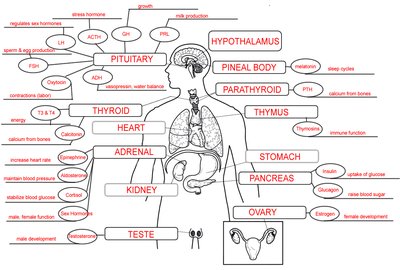
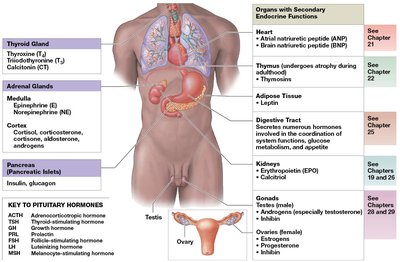
Primary Endocrine Organs: Hypothalamus, pituitary gland, pineal gland, thyroid gland, parathyroid glands, thymus, adrenal glands, ovaries, testes.
Secondary Endocrine Functions: Heart, kidneys, liver, placenta, adipose tissue.
The Hypothalamus and Pituitary Gland
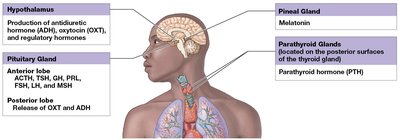
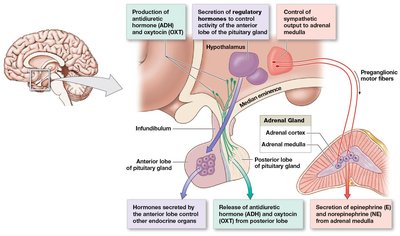
Hypothalamus: Coordinates endocrine activity, produces regulatory hormones, synthesizes ADH and oxytocin.
Pituitary Gland: Located in the sella turcica, connected to hypothalamus by the infundibulum; consists of anterior (adenohypophysis) and posterior (neurohypophysis) lobes.
Anterior Pituitary (Adenohypophysis)
Glandular tissue; synthesizes and secretes its own hormones.
Controlled by hypothalamic releasing and inhibiting hormones.
Major hormones: GH, TSH, ACTH, FSH, LH, PRL, MSH.
Posterior Pituitary (Neurohypophysis)
Neural tissue; stores and releases hormones made by the hypothalamus (ADH and oxytocin).
Release is controlled by nerve impulses from the hypothalamus.
Hypothalamic-Pituitary Relationships
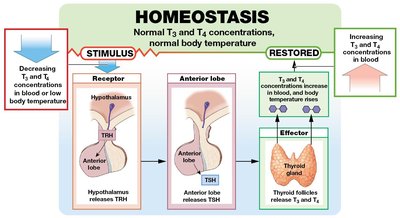
Hypothalamus releases regulatory hormones to control anterior pituitary secretion.
Negative feedback regulates hormone levels.
The Thyroid and Parathyroid Glands
Thyroid Gland Anatomy and Physiology
Bilobed, butterfly-shaped gland anterior to the trachea and inferior to the thyroid cartilage.
Follicular cells produce thyroglobulin, which is the precursor to T3 and T4.
Iodine is essential for thyroid hormone synthesis.
C cells (parafollicular cells) secrete calcitonin to regulate calcium levels.
Thyroid Hormone Regulation
TSH from the anterior pituitary stimulates thyroid hormone release.
Thyroid hormones (T3 and T4) increase metabolic rate, oxygen consumption, and heat production (calorigenic effect).
Calcitonin lowers blood calcium by inhibiting osteoclasts and increasing calcium excretion.
Parathyroid Gland Anatomy and Physiology
Four small glands on the posterior surface of the thyroid.
Principal cells secrete parathyroid hormone (PTH) in response to low blood calcium.
PTH increases blood calcium by stimulating bone resorption, increasing renal reabsorption, and promoting calcitriol synthesis for intestinal absorption.
The Adrenal Glands
Anatomy and Physiology
Located on the superior border of each kidney; consist of cortex and medulla.
Adrenal cortex produces corticosteroids (mineralocorticoids, glucocorticoids, and androgens).
Adrenal medulla produces epinephrine and norepinephrine for the fight-or-flight response.
The Pineal Gland
Anatomy and Physiology
Located in the roof of the third ventricle of the brain.
Contains pinealocytes that synthesize melatonin.
Melatonin regulates circadian rhythms, sleep, and acts as an antioxidant.
The Pancreas
Anatomy and Physiology
Located between the stomach and small intestine; has both exocrine and endocrine functions.
Beta cells secrete insulin (lowers blood glucose); alpha cells secrete glucagon (raises blood glucose).
Diabetes Mellitus
Type 1: Autoimmune destruction of beta cells; requires insulin therapy.
Type 2: Insulin resistance; managed with lifestyle changes and medications.
Gestational: Occurs during pregnancy; risks for mother and fetus.
Gonads and Placenta
Ovaries and Testes
Ovaries produce estrogens and progesterone; regulate menstrual cycle and pregnancy.
Testes produce testosterone; regulate sperm production and male secondary sex characteristics.
Placenta
Temporary endocrine organ during pregnancy; produces hCG, progesterone, estrogen, hPL, relaxin, and CRH.
Secondary Endocrine Organs
Stomach/intestines: Release hormones for digestive regulation.
Skin/liver/kidneys: Synthesize and activate vitamin D (calcitriol) for calcium absorption.
Adipose tissue: Produces leptin for appetite regulation.
Heart: Produces natriuretic peptides to lower blood pressure.
Thymus: Produces thymosin for immune cell maturation.
Hormonal Interactions
Antagonistic: Opposing effects (e.g., insulin vs. glucagon).
Synergistic: Additive effects (e.g., glucagon + epinephrine).
Permissive: One hormone enables another to act (e.g., thyroid hormone for epinephrine).
Integrative: Different but complementary effects (e.g., PTH and calcitriol on calcium balance).
Hormones and Growth
Growth hormone, thyroid hormones, insulin, parathyroid hormone, calcitriol, and reproductive hormones all contribute to growth and development.
Deficiencies or excesses can lead to developmental abnormalities.
Stress and the General Adaptation Syndrome (GAS)
Alarm Phase: Immediate response to stress; epinephrine is dominant.
Resistance Phase: Prolonged stress; glucocorticoids are dominant, energy reserves are mobilized.
Exhaustion Phase: Homeostatic regulation fails; organ systems may fail.
Hormonal Changes with Aging
Hormone production and regulation change with age, affecting mood, metabolism, and reproductive function.
Most basic endocrine functions remain stable, but responsiveness may decline.
