 Back
The Endocrine System: Structure, Function, and Major Glands
Study Guide - Smart Notes
 Tailored notes based on your materials, expanded with key definitions, examples, and context.
Endocrine System Overview
Introduction to the Endocrine System
The endocrine system is a collection of glands that secrete hormones directly into the bloodstream to regulate various bodily functions. Unlike exocrine glands, endocrine glands are ductless and their secretions have widespread effects on target organs throughout the body.
Endocrine glands: Ductless glands that release hormones into the blood.
Exocrine glands: Glands that secrete substances through ducts to the outside of the body or into the digestive tract.
Hormones: Chemical messengers that influence metabolism, growth, reproduction, and homeostasis.
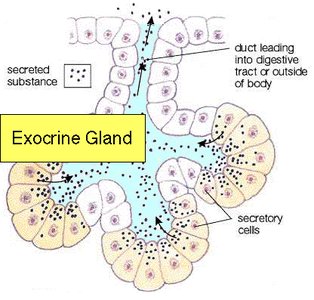
Endocrine vs. Exocrine Glands
Endocrine and exocrine glands differ in their structure and function. Endocrine glands release hormones into the bloodstream, while exocrine glands use ducts to transport their secretions.
Endocrine glands: Examples include the pituitary, thyroid, and adrenal glands.
Exocrine glands: Examples include sweat, salivary, and digestive glands.
Hormones and Their Mechanisms
Hormone Action and Target Cells
Hormones are released by endocrine cells and travel through the bloodstream to reach target cells, which possess specific receptors for those hormones. Only cells with the appropriate receptors will respond to a given hormone.
Target cells: Cells with receptors specific to a hormone.
Specificity: Ensures that only certain tissues respond to each hormone.
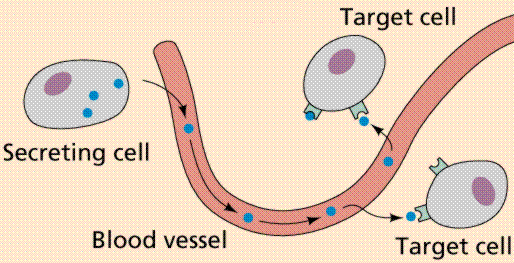
Properties of Hormones
Hormones can be classified based on their chemical structure and mechanism of action. They may be steroid or peptide hormones, and their effects can be rapid or prolonged depending on their nature and the target tissue.
Steroid hormones: Lipid-soluble, pass through cell membranes, and act on intracellular receptors.
Peptide hormones: Water-soluble, bind to cell surface receptors, and often use second messengers.
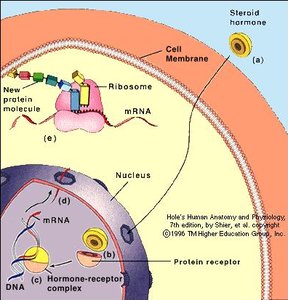
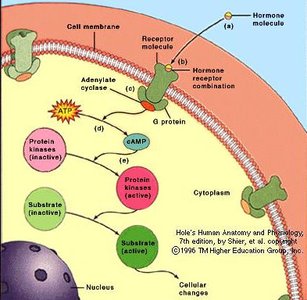
Coordination of Body Functions: Endocrine vs. Nervous System
Comparison of Endocrine and Nervous Systems
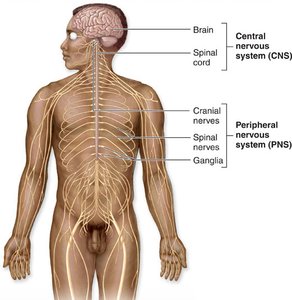
The endocrine and nervous systems are the two main regulatory systems in the body. They differ in their signaling mechanisms, speed, and duration of effects.
Endocrine system: Uses hormones, acts over long distances, slower onset (minutes to years), longer duration.
Nervous system: Uses electrical impulses and neurotransmitters, acts over short distances, rapid onset (milliseconds), short duration.
The Hypothalamus and Pituitary Gland
Structure and Connection
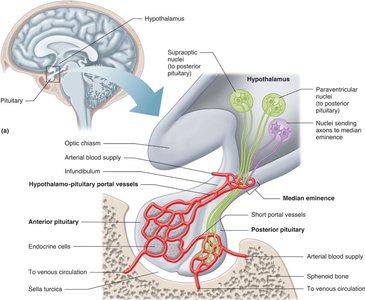
The pituitary gland, often called the "master gland," is connected to the hypothalamus by the infundibulum and is housed in the sella turcica. It consists of two lobes: the anterior (adenohypophysis) and posterior (neurohypophysis) pituitary.
Infundibulum: The stalk connecting the hypothalamus and pituitary gland.
Sella turcica: A bony structure housing the pituitary gland.
Control of the Pituitary Gland
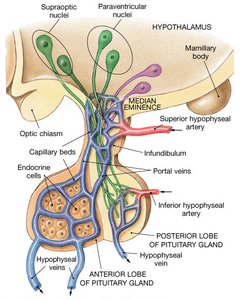
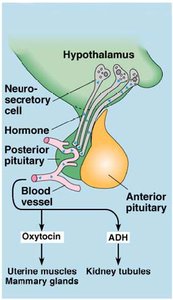
The hypothalamus regulates the pituitary gland through two main pathways: the hypophyseal portal system (vascular connection to the anterior pituitary) and the hypophyseal tract (neural connection to the posterior pituitary).
Hypophyseal portal system: Transports releasing and inhibiting hormones from the hypothalamus to the anterior pituitary.
Hypophyseal tract: Axons from hypothalamic neurons extend into the posterior pituitary, where hormones are stored and released.
Anterior Pituitary (Adenohypophysis)
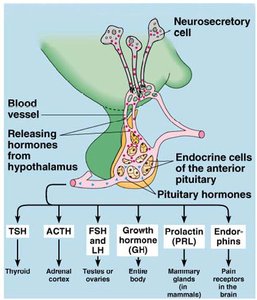
The anterior pituitary is regulated by hypothalamic hormones delivered via the portal system. It synthesizes and releases six major hormones:
TSH (Thyroid-stimulating hormone)
PRL (Prolactin)
ACTH (Adrenocorticotropic hormone)
GH (Growth hormone)
FSH (Follicle-stimulating hormone)
LH (Luteinizing hormone)
Posterior Pituitary (Neurohypophysis)
The posterior pituitary stores and releases hormones produced by the hypothalamus. These hormones are transported down axons and released into the bloodstream:
ADH (Antidiuretic hormone): Regulates water balance by acting on the kidneys.
Oxytocin (OT): Stimulates uterine contractions and milk ejection.
Major Endocrine Glands and Their Functions
Overview of Major Glands
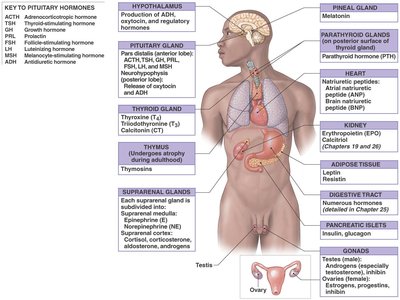
Several glands throughout the body secrete hormones that regulate metabolism, growth, reproduction, and homeostasis.
Thyroid gland: Releases thyroxine (T4) and triiodothyronine (T3) to control metabolism.
Pineal gland: Releases melatonin, regulating circadian rhythms.
Testes and ovaries: Produce sex hormones (testosterone, estrogen) for reproductive function.
Pancreas: Releases insulin and glucagon to regulate blood glucose levels.
Adrenal gland: Releases cortisol and other hormones to manage stress and metabolism.
Clinical Implications of Endocrine Malfunctions
Common Disorders and Symptoms
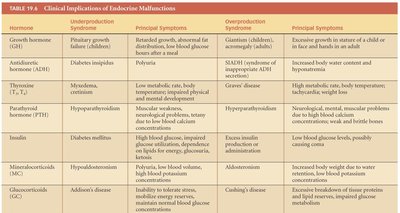
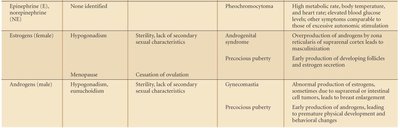
Endocrine disorders can result from underproduction or overproduction of hormones, leading to various clinical syndromes. The following table summarizes key hormones, associated disorders, and principal symptoms.
Hormone | Underproduction Syndrome | Principal Symptoms | Overproduction Syndrome | Principal Symptoms |
|---|---|---|---|---|
Growth hormone (GH) | Pituitary growth failure (children) | Retarded growth, abnormal fat distribution | Gigantism (children), Acromegaly (adults) | Excessive growth in stature or child; thickening of bones in adults |
Antidiuretic hormone (ADH) | Diabetes insipidus | Polyuria | SIADH (syndrome of inappropriate ADH secretion) | High water retention, hyponatremia |
Thyroxine (T4), Triiodothyronine (T3) | Hypothyroidism | Low metabolic rate, cold intolerance, weight gain | Hyperthyroidism (Graves' disease) | High metabolic rate, weight loss, nervousness |
Insulin | Diabetes mellitus | High blood glucose, impaired glucose utilization | Excess insulin production | Low blood glucose, possible coma |
Mineralocorticoids (MC) | Addison's disease | Low blood sodium, high blood potassium, low blood glucose | Aldosteronism | Increased body water and sodium, muscle weakness |
Glucocorticoids (GC) | Addison's disease | Low blood glucose, inability to tolerate stress | Cushing's disease | High blood glucose, altered fat distribution |
Estrogens (female) | Hypogonadism | Sterility, lack of secondary sexual characteristics | Androgenital syndrome, Precocious puberty | Overproduction of androgens, early puberty |
Androgens (male) | Hypogonadism, eunuchoidism | Sterility, lack of secondary sexual characteristics | Gynecomastia, Precocious puberty | Abnormal estrogen production, early puberty |
Summary Table: Major Endocrine Glands and Hormones
Gland | Hormone(s) | Main Function(s) |
|---|---|---|
Pituitary (anterior) | TSH, ACTH, FSH, LH, GH, PRL | Regulates thyroid, adrenal cortex, gonads, growth, lactation |
Pituitary (posterior) | ADH, Oxytocin | Water balance, uterine contraction, milk ejection |
Thyroid | T3, T4 | Regulates metabolism |
Adrenal cortex | Cortisol, aldosterone | Stress response, sodium/potassium balance |
Adrenal medulla | Epinephrine, norepinephrine | Fight-or-flight response |
Pancreas | Insulin, glucagon | Blood glucose regulation |
Ovaries/Testes | Estrogen, progesterone, testosterone | Sexual development, reproduction |
Pineal gland | Melatonin | Circadian rhythms |
Additional info: This guide integrates foundational concepts of the endocrine system, its comparison with the nervous system, and the clinical significance of hormone imbalances, as relevant to an introductory college-level anatomy and physiology course.
