 Back
The Endocrine System: Structure, Function, and Regulation
Study Guide - Smart Notes
 Tailored notes based on your materials, expanded with key definitions, examples, and context.
The Endocrine System
Overview and Major Functions
The endocrine system is one of the body's two major control systems, working alongside the nervous system to coordinate and integrate the activity of body cells. It uses hormones—chemical messengers transported in the blood—to influence metabolic activities. Endocrine responses are generally slower but longer-lasting than those of the nervous system. The study of hormones and endocrine organs is called endocrinology.
Major processes controlled by the endocrine system:
Reproduction
Growth and development
Maintenance of electrolyte, water, and nutrient balance
Regulation of cellular metabolism and energy balance
Mobilization of body defenses
Comparison of Nervous and Endocrine Systems
Feature | Nervous System | Endocrine System |
|---|---|---|
Response initiation | Rapid | Slow |
Duration of response | Short | Long |
Signal type | Action potentials, neurotransmitters | Hormones in blood |
Target location | Specific (axon pathways) | Diffuse (anywhere blood reaches) |
Distance of action | Short | Long |
Signal strength coding | Frequency of action potentials | Hormone concentration |
Endocrine vs. Exocrine Glands
Exocrine glands: Produce nonhormonal substances (e.g., sweat, saliva); have ducts to carry secretions to membrane surfaces.
Endocrine glands: Produce hormones; ductless; secrete hormones directly into extracellular fluid. Major glands include the pituitary, thyroid, parathyroid, adrenal, and pineal glands. The hypothalamus is a neuroendocrine organ.
Other organs with endocrine tissue: pancreas, gonads, placenta, stomach, intestine, heart, kidneys, skin, thymus, bone, adipose tissue.
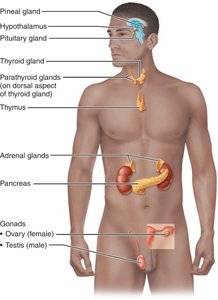
Chemical Messengers
Hormones: Long-distance chemical signals; travel in blood to target cells.
Autocrines: Act on the same cells that secrete them (local effect).
Paracrines: Affect neighboring cells (local effect).
Autocrines and paracrines are not considered part of the endocrine system.
Chemical Structure and Classes of Hormones
Hormone Structure and Solubility
The chemical structure of a hormone determines its solubility in water, which affects its transport in blood, degradation rate, and receptor interaction.
Amino acid–based hormones: Most hormones; include amino acid derivatives, peptides, and proteins. They are water-soluble (except thyroxine) and cannot cross the plasma membrane.
Steroid hormones: Synthesized from cholesterol; lipid-soluble and can cross the plasma membrane. Includes gonadal and adrenocortical hormones.
Eicosanoids: Sometimes considered hormones, but mostly act as paracrines and autocrines due to their localized effects.
Mechanisms of Hormone Action
Target Cells and Effects
Hormones affect only cells with specific receptors (target cells). They alter target cell activity by increasing or decreasing the rates of normal cellular processes, such as:
Altering membrane permeability or potential
Stimulating synthesis of enzymes or proteins
Activating or deactivating enzymes
Inducing secretory activity
Stimulating mitosis
Second Messenger Systems
Hormones act via two main mechanisms, depending on their solubility:
Water-soluble hormones: Act on plasma membrane receptors; use second messenger systems (e.g., cAMP, PIP2-calcium). Cannot enter the cell.
Lipid-soluble hormones: Act on intracellular receptors; directly activate genes. Can diffuse through the plasma membrane.
Cyclic AMP (cAMP) Signaling Mechanism
Hormone (first messenger) binds to receptor.
Receptor activates a G protein.
G protein activates (or inhibits) adenylate cyclase.
Adenylate cyclase converts ATP to cAMP (second messenger).
cAMP activates protein kinases, which phosphorylate other proteins.
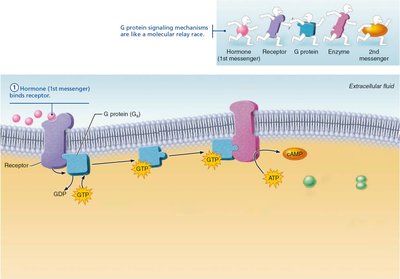
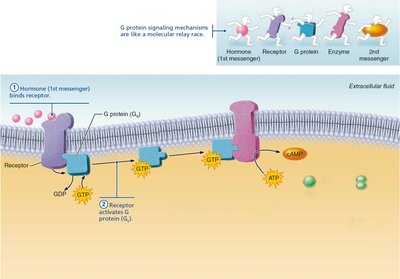
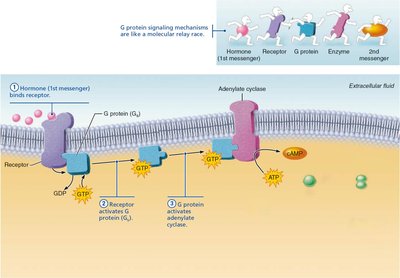
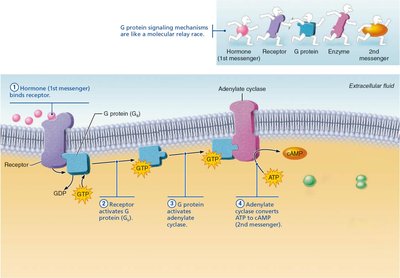
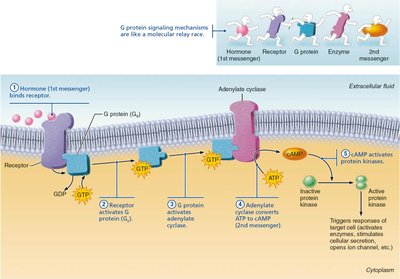
Phosphorylated proteins are then activated or inactivated. cAMP is rapidly degraded by phosphodiesterase, stopping the cascade. This mechanism allows for amplification: one hormone can lead to millions of phosphorylated proteins.
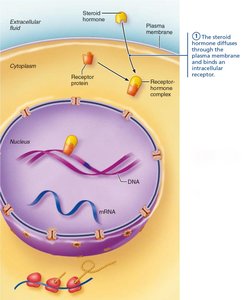
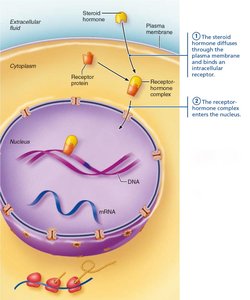
Direct Gene Activation by Lipid-Soluble Hormones
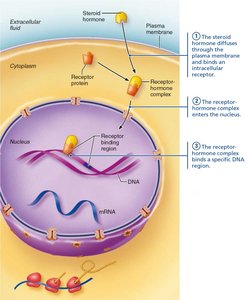
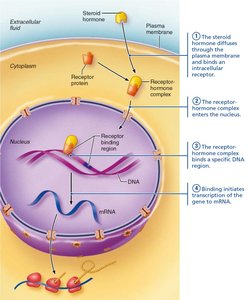
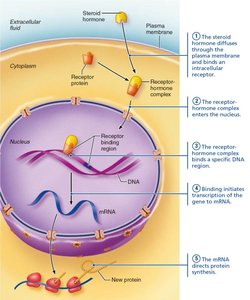
Lipid-soluble hormone diffuses through the plasma membrane and binds to an intracellular receptor.
The receptor-hormone complex enters the nucleus.
The complex binds to a specific DNA region.
Binding initiates transcription of the gene to mRNA.
mRNA directs protein synthesis.
Regulation of Hormone Release
Negative Feedback and Stimuli
Hormone levels are primarily controlled by negative feedback mechanisms, maintaining homeostasis. Hormone release is triggered by:
Endocrine gland stimuli (humoral, neural, hormonal)
Nervous system modulation
Types of Endocrine Gland Stimuli
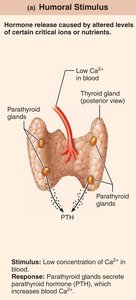
Humoral stimuli: Changing blood levels of ions/nutrients directly stimulate hormone release (e.g., low Ca2+ stimulates PTH release).
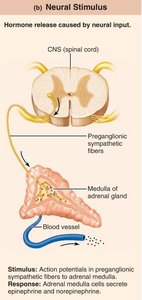
Neural stimuli: Nerve fibers stimulate hormone release (e.g., sympathetic fibers stimulate adrenal medulla to secrete catecholamines).
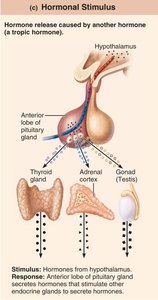
Hormonal stimuli: Hormones stimulate other endocrine organs to release their hormones (e.g., hypothalamic hormones regulate anterior pituitary hormones).
Nervous System Modulation
The nervous system can override or modulate endocrine controls, especially during stress (e.g., overriding insulin to increase blood glucose for fight-or-flight response).
Hypothalamus and Pituitary Gland
Structure and Function
The hypothalamus is connected to the pituitary gland (hypophysis) via the infundibulum. The pituitary has two major lobes:
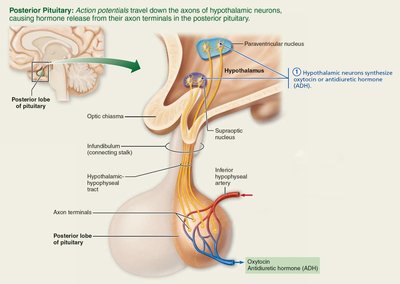
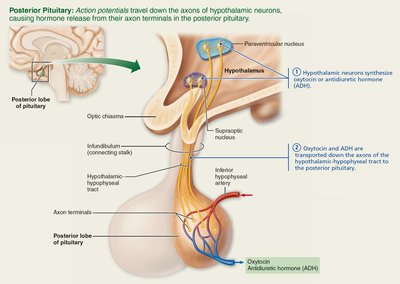
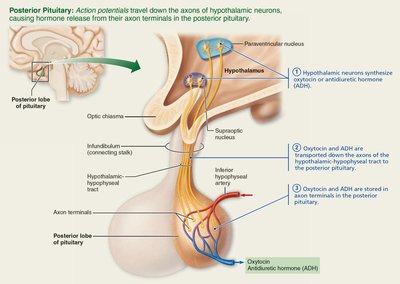
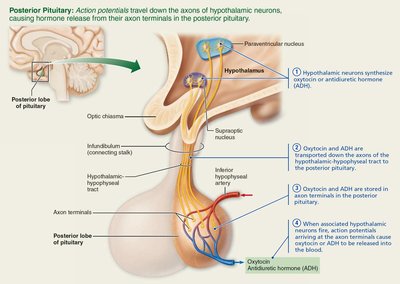
Posterior pituitary (neurohypophysis): Neural tissue; stores and secretes two neurohormones (oxytocin and ADH) produced by the hypothalamus.
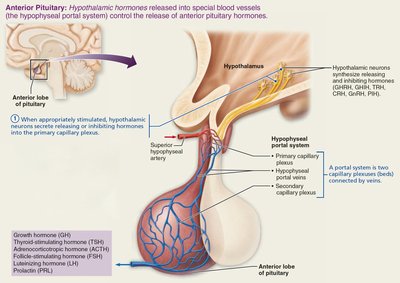
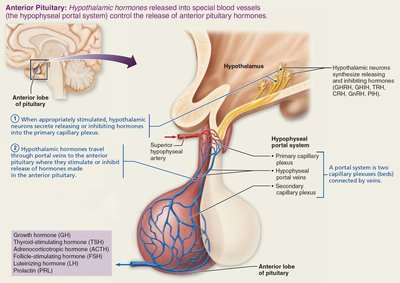
Anterior pituitary (adenohypophysis): Glandular tissue; manufactures and secretes six hormones.
Pituitary-Hypothalamic Relationships
Posterior pituitary contains axon terminals of hypothalamic neurons; hormones are released "on demand" when neurons fire action potentials.
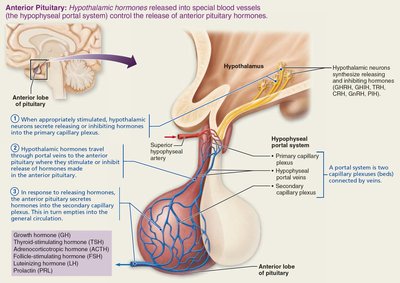
Anterior pituitary is connected to the hypothalamus via the hypophyseal portal system (primary capillary plexus, portal veins, secondary capillary plexus).
Posterior Pituitary Hormones
Oxytocin
Released during childbirth and breastfeeding; stimulates uterine contractions and milk ejection (positive feedback mechanisms).
Acts as a neurotransmitter in the brain.
Antidiuretic Hormone (ADH)
Triggered by high blood osmolarity; signals kidneys to reabsorb more water, reducing urine output.
High concentrations cause vasoconstriction (vasopressin).
Inhibited by alcohol.
Anterior Pituitary Hormones
Growth Hormone (GH)
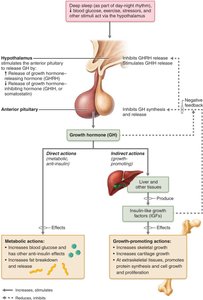
Direct actions: Decreases glucose uptake (glucose-sparing), increases blood glucose and fatty acids, stimulates protein synthesis.
Indirect actions: Stimulates liver, skeletal muscle, and bone to produce insulin-like growth factors (IGFs), promoting cell growth and division.
Regulation: Stimulated by GHRH (low GH, low glucose, stress, exercise); inhibited by GHIH (high GH/IGF levels).
Disorders of GH Secretion
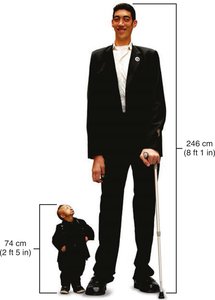
Hypersecretion: Gigantism in children, acromegaly in adults.
Hyposecretion: Pituitary dwarfism in children.
Other Anterior Pituitary Hormones
Thyroid-stimulating hormone (TSH): Stimulates thyroid hormone release; regulated by TRH and negative feedback from thyroid hormones.
Adrenocorticotropic hormone (ACTH): Stimulates adrenal cortex to release corticosteroids; regulated by CRH and negative feedback from glucocorticoids.
Gonadotropins (FSH and LH): Regulate function of gonads; FSH stimulates gamete production, LH stimulates hormone production and ovulation; regulated by GnRH and negative feedback from gonadal hormones.
Prolactin (PRL): Stimulates milk production; regulated by PIH (dopamine) and estrogen levels.
Summary Table: Pituitary Hormones
Hormone | Regulation | Target/Effects | Hyposecretion | Hypersecretion |
|---|---|---|---|---|
GH | GHRH/GHIH | Liver, muscle, bone; growth, metabolism | Pituitary dwarfism | Gigantism, acromegaly |
TSH | TRH, feedback | Thyroid gland; TH release | Hypothyroidism | Hyperthyroidism |
ACTH | CRH, feedback | Adrenal cortex; corticosteroid release | Rare | Cushing's disease |
FSH/LH | GnRH, feedback | Gonads; gamete/hormone production | Failure of sexual maturation | None/No important effects |
PRL | PIH, estrogen | Breast; lactation | Poor milk production | Inappropriate milk production |
Additional info: This summary covers the structure, function, and regulation of the endocrine system, focusing on hormone mechanisms, feedback, and the hypothalamic-pituitary axis. For more details on specific glands and hormones, refer to the full chapter or textbook.
