 Back
The Endocrine System: Structure, Function, and Regulation
Study Guide - Smart Notes
 Tailored notes based on your materials, expanded with key definitions, examples, and context.
Chapter 16: The Endocrine System
Overview of the Endocrine System
The endocrine system, together with the nervous system, is one of the two major regulatory systems of the body. It consists of glands that synthesize and secrete chemical messengers called hormones into the bloodstream. These hormones interact with specific target cells that possess receptors for the hormone, leading to changes in cellular function. The tissues containing these target cells are called target tissues.
Hormones: Chemical messengers secreted into the blood to regulate physiological processes.
Target Cells: Cells with specific receptors for a hormone.
Receptors: Proteins on or in target cells that bind hormones and initiate a response.
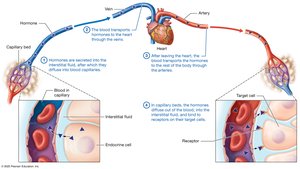
Comparison of the Endocrine and Nervous Systems
The endocrine and nervous systems both regulate body functions, but differ in their mechanisms and effects:
Endocrine system: Hormones are secreted into the interstitial fluid, diffuse into blood capillaries, and are transported throughout the body. Effects are generally slower but longer-lasting.
Nervous system: Neurotransmitters are released directly onto target cells, producing rapid but short-lived effects.
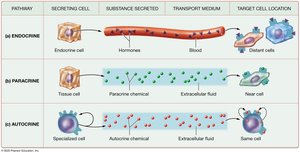
Types of Chemical Signaling
Not all chemical signals are classic hormones. Other types include:
Endocrine signals: Hormones travel through the blood to distant target cells.
Paracrine signals: Chemicals affect nearby cells without entering the blood.
Autocrine signals: Chemicals affect the same cell that secreted them.
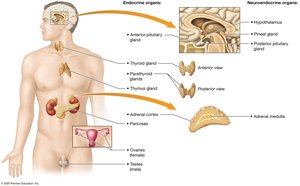
Endocrine Organs
Endocrine glands are ductless organs that secrete hormones into the interstitial fluid for transport by the bloodstream. In contrast, exocrine glands secrete their products into ducts leading to body surfaces or cavities.
Primary endocrine organs: Anterior pituitary, thyroid, parathyroid, adrenal cortices, pancreas, thymus, ovaries/testes.
Secondary endocrine glands: Heart, kidneys, small intestine, adipose tissue.
Neuroendocrine organs: Hypothalamus, pineal gland, adrenal medulla (nervous tissue that secretes hormones).
Hormones: Structure, Transport, and Mechanism of Action
Classes of Hormones
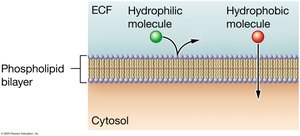
Amino acid-based hormones: Derived from amino acids; generally hydrophilic (except thyroid hormone).
Peptide/protein hormones: Chains of amino acids; hydrophilic.
Steroid hormones: Derived from cholesterol; hydrophobic (lipid-soluble).
Hormone Transport in Blood
Free hormones: Hydrophilic, travel dissolved in plasma.
Bound hormones: Hydrophobic, travel bound to plasma proteins, which extends their half-life.
Target Cells and Receptors
Hormones bind to specific receptors on or in target cells. The number of receptors can be regulated:
Upregulation: Increase in receptor number in response to low hormone levels.
Downregulation: Decrease in receptor number after prolonged high hormone levels.
Mechanisms of Hormone Action
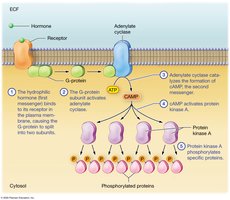
Hydrophilic hormones: Bind to cell surface receptors, activating second-messenger systems (e.g., cAMP pathway).
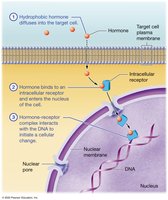
Hydrophobic hormones: Diffuse into cells, bind to intracellular receptors, and directly affect gene transcription.
Effects of Hormone Actions
Stimulate secretion from other cells
Activate/inhibit enzymes
Stimulate/inhibit mitosis or meiosis
Open/close ion channels
Regulate gene expression
Hormone Interactions
Complementary: Different hormones act on different target cells for a common goal.
Synergists: Hormones act on the same target cell for the same effect.
Antagonists: Hormones have opposite effects on the same target cell.
Regulation of Hormone Secretion
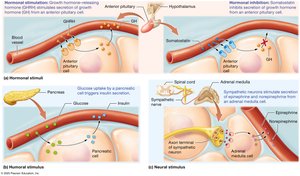
Hormone secretion is regulated by:
Hormonal stimuli: Hormones stimulate or inhibit other hormones.
Humoral stimuli: Changes in blood levels of ions or nutrients.
Neural stimuli: Nerve fibers stimulate hormone release.
Negative Feedback Loops
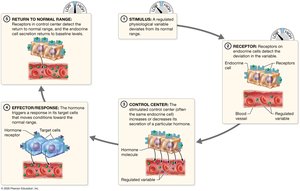
Most hormone secretion is regulated by negative feedback loops, maintaining homeostasis.
Hypothalamus and Pituitary Gland
Structure and Functional Relationships
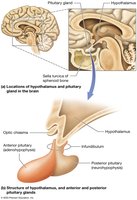
The hypothalamus connects to the pituitary gland via the infundibulum. The pituitary has two parts:
Anterior pituitary (adenohypophysis): Glandular tissue, produces hormones.
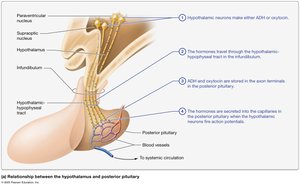
Posterior pituitary (neurohypophysis): Nervous tissue, stores and releases hypothalamic hormones.
Hormones of the Hypothalamus and Posterior Pituitary
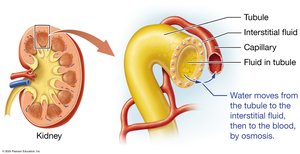
Antidiuretic hormone (ADH): Water retention by kidneys; released in response to high blood solute concentration.
Oxytocin: Stimulates uterine contractions and milk ejection; involved in emotional bonding.
Hormones of the Anterior Pituitary
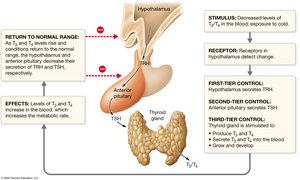
Thyroid-stimulating hormone (TSH): Stimulates thyroid gland.
Adrenocorticotropic hormone (ACTH): Stimulates adrenal cortex.
Prolactin: Stimulates milk production.
Luteinizing hormone (LH) and Follicle-stimulating hormone (FSH): Regulate gonads.
Growth hormone (GH): Stimulates growth and metabolism.
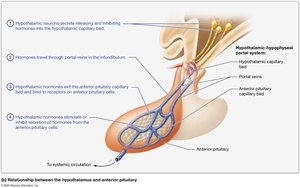
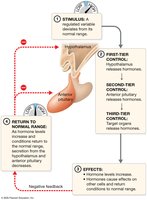
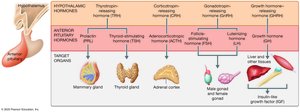
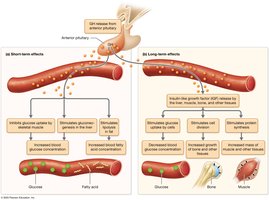
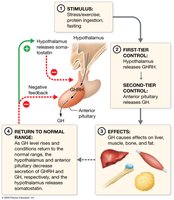
Table: Hormones of the Hypothalamus and Pituitary Gland
Hormone | Stimulus for Release | Inhibitor of Release | Target Tissue(s) | Effects |
|---|---|---|---|---|
ADH | Increased blood solute concentration | Decreased blood solute concentration | Kidneys | Water reabsorption |
Oxytocin | Stretching of uterus, infant suckling | Lack of appropriate stimuli | Uterus, mammary glands | Uterine contractions, milk ejection |
TSH | TRH from hypothalamus | Somatostatin | Thyroid gland | Growth and secretion of thyroid hormones |
ACTH | CRH from hypothalamus | Increased cortisol | Adrenal cortex | Release of adrenal steroids |
Prolactin | Infant suckling, PRH | PIH (dopamine) | Mammary glands | Milk production |
LH, FSH | GnRH from hypothalamus | Increased sex hormones | Gonads | Regulation of gonadal function |
GH | GHRH, stress, exercise | Somatostatin | Liver, muscle, bone, fat | Growth, protein synthesis |
Thyroid and Parathyroid Glands
Structure and Function
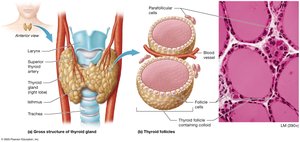
Thyroid gland: Located in the anterior neck; produces thyroid hormones (T3 and T4) and calcitonin.
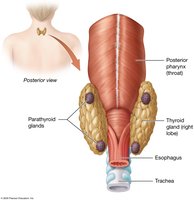
Parathyroid glands: Usually four, embedded in the posterior thyroid; produce parathyroid hormone (PTH).
Thyroid Hormones: Metabolic Regulators
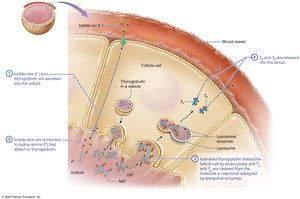
Triiodothyronine (T3): Three iodine atoms; more active form.
Thyroxine (T4): Four iodine atoms; converted to T3 in target cells.
Regulate basal metabolic rate, thermoregulation, growth, and development; synergize with the sympathetic nervous system.
Thyroid Disorders
Hyperthyroidism: Excess thyroid hormone; causes weight loss, heat intolerance, increased heart rate.
Hypothyroidism: Deficient thyroid hormone; causes weight gain, cold intolerance, slow heart rate.
Graves disease: Autoimmune hyperthyroidism; may cause goiter and exophthalmos.
Goiter: Enlargement of the thyroid gland.

Parathyroid Hormone and Calcitonin: Bone Homeostasis
PTH: Increases blood calcium by stimulating osteoclasts, increasing intestinal absorption (via vitamin D), and increasing renal reabsorption.
Calcitonin: Lowers blood calcium by inhibiting osteoclasts; secreted in response to hypercalcemia.
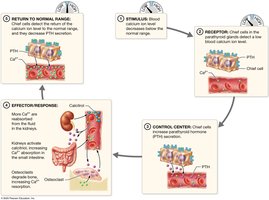
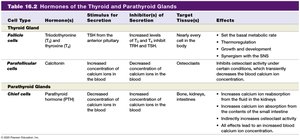
Table: Hormones of the Thyroid and Parathyroid Glands
Cell Type | Hormone(s) | Stimulus for Secretion | Inhibitor(s) of Secretion | Target Tissue(s) | Effects |
|---|---|---|---|---|---|
Follicle cells | T3, T4 | TSH | Increased T3/T4 | Nearly every cell | Increase metabolic rate, thermoregulation, growth, SNS synergy |
Parafollicular cells | Calcitonin | Increased blood Ca2+ | Decreased blood Ca2+ | Osteoclasts | Inhibits bone resorption |
Chief cells | PTH | Decreased blood Ca2+ | Increased blood Ca2+ | Bone, kidneys, intestine | Increases blood Ca2+ |
Adrenal Glands
Structure
The adrenal glands are located on the superior aspect of each kidney and consist of an outer cortex and inner medulla.
Adrenal cortex: Produces steroid hormones (mineralocorticoids, glucocorticoids, and androgens).
Adrenal medulla: Produces catecholamines (epinephrine and norepinephrine).
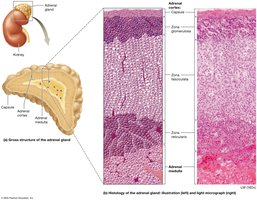
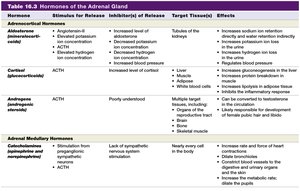
Hormones of the Adrenal Cortex
Mineralocorticoids (Aldosterone): Regulate sodium, potassium, and acid-base balance; increase blood pressure.
Glucocorticoids (Cortisol): Mediate stress response, increase blood glucose, suppress inflammation.
Androgenic steroids: Minor role in reproductive function.
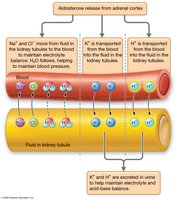
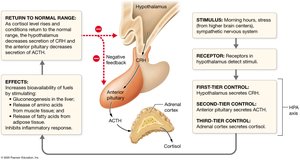
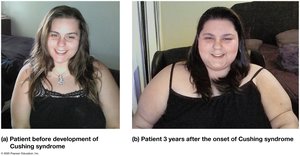
Table: Hormones of the Adrenal Gland
Hormone | Stimulus for Release | Inhibitor of Release | Target Tissue(s) | Effects |
|---|---|---|---|---|
Aldosterone | Angiotensin-II, high K+, low pH, ACTH | Increased blood pressure, low K+ | Kidneys | Increases Na+ retention, K+ excretion, raises BP |
Cortisol | ACTH | Increased cortisol | Liver, muscle, adipose | Increases blood glucose, suppresses inflammation |
Androgens | ACTH | Poorly understood | Multiple tissues | Minor androgenic effects |
Epinephrine/Norepinephrine | Sympathetic stimulation, ACTH | Lack of stimulation | Most cells | Fight-or-flight response |
Pancreas and Glucose Homeostasis
Structure and Function
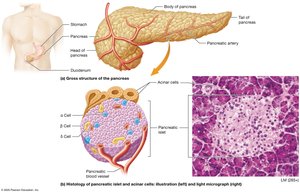
The pancreas contains both exocrine (acinar cells) and endocrine (islets of Langerhans) components. The islets contain:
Alpha cells: Secrete glucagon.
Beta cells: Secrete insulin.
Delta cells: Secrete somatostatin.
Hormones of the Endocrine Pancreas
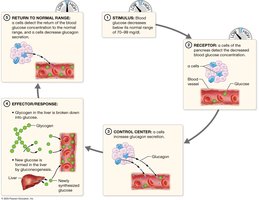
Glucagon: Raises blood glucose by promoting glycogenolysis, gluconeogenesis, and ketone body formation.
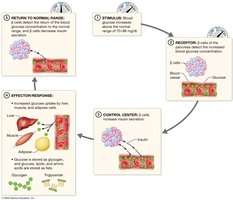
Insulin: Lowers blood glucose by promoting glucose uptake and storage, and synthesis of glycogen and fat.
Blood Glucose Regulation
Blood glucose is tightly regulated by insulin and glucagon through negative feedback loops.
Diabetes Mellitus
Type 1: Autoimmune destruction of beta cells; requires insulin therapy.
Type 2: Insulin resistance; associated with obesity and heredity; may require lifestyle changes, oral hypoglycemics, or insulin.
Hormones Produced by Other Endocrine Organs and Tissues
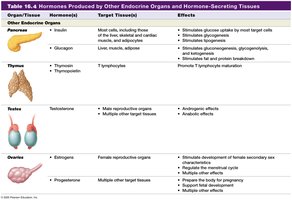
Table: Hormones Produced by Other Endocrine Organs and Hormone-Secreting Tissues
Organ/Tissue | Hormone(s) | Target Tissue(s) | Effects |
|---|---|---|---|
Thymus | Thymosin, Thymopoietin | T lymphocytes | Promote T cell maturation |
Testes | Testosterone | Male reproductive organs | Androgenic effects, sperm production |
Ovaries | Estrogens, Progesterone | Female reproductive organs | Development of secondary sex characteristics, regulation of menstrual cycle |
Heart | Atrial natriuretic peptide (ANP) | Kidneys | Decreases blood pressure |
Kidneys | Erythropoietin, Renin | Bone marrow, blood vessels | Stimulates red blood cell production, raises blood pressure |
Additional info: This summary covers the structure, function, and regulation of the endocrine system, including major glands, hormone classes, mechanisms of action, and clinical disorders. It is suitable for ANP college students preparing for exams on the endocrine system.
