 Back
6.2 The Endocrine System: Structure, Function, and Regulation
Study Guide - Smart Notes
 Tailored notes based on your materials, expanded with key definitions, examples, and context.
The Endocrine System
Overview and Essential Characteristics
The endocrine system is a network of glands and tissues that produce hormones to regulate various physiological processes. It works alongside the nervous system to maintain homeostasis, but differs in its mechanisms and effects.
Endocrine vs. Nervous System:
Both use chemical messengers, but the endocrine system uses hormones while the nervous system uses neurotransmitters.
Endocrine signals are distributed throughout the body and have longer-lasting effects; nervous signals are targeted and short-lived.
Both systems are regulated mainly by negative feedback mechanisms.
Endocrine Cells: Release hormones into extracellular fluid, affecting distant target cells.
Exocrine Cells: Release secretions into ducts, not directly into the bloodstream.
Organs and Tissues of the Endocrine System
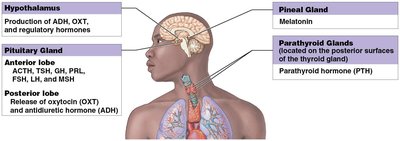
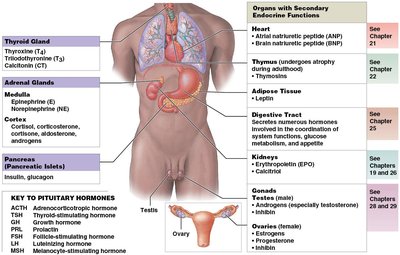
The endocrine system includes primary glands (e.g., pituitary, thyroid, adrenal, pancreas) and organs with secondary endocrine functions (e.g., heart, kidneys, digestive tract).
Primary Endocrine Glands: Hypothalamus, pituitary, thyroid, adrenal, pancreas, pineal, parathyroid.
Secondary Endocrine Functions: Heart, kidneys, digestive tract, adipose tissue, thymus, gonads.
Hormones: Classes and Mechanisms
Classes of Hormones
Hormones are classified based on their chemical structure, which determines their function and mechanism of action.
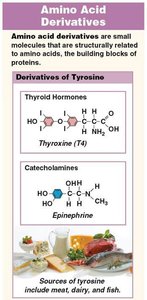
Amino Acid Derivatives: Small molecules derived from amino acids such as tyrosine and tryptophan.
Examples: Thyroid hormones (T3, T4), catecholamines (epinephrine, norepinephrine, dopamine), serotonin, melatonin.
Peptide Hormones: Chains of amino acids, often synthesized as inactive prohormones.
Examples: Insulin, growth hormone, prolactin, glycoproteins (TSH, LH, FSH).
Lipid Derivatives: Derived from fatty acids or cholesterol.
Eicosanoids: Paracrines coordinating cellular activities (e.g., prostaglandins, leukotrienes).
Steroid Hormones: Androgens, estrogens, progesterone, corticosteroids, calcitriol.
Hormone Transport and Inactivation
Hormones may circulate freely or be bound to carrier proteins. Free hormones are quickly inactivated by binding to receptors, breakdown in the liver/kidneys, or enzymatic degradation.
Free Hormones: Short-lived, rapidly inactivated.
Bound Hormones: Remain in circulation longer, protected by carrier proteins.
Mechanisms of Hormone Action
Hormones exert their effects by binding to specific receptors on target cells, which can alter genetic activity, protein synthesis, or membrane permeability.
Hormone Receptors: Protein molecules that determine a cell's sensitivity to a hormone.
Down-Regulation: High hormone levels decrease receptor numbers, reducing sensitivity.
Up-Regulation: Low hormone levels increase receptor numbers, enhancing sensitivity.
Major Endocrine Glands and Their Functions
The Pituitary Gland
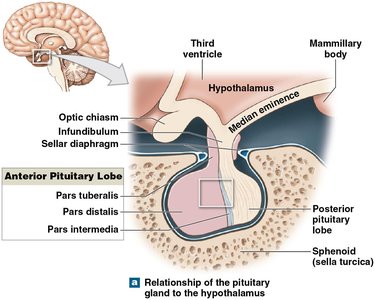
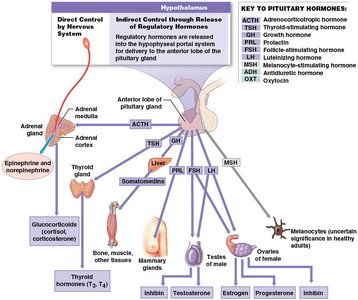
The pituitary gland (hypophysis) is located within the sella turcica and is connected to the hypothalamus. It releases nine important peptide hormones and is divided into anterior and posterior lobes.
Anterior Lobe: Produces ACTH, TSH, GH, PRL, FSH, LH, MSH.
Posterior Lobe: Releases oxytocin (OXT) and antidiuretic hormone (ADH).
The Thyroid Gland
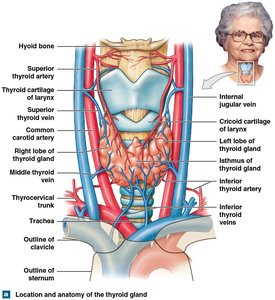
The thyroid gland is located inferior to the thyroid cartilage of the larynx. It produces T3 (triiodothyronine) and T4 (thyroxine), which contain three and four iodine atoms, respectively.
Thyroid Hormones: Affect nearly every cell, essential for development in children, regulate metabolism, heart rate, and bone turnover.
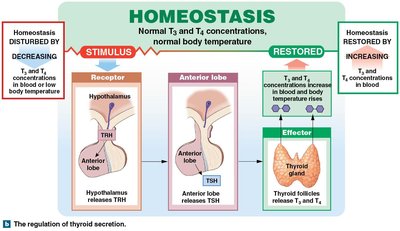
Regulation: Controlled by negative feedback involving hypothalamus (TRH), anterior pituitary (TSH), and thyroid gland.
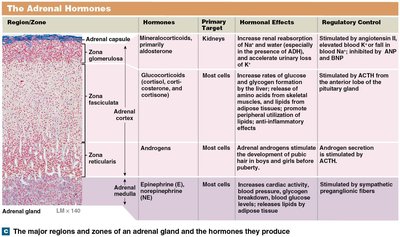
The Adrenal Glands
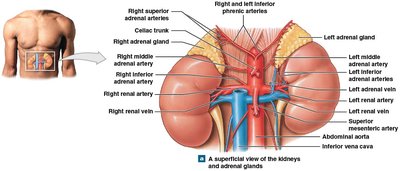
The adrenal glands are located on the superior border of each kidney and consist of an outer cortex and inner medulla.
Adrenal Cortex: Produces corticosteroids (mineralocorticoids, glucocorticoids, androgens).
Adrenal Medulla: Produces catecholamines (epinephrine, norepinephrine).
Cortex Zones: Zona glomerulosa (mineralocorticoids), zona fasciculata (glucocorticoids), zona reticularis (androgens).
Region/Zone | Hormones | Primary Target | Hormonal Effects | Regulatory Control |
|---|---|---|---|---|
Zona glomerulosa | Mineralocorticoids (aldosterone) | Kidneys | Increase renal reabsorption of Na+ and water; accelerate urinary loss of K+ | Stimulated by angiotensin II, elevated K+ or fall in Na+ |
Zona fasciculata | Glucocorticoids (cortisol, corticosterone) | Most cells | Increase rates of glucose and glycogen formation; anti-inflammatory effects | Stimulated by ACTH |
Zona reticularis | Androgens | Most cells | Stimulate development of pubic hair in boys and girls before puberty | Androgen secretion stimulated by ACTH |
Adrenal medulla | Epinephrine, norepinephrine | Most cells | Increase cardiac activity, blood pressure, glycogen breakdown | Stimulated by sympathetic preganglionic fibers |
The Pancreas
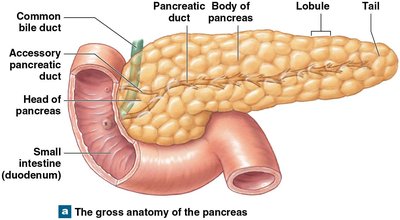
The pancreas is a large gland located between the stomach and small intestine. It contains both exocrine and endocrine cells.
Exocrine Pancreas: Produces enzyme-rich fluid for digestion.
Endocrine Pancreas: Contains pancreatic islets with alpha (glucagon), beta (insulin), delta, and PP cells.
Regulation of Blood Glucose
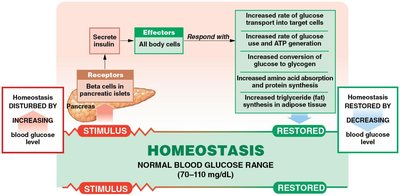
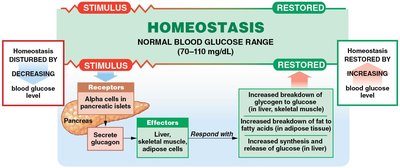
Blood glucose levels are regulated by insulin and glucagon, maintaining homeostasis.
High Blood Glucose: Beta cells secrete insulin, promoting glucose uptake and storage.
Low Blood Glucose: Alpha cells secrete glucagon, stimulating glycogen breakdown and glucose release.
Diabetes Mellitus
Diabetes mellitus is a disorder of blood glucose regulation.
Type 1 Diabetes: Inadequate insulin production; requires insulin therapy; often develops in children/young adults.
Type 2 Diabetes: Most common; tissues are resistant to insulin; associated with obesity; weight loss can be effective.
Complications: Kidney degeneration, retinal damage, heart attacks, neuropathies, peripheral tissue damage.
Summary Table: Major Endocrine Glands and Their Hormones
Gland | Hormones | Main Functions |
|---|---|---|
Hypothalamus | ADH, OXT, regulatory hormones | Controls pituitary gland, water balance, uterine contraction |
Pituitary (anterior) | ACTH, TSH, GH, PRL, FSH, LH, MSH | Regulates adrenal, thyroid, growth, lactation, gonads, pigmentation |
Pituitary (posterior) | OXT, ADH | Uterine contraction, water reabsorption |
Thyroid | T3, T4, calcitonin | Metabolism, calcium regulation |
Adrenal cortex | Corticosteroids, androgens | Metabolism, stress response, sex hormones |
Adrenal medulla | Epinephrine, norepinephrine | Fight-or-flight response |
Pancreas | Insulin, glucagon | Blood glucose regulation |
Pineal | Melatonin | Sleep-wake cycles |
Parathyroid | PTH | Calcium regulation |
