 Back
The Endocrine System: Structure, Function, and Hormonal Regulation
Study Guide - Smart Notes
 Tailored notes based on your materials, expanded with key definitions, examples, and context.
The Endocrine System
Overview and Functions
The endocrine system is a major regulatory system of the body, responsible for controlling and integrating numerous physiological processes through the secretion of hormones. These processes include reproduction, growth and development, maintenance of electrolyte, water, and nutrient balance, regulation of cellular metabolism and energy balance, and mobilization of body defenses.
Hormones are chemical messengers released in small amounts and affect target cells throughout the body.
The endocrine system is composed of glands that are richly vascularized and scattered throughout the body.
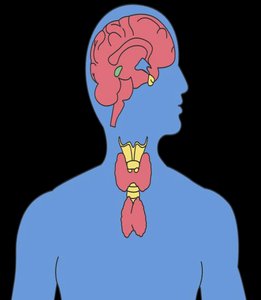
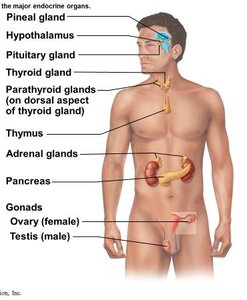
Major Endocrine Organs and Glands
The organs containing endocrine cells are divided into three groups:
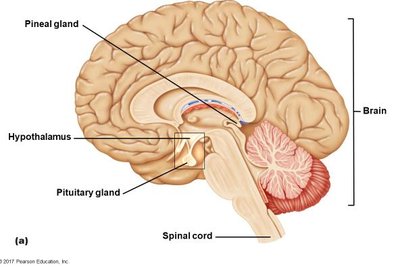
Organs that contain only endocrine cells (e.g., pituitary gland, pineal gland, thyroid and parathyroid glands, adrenal glands).
Organs containing a large proportion of endocrine cells but also function in other organ systems (e.g., hypothalamus, pancreas, gonads, placenta).
Organs that contain some endocrine cells (e.g., heart, kidneys, skin, digestive tract).
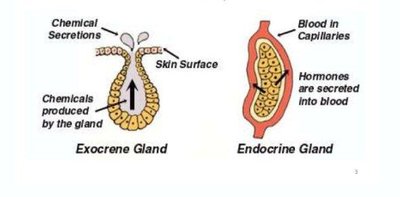
Endocrine vs. Exocrine Glands
Structural and Functional Differences
Endocrine glands are derived from epithelial tissue and are ductless, secreting hormones directly into the bloodstream. In contrast, exocrine glands produce nonhormonal substances (such as sweat or saliva) and have ducts to carry their secretions to membrane surfaces.
Endocrine glands: Ductless, secrete hormones into blood.
Exocrine glands: Have ducts, secrete nonhormonal substances to surface.
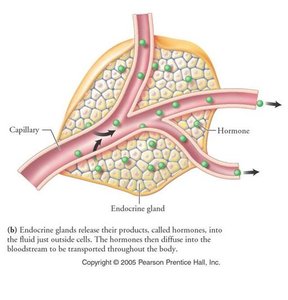
Hormones: Chemical Messengers
Types of Chemical Messengers
Hormones: Long-distance chemical signals, travel in blood or lymph.
Autocrines: Act on the same cells that secrete them.
Paracrines: Affect nearby cells other than those that secrete them.
Classification of Hormones
Hormones are classified based on their chemical structure, which determines their solubility in water and their mechanism of action.
Amino acid–based hormones: Includes amino acid derivatives, peptides, and proteins.
Steroid hormones: Synthesized from cholesterol; includes gonadal and adrenocortical hormones.
Eicosanoids: Sometimes considered hormones, but mostly classified as paracrines.
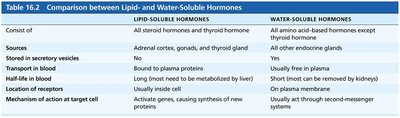
Comparison of Lipid-Soluble and Water-Soluble Hormones
Property | Lipid-Soluble Hormones | Water-Soluble Hormones |
|---|---|---|
Consist of | All steroid hormones and thyroid hormone | All amino acid-based hormones except thyroid hormone |
Sources | Adrenal cortex, gonads, thyroid gland | Other endocrine glands |
Stored in secretory vesicles | No | Yes |
Transport in blood | Bound to plasma proteins | Usually free in plasma |
Half-life in blood | Long (must be metabolized by liver) | Short (must be removed by kidneys) |
Location of receptors | Usually inside cell | On plasma membrane |
Mechanism of action at target cell | Activate genes, causing synthesis of new proteins | Usually act through second-messenger systems |
Mechanisms of Hormone Action
Target Cell Specificity
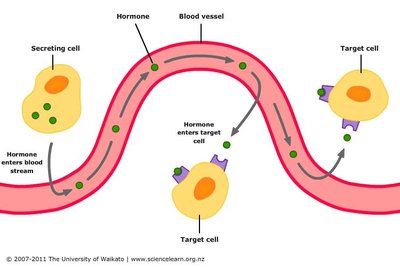
Although hormones circulate systemically, only cells with specific receptors for that hormone are affected.
Target cells: Tissues with receptors for a specific hormone.
Hormones alter target cell activity by increasing or decreasing the rates of normal cellular processes.
Factors Affecting Target Cell Activation
Blood levels of hormone
Relative number of receptors on/in target cell
Affinity (strength) of binding between receptor and hormone
Regulation of Receptors
Up-regulation: Target cells form more receptors in response to low hormone levels.
Down-regulation: Target cells lose receptors in response to high hormone levels.
Hormone Clearance and Half-Life
Hormones are removed from blood by degrading enzymes, kidneys, or liver.
Half-life: Time required for hormone level in blood to decrease by half.
Hormone Action: Water-Soluble vs. Lipid-Soluble
Water-Soluble Hormones
Water-soluble hormones (all amino acid–based hormones except thyroid hormone) act on plasma membrane receptors and use G protein second messengers. They cannot enter the cell. 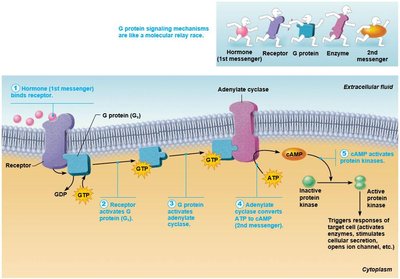
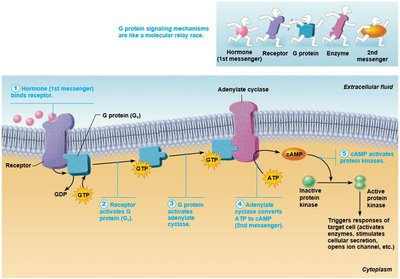
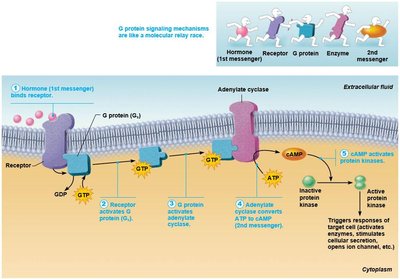
cAMP Second Messenger System
Hormone (first messenger) binds to receptor.
Receptor activates a G protein.
G protein activates or inhibits adenylate cyclase.
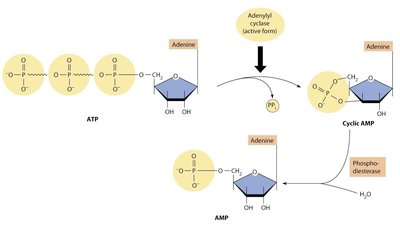
Adenylate cyclase converts ATP to cAMP (second messenger).
cAMP activates protein kinases that phosphorylate other proteins.
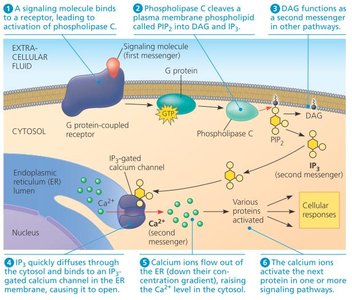
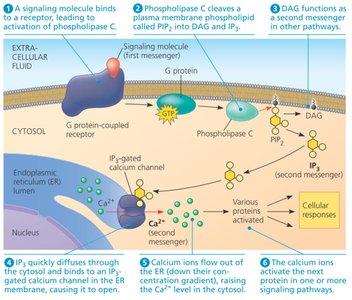
PIP2-Calcium Second Messenger System
Hormone-activated G protein activates phospholipase C.
Phospholipase C splits PIP2 into DAG and IP3.
DAG activates protein kinases; IP3 causes Ca2+ release from intracellular storage sites.
Ca2+ acts as another second messenger, binds to calmodulin, and activates enzymes that amplify cellular response.
Lipid-Soluble Hormones
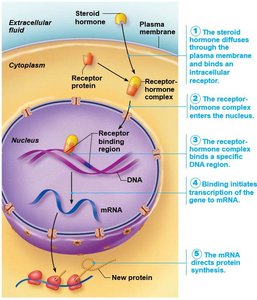
Lipid-soluble steroid hormones and thyroid hormone can diffuse into target cells and bind with intracellular receptors. The receptor-hormone complex enters the nucleus, binds to DNA, and initiates transcription to produce mRNA, which is then translated into specific proteins. 
Hormone Release and Regulation
Control of Hormone Release
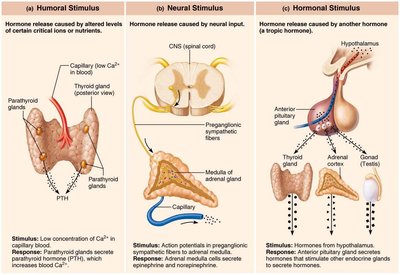
Blood levels of hormones are controlled by negative feedback systems. Hormone release is triggered by three types of stimuli:
Humoral stimuli: Changes in blood levels of certain ions or nutrients (e.g., blood calcium).
Neural stimuli: Nerve fibers stimulate hormone release (e.g., sympathetic input to adrenal medulla).
Hormonal stimuli: Hormones stimulate other endocrine glands to release their hormones (e.g., TRH → TSH → T3/T4).
The Hypothalamus and Pituitary Gland
Structure and Function
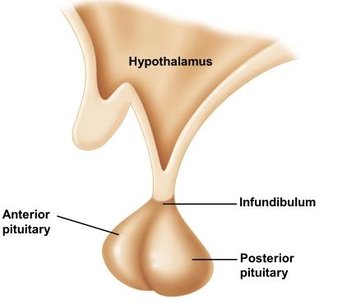
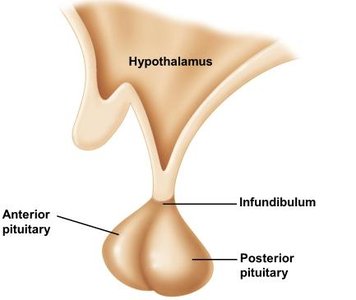
The hypothalamus is connected to the pituitary gland via the infundibulum. The pituitary gland has two major lobes:
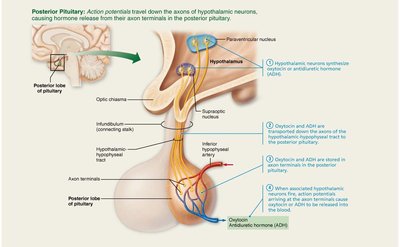
Posterior pituitary: Composed of neural tissue, secretes neurohormones (oxytocin and vasopressin/antidiuretic hormone).
Anterior pituitary: Consists of glandular tissue, secretes at least six major peptide hormones.
Pituitary-Hypothalamic Relationships
Posterior lobe maintains neural connection to hypothalamus via the hypothalamic-hypophyseal tract.
Anterior lobe is vascularly connected to hypothalamus via the hypophyseal portal system.
Hypothalamus secretes releasing and inhibiting hormones to regulate anterior pituitary hormone secretion.
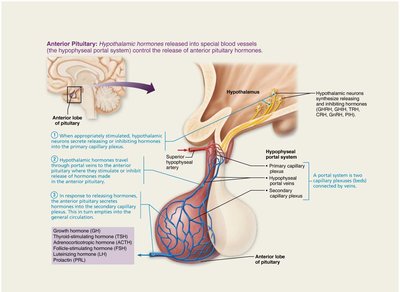
Anterior Pituitary Hormones
Types and Functions
All six hormones are peptide hormones.
All but growth hormone (GH) activate target cells via cAMP second-messenger system.
All but two are tropic hormones (regulate secretion of other hormones).
Growth hormone (GH): Direct actions on metabolism and indirect growth-promoting actions.
Thyroid-stimulating hormone (TSH): Stimulates normal development and secretory activity of thyroid.
Adrenocorticotropic hormone (ACTH): Stimulates adrenal cortex to release corticosteroids.
Follicle-stimulating hormone (FSH): Tropic hormone.
Luteinizing hormone (LH): Tropic hormone.
Prolactin (PRL): Stimulates milk production.
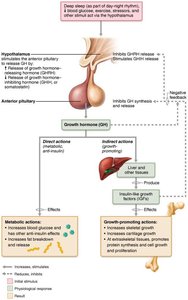
Thyroid Gland and Hormones
Structure and Function
The thyroid gland is the body's major metabolic hormone producer. It releases T4 (thyroxine) and T3 (triiodothyronine), which regulate metabolism, growth, development, and blood pressure.
Colloid: Fluid containing thyroglobulin and iodine, precursor to thyroid hormone.
Parafollicular cells: Produce calcitonin.
Thyroid Hormone Synthesis
Thyroglobulin is synthesized and discharged into follicle lumen.
Iodide is trapped and released into lumen.
Iodide is oxidized to iodine.
Iodine attaches to tyrosine, forming MIT and DIT.
Iodinated tyrosines link to form T3 and T4.
Colloid is endocytosed by follicular cells and combined with lysosome.
Lysosomal enzymes cleave T3 and T4 from thyroglobulin; hormones are secreted into bloodstream.
Regulation and Clinical Aspects
TH release is regulated by negative feedback.
Hyposecretion leads to myxedema and goiter; hypersecretion leads to Graves' disease.
Parathyroid Gland and Hormones
Structure and Function
The parathyroid glands secrete parathyroid hormone (PTH), the most important hormone in Ca2+ homeostasis.
PTH stimulates osteoclasts, enhances Ca2+ reabsorption by kidneys, and promotes activation of vitamin D.
Hyperparathyroidism leads to bone softening and kidney stones; hypoparathyroidism causes hypocalcemia and tetany.
Adrenal Glands and Hormones
Structure and Function
The adrenal glands consist of the adrenal cortex (produces corticosteroids) and adrenal medulla (produces catecholamines).
Mineralocorticoids (e.g., aldosterone): Regulate electrolyte concentrations.
Glucocorticoids (e.g., cortisol): Influence metabolism and help resist stressors.
Gonadocorticoids: Weak androgens converted to testosterone or estrogens.
Catecholamines (epinephrine and norepinephrine): Mediate short-term stress responses.
Regulation and Clinical Aspects
Hypersecretion of glucocorticoids leads to Cushing's syndrome; hyposecretion leads to Addison's disease.
Hypersecretion of gonadocorticoids leads to adrenogenital syndrome.
Hypersecretion of catecholamines leads to symptoms of uncontrolled sympathetic nervous system.
Summary Table: Regulation and Effects of Adrenal Gland Hormones
Hormone | Source | Regulation | Effects |
|---|---|---|---|
Aldosterone | Zona glomerulosa | Renin-angiotensin, K+, ACTH | Na+ reabsorption, K+ elimination |
Cortisol | Zona fasciculata | ACTH, CRH | Metabolism, stress resistance |
Androgens | Zona reticularis | ACTH | Sex characteristics, libido |
Epinephrine/Norepinephrine | Adrenal medulla | Neural stimuli | Fight-or-flight response |
Key Questions for Review
What defines an endocrine gland vs. an exocrine gland?
What distinguishes amino acid-based hormones from steroid hormones?
How do water-soluble hormones act on target cells?
What is the role of second messengers like cAMP or Ca²⁺?
How do lipid-soluble hormones trigger cellular changes?
What determines a hormone’s target specificity?
What is receptor upregulation/downregulation?
How are hormones cleared from the body?
What factors influence hormone half-life?
Define and give examples of humoral, neural, and hormonal stimuli.
What’s the structural and functional difference between anterior and posterior pituitary?
Which hypothalamic hormones influence the anterior pituitary?
Which hormones are stored in the posterior pituitary?
What two hypothalamic hormones regulate GH release?
Describe the synthesis and function of T3 and T4.
What does calcitonin do, and when is it released?
What stimulates PTH secretion, and what are its effects?
What hormones are secreted by the adrenal cortex?
What are the clinical consequences of over- or under-secretion?
What do epinephrine and norepinephrine do in the body?
