 Back
BackThe Endocrine System: Structure, Function, and Regulation
Study Guide - Smart Notes
 Tailored notes based on your materials, expanded with key definitions, examples, and context.
The Endocrine System
Overview and Functions
The endocrine system is a major regulatory system of the body, responsible for controlling and integrating processes such as reproduction, growth and development, maintenance of electrolyte, water, and nutrient balance, regulation of cellular metabolism and energy balance, and mobilization of body defenses. It achieves these functions through the secretion of chemical messengers called hormones that travel through the bloodstream to target organs.
Hormones are chemical messengers released in small amounts that affect target cells throughout the body.
The endocrine system is composed of glands that are richly vascularized and scattered throughout the body.
Endocrine vs. Exocrine Glands
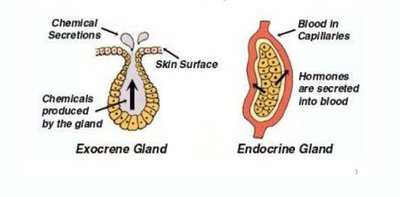
Endocrine glands are ductless glands that secrete hormones directly into the bloodstream, whereas exocrine glands have ducts and release nonhormonal substances (such as sweat or saliva) onto epithelial surfaces.
Endocrine glands: Ductless, secrete hormones into blood.
Exocrine glands: Have ducts, secrete nonhormonal products to body surfaces or cavities.
Classification and Structure of Endocrine Organs
Types of Endocrine Organs
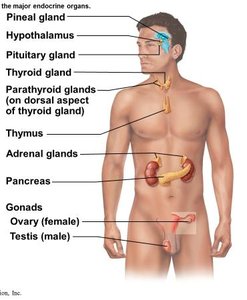
Organs containing only endocrine cells: Pituitary gland, pineal gland, thyroid gland, parathyroid glands, adrenal glands.
Organs with a large proportion of endocrine cells: Hypothalamus, pancreas, gonads, placenta.
Organs with scattered endocrine cells: Heart, kidneys, skin, digestive tract.
Hormones: Types, Structure, and Mechanisms
Chemical Classification of Hormones
Hormones are classified based on their chemical structure, which determines their solubility, transport in blood, receptor location, and mechanism of action.
Amino acid–based hormones: Includes amino acid derivatives, peptides, and proteins. Most hormones belong to this class.
Steroid hormones: Synthesized from cholesterol; includes gonadal and adrenocortical hormones.
Eicosanoids: Sometimes considered hormones, but mainly act as paracrines.
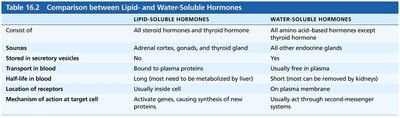
Lipid-Soluble Hormones | Water-Soluble Hormones | |
|---|---|---|
Consist of | All steroid hormones and thyroid hormone | All amino acid–based hormones except thyroid hormone |
Sources | Adrenal cortex, gonads, thyroid gland | All other endocrine glands |
Stored in secretory vesicles | No | Yes |
Transport in blood | Bound to plasma proteins | Usually free in plasma |
Half-life in blood | Long (must be metabolized by liver) | Short (most removed by kidneys) |
Location of receptors | Usually inside cell | On plasma membrane |
Mechanism of action at target cell | Activate genes, causing synthesis of new proteins | Usually act through second-messenger systems |
Mechanisms of Hormone Action
Hormones act on target cells by binding to specific receptors. The mechanism depends on the hormone's solubility:
Water-soluble hormones (all amino acid–based except thyroid hormone): Act on plasma membrane receptors via G protein–coupled second messenger systems (e.g., cAMP, PIP2-calcium). They cannot enter the cell.
Lipid-soluble hormones (steroid and thyroid hormones): Act on intracellular receptors that directly activate genes. They can diffuse through the plasma membrane.
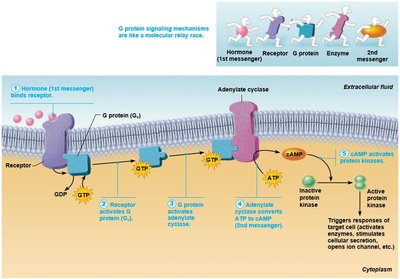
cAMP Second Messenger System
Hormone (first messenger) binds to receptor.
Receptor activates G protein.
G protein activates adenylate cyclase.
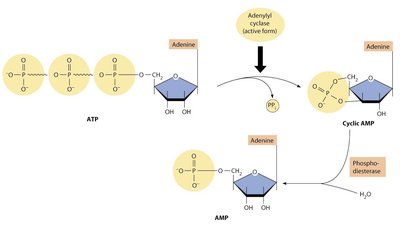
Adenylate cyclase converts ATP to cAMP (second messenger).
cAMP activates protein kinases, which phosphorylate proteins, leading to cellular responses.
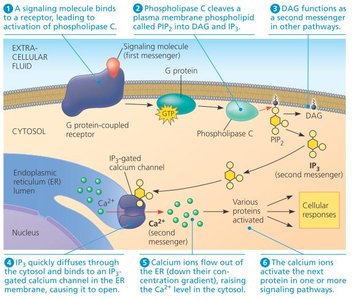
PIP2-Calcium Second Messenger System
Hormone-activated G protein activates phospholipase C.
Phospholipase C splits PIP2 into DAG and IP3.
DAG activates protein kinases; IP3 releases Ca2+ from intracellular stores.
Ca2+ acts as a second messenger, often binding to calmodulin to activate enzymes.
Direct Gene Activation by Lipid-Soluble Hormones
Lipid-soluble hormone diffuses into target cell and binds to intracellular receptor.
Receptor-hormone complex enters nucleus and binds to DNA.
Initiates transcription of specific genes to mRNA.
mRNA is translated into proteins that alter cell function.
Regulation of Hormone Release
Feedback Mechanisms
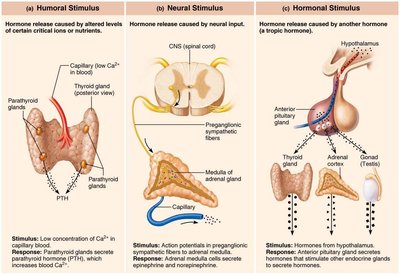
Hormone secretion is primarily regulated by negative feedback mechanisms, maintaining hormone levels within a narrow range. Hormone release can be triggered by:
Humoral stimuli: Changes in blood levels of ions or nutrients (e.g., Ca2+ triggers PTH release).
Neural stimuli: Nerve fibers stimulate hormone release (e.g., sympathetic input to adrenal medulla).
Hormonal stimuli: Hormones stimulate other endocrine glands to release hormones (e.g., TRH → TSH → T3/T4).
Hypothalamus and Pituitary Gland
Structure and Function
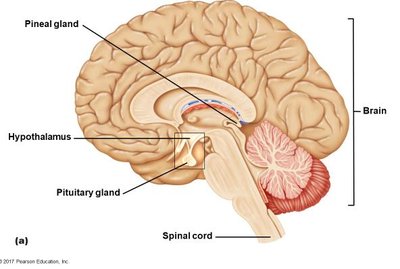
The hypothalamus is the center for homeostasis and regulates the pituitary gland (hypophysis), which is divided into two lobes:
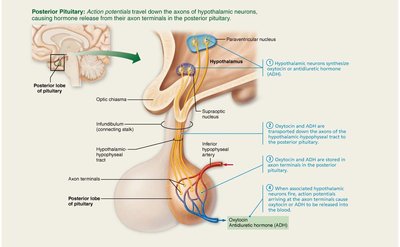
Posterior pituitary (neurohypophysis): Neural tissue; stores and releases oxytocin and antidiuretic hormone (ADH) produced by the hypothalamus.
Anterior pituitary (adenohypophysis): Glandular tissue; produces and releases hormones in response to hypothalamic releasing and inhibiting hormones.
Posterior Pituitary Hormones
Oxytocin: Stimulates uterine contractions during childbirth and milk ejection during lactation; acts via positive feedback.
Antidiuretic hormone (ADH, vasopressin): Promotes water reabsorption in kidneys; released in response to high blood solute concentration, pain, low blood pressure, or drugs; inhibited by alcohol and diuretics.
Anterior Pituitary Hormones
Growth hormone (GH): Stimulates growth, protein synthesis, and mobilizes fat; regulated by GHRH and GHIH from hypothalamus.
Thyroid-stimulating hormone (TSH): Stimulates thyroid gland; regulated by TRH from hypothalamus.
Adrenocorticotropic hormone (ACTH): Stimulates adrenal cortex; regulated by CRH from hypothalamus.
Follicle-stimulating hormone (FSH) and Luteinizing hormone (LH): Regulate gonadal function; controlled by GnRH.
Prolactin (PRL): Stimulates milk production; regulated by PIH (dopamine).
Major Endocrine Glands and Their Hormones
Thyroid Gland
Thyroid hormone (TH): Increases metabolic rate, regulates growth and development, maintains blood pressure.
Calcitonin: Lowers blood calcium levels; antagonistic to parathyroid hormone.
Parathyroid Glands
Parathyroid hormone (PTH): Increases blood calcium by stimulating osteoclasts, enhancing kidney reabsorption, and activating vitamin D for intestinal absorption.
Adrenal Glands
Adrenal cortex: Produces corticosteroids (mineralocorticoids, glucocorticoids, gonadocorticoids).
Adrenal medulla: Produces catecholamines (epinephrine and norepinephrine) for short-term stress response.
Pancreas
Glucagon (alpha cells): Raises blood glucose by promoting glycogen breakdown and gluconeogenesis.
Insulin (beta cells): Lowers blood glucose by enhancing cellular uptake and storage of glucose.
Clinical Correlations
Diabetes mellitus: Due to insulin deficiency (Type 1) or resistance (Type 2); characterized by polyuria, polydipsia, and polyphagia.
Addison’s disease: Hyposecretion of adrenal cortex hormones; causes weight loss, dehydration, hypotension.
Cushing’s syndrome: Hypersecretion of glucocorticoids; causes fat redistribution, muscle weakness, and immune suppression.
Graves’ disease: Hyperthyroidism; causes elevated metabolism, weight loss, exophthalmos.
Myxedema/goiter: Hypothyroidism, often due to iodine deficiency.
Summary Table: Major Endocrine Glands and Hormones
Gland | Hormone(s) | Main Function(s) |
|---|---|---|
Pituitary (anterior) | GH, TSH, ACTH, FSH, LH, PRL | Growth, metabolism, stress, reproduction, lactation |
Pituitary (posterior) | Oxytocin, ADH | Uterine contraction, milk ejection, water balance |
Thyroid | TH, Calcitonin | Metabolism, calcium regulation |
Parathyroid | PTH | Calcium homeostasis |
Adrenal cortex | Aldosterone, cortisol, androgens | Electrolyte balance, stress response, sex characteristics |
Adrenal medulla | Epinephrine, norepinephrine | Fight-or-flight response |
Pancreas | Insulin, glucagon | Blood glucose regulation |
Gonads | Estrogen, progesterone, testosterone | Reproduction, secondary sex characteristics |
Why This Chapter Matters
Understanding hormonal regulation is essential for diagnosing and managing endocrine disorders such as diabetes, thyroid disease, and adrenal insufficiency.
Many medications act by mimicking or altering hormone activity.
Imaging and laboratory tests are crucial for identifying endocrine abnormalities.
Endocrine disorders are significant public health concerns, requiring knowledge for prevention and treatment strategies.
