 Back
The Endocrine System: Structure, Function, and Regulation
Study Guide - Smart Notes
 Tailored notes based on your materials, expanded with key definitions, examples, and context.
The Endocrine System
Introduction to the Endocrine System
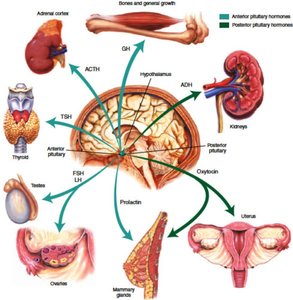
The endocrine system is a major regulatory system in the human body, responsible for producing and releasing hormones that control and coordinate various physiological processes. Endocrine cells and tissues produce approximately 30 different hormones, which act as chemical messengers to maintain homeostasis and coordinate cellular activities.
Hormones: Chemical messengers released by endocrine cells to regulate body functions.
Homeostasis: The maintenance of stable internal conditions.
Endocrine organs: Scattered throughout the body, releasing hormones into the bloodstream.
Mechanisms of Intercellular Communication
Types of Cellular Communication
Cells communicate through several mechanisms to regulate their activities and maintain homeostasis. These include direct, paracrine, autocrine, endocrine, and synaptic communication.
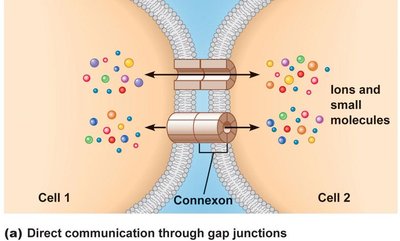
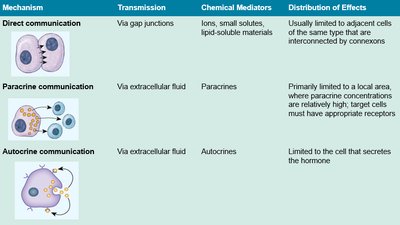
Direct communication: Occurs between cells of the same type via gap junctions, allowing ions and small molecules to pass directly between cells.
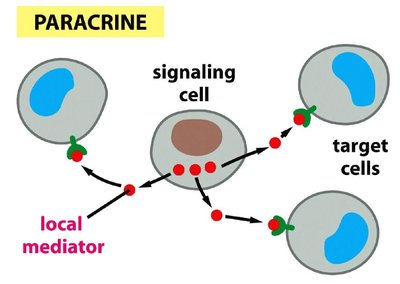
Paracrine communication: Chemical messengers transfer information from one cell to neighboring cells within the same tissue.
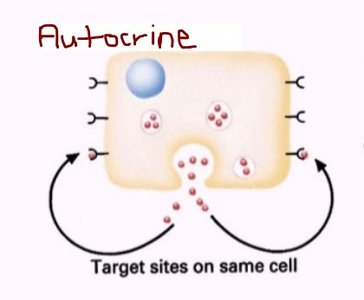
Autocrine communication: Cells release messengers that affect themselves.
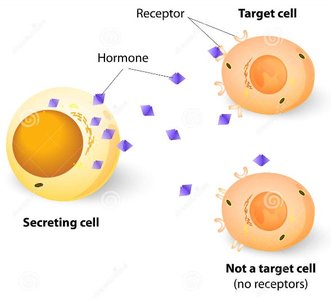
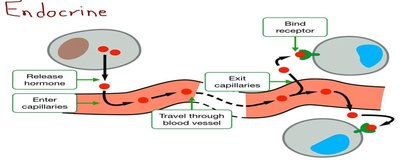
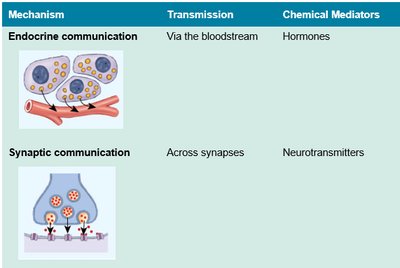
Endocrine communication: Endocrine cells release hormones into the bloodstream, affecting distant target cells.
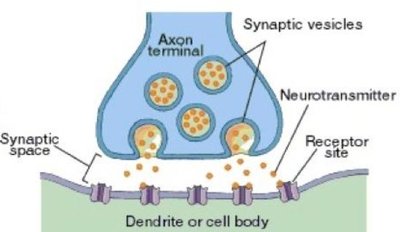
Synaptic communication: Neurons release neurotransmitters at synapses, leading to rapid, targeted responses.
Comparison of Communication Mechanisms
The following table summarizes the main mechanisms of intercellular communication, their transmission methods, chemical mediators, and distribution of effects.
Mechanism | Transmission | Chemical Mediators | Distribution of Effects |
|---|---|---|---|
Direct communication | Via gap junctions | Ions, small solutes, lipid-soluble materials | Adjacent cells of same type |
Paracrine communication | Via extracellular fluid | Paracrines | Local area, target cells with appropriate receptors |
Autocrine communication | Via extracellular fluid | Autocrines | Limited to cell that secretes hormone |
Mechanism | Transmission | Chemical Mediators |
|---|---|---|
Endocrine communication | Via bloodstream | Hormones |
Synaptic communication | Across synapses | Neurotransmitters |
Hormones: Regulation and Function
Hormone Functions and Regulation
Hormones regulate essential physiological processes, including growth, development, reproduction, metabolism, water and electrolyte balance, and mobilization of body defenses. Their secretion is mainly regulated by negative feedback mechanisms to preserve homeostasis.
Negative feedback: A process where the output reduces the original stimulus, maintaining balance.
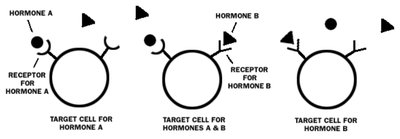
Target cells: Cells with specific receptors for hormones.
Classes of Hormones
Hormones are classified based on their chemical structure:
Amino acid derivatives: Small molecules related to amino acids (e.g., thyroid hormones, catecholamines, serotonin, melatonin).
Peptide hormones: Chains of amino acids, including glycoproteins and small proteins (e.g., insulin, growth hormone, ADH).
Lipid derivatives: Includes eicosanoids (derived from arachidonic acid) and steroid hormones (derived from cholesterol).
Hormone Transport and Inactivation
Hormones may circulate freely or bound to carrier proteins.
Free hormones: Remain functional for less than an hour, inactivated by binding to receptors, breakdown by liver/kidneys, or enzymes.
Bound hormones: Thyroid and steroid hormones remain functional longer, attached to transport proteins.
Hormone Receptors and Cellular Response
Types of Hormone Receptors
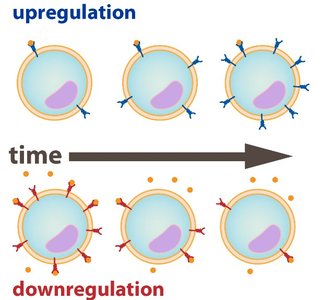
The presence or absence of specific receptors determines a cell's sensitivity to hormones.
Extracellular receptors: Located on the plasma membrane; bind water-soluble hormones.
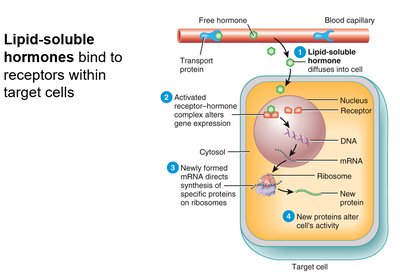
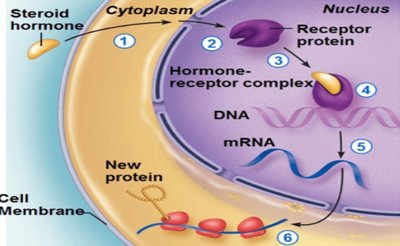
Intracellular receptors: Located inside the cell; bind lipid-soluble hormones.
Regulation of Receptor Numbers
Down-regulation: High hormone levels decrease receptor numbers, reducing sensitivity.
Up-regulation: Low hormone levels increase receptor numbers, enhancing sensitivity.

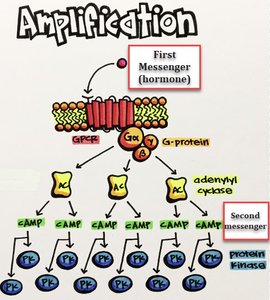
Signal Transduction: Second Messengers
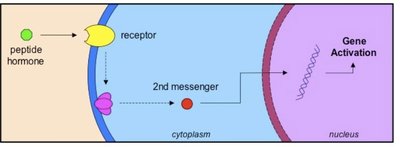
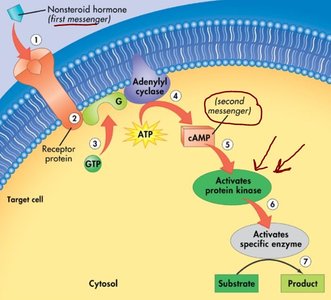
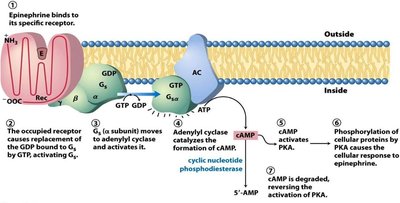
Many hormones act through second messenger systems, especially water-soluble hormones.
First messenger: The hormone binding to the extracellular receptor.
G protein: Enzyme complex linking first messenger to second messenger.
Second messenger: Molecule generated inside the cell (e.g., cAMP, cGMP, Ca2+) that amplifies the hormone's effect.
Amplification: One receptor can activate many second messengers, magnifying the effect.


Intracellular Receptors and Gene Activation
Steroid and thyroid hormones bind to intracellular receptors, affecting gene expression and protein synthesis.
Hormone–receptor complex can activate or deactivate specific genes.
Changes the rate of DNA transcription and metabolic activity.
Can increase ATP production.


Control of Hormone Secretion
Negative Feedback Regulation
Hormone secretion is primarily controlled by negative feedback, where a stimulus triggers hormone production that reduces the intensity of the stimulus. 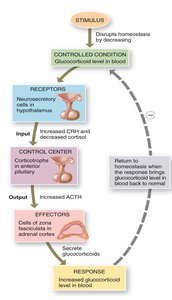
Types of Stimuli for Hormone Secretion
Humoral stimuli: Changes in extracellular fluid composition (e.g., blood calcium levels).
Hormonal stimuli: Arrival or removal of another hormone.
Neural stimuli: Stimulation by neurotransmitters at neuroglandular junctions.
Endocrine vs. Exocrine Glands
Comparison of Gland Types
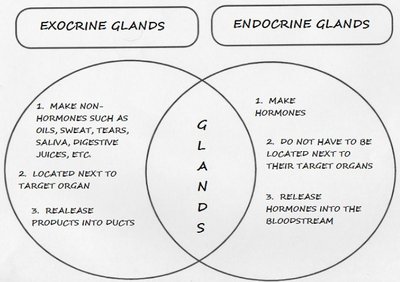
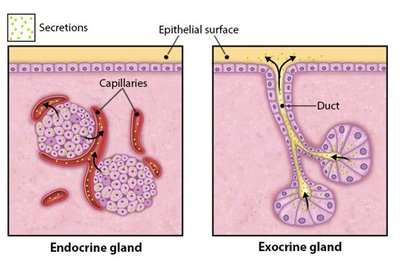
Endocrine glands release hormones into the bloodstream, while exocrine glands release non-hormonal substances into ducts.
Exocrine Glands | Endocrine Glands |
|---|---|
Make non-hormones (e.g., oils, sweat, saliva) | Make hormones |
Located next to target organ | Do not have to be near target organs |
Release products into ducts | Release hormones into bloodstream |
Summary Table: Hormone Communication Pathways
Mechanism | Transmission | Chemical Mediators |
|---|---|---|
Direct communication | Via gap junctions | Ions, small solutes |
Paracrine communication | Via extracellular fluid | Paracrines |
Autocrine communication | Via extracellular fluid | Autocrines |
Endocrine communication | Via bloodstream | Hormones |
Synaptic communication | Across synapses | Neurotransmitters |
Key Equations and Concepts
Second Messenger Pathways
cAMP formation:
Phosphodiesterase inactivation:
Conclusion
The endocrine system is essential for regulating long-term processes such as growth, development, metabolism, and homeostasis. Understanding the mechanisms of hormone action, receptor regulation, and feedback control is fundamental for comprehending human physiology.
Additional info:
Some diagrams and tables were expanded for clarity and completeness. The notes cover all major aspects of endocrine system structure, function, and regulation as outlined in the ANP college course.
