 Back
The Endocrine System: Structure, Function, and Regulation
Study Guide - Smart Notes
 Tailored notes based on your materials, expanded with key definitions, examples, and context.
The Endocrine System: Overview
Major Control Systems of the Body
The endocrine system is one of the body's two major control systems, working alongside the nervous system to coordinate and integrate the activity of most body cells. It uses hormones—chemical messengers transported in the blood—to influence metabolic activities. Endocrine responses are typically slower but longer-lasting than nervous system responses. The study of hormones and endocrine organs is called endocrinology.
Major processes controlled by the endocrine system:
Reproduction
Growth and development
Maintenance of electrolyte, water, and nutrient balance
Regulation of cellular metabolism and energy balance
Mobilization of body defenses
Endocrine vs. Nervous System
Feature | Nervous System | Endocrine System |
|---|---|---|
Response initiation | Rapid | Slow |
Duration of response | Short | Long |
Signal type | Action potentials, neurotransmitters | Hormones in blood |
Target location | Specific (axon pathways) | Diffuse (anywhere blood reaches) |
Distance of action | Short | Long |
Signal strength coding | Frequency of action potentials | Hormone concentration |
Endocrine and Exocrine Glands
Exocrine glands: Produce nonhormonal substances (e.g., sweat, saliva); have ducts to carry secretion to membrane surface.
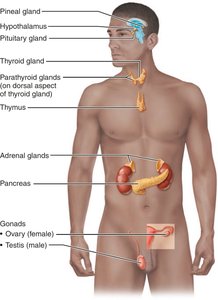
Endocrine glands: Produce hormones; ductless; hormones secreted directly into extracellular fluid. Major glands include the pituitary, thyroid, parathyroid, adrenal, and pineal glands. The hypothalamus is a neuroendocrine organ.
Other organs with endocrine tissue: pancreas, gonads, placenta, stomach, intestine, heart, kidneys, skin, thymus, bone, adipose tissue.
Chemical Messengers of the Endocrine System
Types of Chemical Messengers
Hormones: Long-distance chemical signals; travel in blood to target cells.
Autocrines: Act on the same cells that secrete them (local effect).
Paracrines: Affect neighboring cells (local effect).
Autocrines and paracrines are not considered part of the endocrine system due to their local effects.
Chemical Structure of Hormones
The chemical structure of a hormone determines its solubility in water, which affects its transport in blood, degradation rate, and receptor interaction.
Amino acid–based hormones: Most hormones; water-soluble (except thyroxine); cannot cross plasma membrane.
Steroid hormones: Synthesized from cholesterol; lipid-soluble; can cross plasma membrane; includes gonadal and adrenocortical hormones.
Eicosanoids: Sometimes considered hormones, but mostly act as paracrines and autocrines.
Mechanisms of Hormone Action
Target Cell Specificity and Effects
Only cells with specific receptors for a hormone are affected (target cells). Hormones alter target cell activity by increasing or decreasing the rates of normal cellular processes.
Alter plasma membrane permeability and/or membrane potential
Stimulate synthesis of enzymes or other proteins
Activate or deactivate enzymes
Induce secretory activity
Stimulate mitosis
Hormone Action: Second Messengers vs. Direct Gene Activation
Water-soluble hormones: Act on plasma membrane receptors; use second messengers (e.g., cAMP, PIP2-calcium); cannot enter cell.
Lipid-soluble hormones (steroids and thyroid hormone): Act on intracellular receptors; directly activate genes; can enter cell.
Direct Gene Activation by Lipid-Soluble Hormones
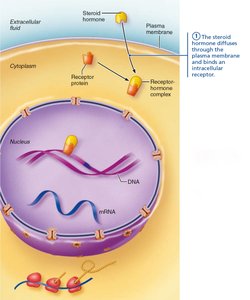
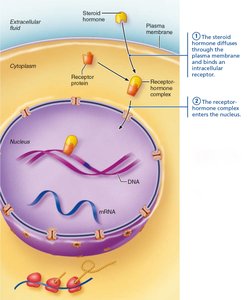
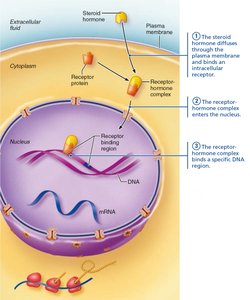
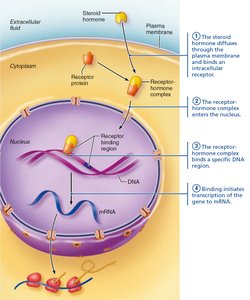
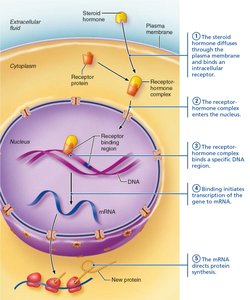
Lipid-soluble hormones diffuse into target cells and bind with intracellular receptors. The receptor-hormone complex enters the nucleus, binds to DNA, and initiates transcription to produce mRNA, which is then translated into protein.
The steroid hormone diffuses through the plasma membrane and binds an intracellular receptor.
The receptor-hormone complex enters the nucleus.
The complex binds a specific DNA region.
Binding initiates transcription of the gene to mRNA.
mRNA directs protein synthesis.
Regulation of Hormone Release
Negative Feedback and Stimuli
Blood levels of hormones are controlled by negative feedback mechanisms, maintaining levels within a narrow range. Hormone release is triggered by:
Endocrine gland stimuli (humoral, neural, hormonal)
Nervous system modulation
Types of Endocrine Gland Stimuli
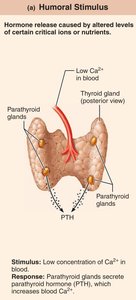
Humoral stimuli: Changing blood levels of ions/nutrients directly stimulate hormone release (e.g., low Ca2+ stimulates PTH release).
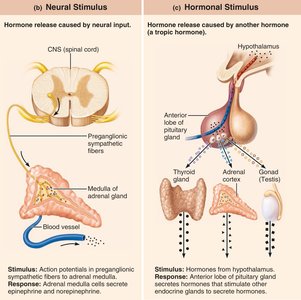
Neural stimuli: Nerve fibers stimulate hormone release (e.g., sympathetic fibers stimulate adrenal medulla to secrete catecholamines).
Hormonal stimuli: Hormones stimulate other endocrine organs to release their hormones (e.g., hypothalamic hormones regulate anterior pituitary).
Nervous System Modulation
The nervous system can override or adjust hormone levels as needed, especially during stress (e.g., overriding insulin to increase blood glucose for fight-or-flight response).
Hypothalamic-Pituitary Relationships
Structure and Function
The hypothalamus is connected to the pituitary gland (hypophysis) via the infundibulum. The pituitary has two major lobes:
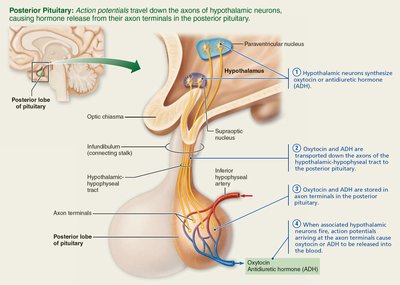
Posterior pituitary (neurohypophysis): Neural tissue; stores and secretes oxytocin and ADH produced by the hypothalamus.
Anterior pituitary (adenohypophysis): Glandular tissue; manufactures and secretes six hormones regulated by hypothalamic hormones.
Posterior Pituitary: Hormone Release
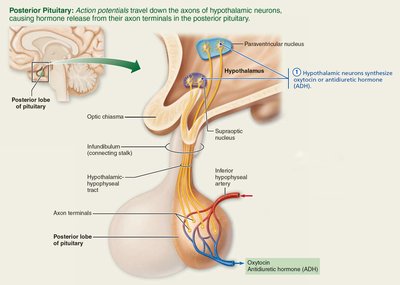
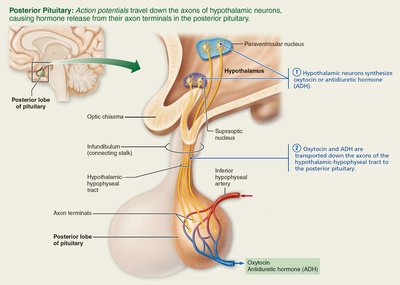
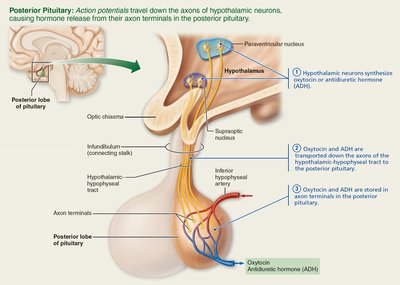
Posterior pituitary contains axon terminals of hypothalamic neurons. Action potentials travel down these axons, causing release of oxytocin and ADH into the blood.
Anterior Pituitary: Hormone Regulation
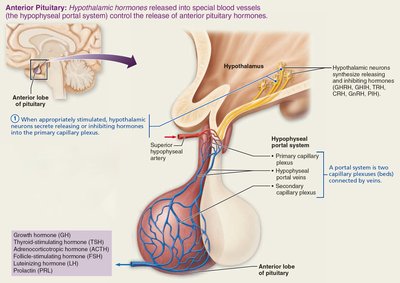
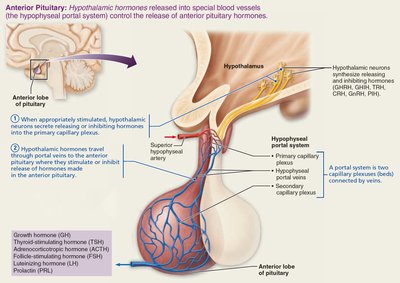
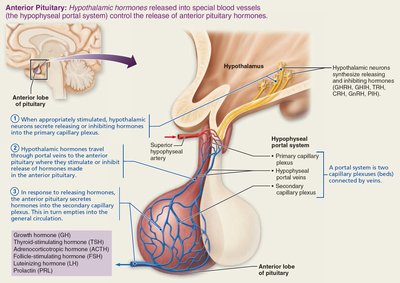
The anterior pituitary is connected to the hypothalamus via the hypophyseal portal system (a network of blood vessels). Hypothalamic hormones travel through this system to regulate secretion of anterior pituitary hormones (GH, TSH, ACTH, FSH, LH, PRL).
Posterior Pituitary Hormones
Oxytocin
Produced by paraventricular nuclei of hypothalamus; stored in posterior pituitary.
Stimulates uterine contractions during childbirth and milk ejection during breastfeeding (positive feedback mechanisms).
Acts as a neurotransmitter in the brain.
Antidiuretic Hormone (ADH)
Produced by supraoptic nuclei of hypothalamus; stored in posterior pituitary.
Stimulated by high blood osmolarity; promotes water reabsorption in kidneys, reducing urine output.
High concentrations cause vasoconstriction (also called vasopressin).
Release inhibited by alcohol.
Anterior Pituitary Hormones
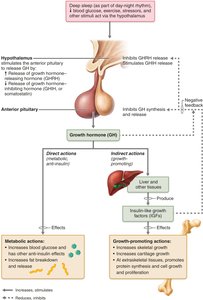
Growth Hormone (GH)
Produced by somatotropic cells; has direct metabolic and indirect growth-promoting actions.
Direct actions: increases blood glucose, stimulates fat breakdown, decreases glucose uptake (anti-insulin effect).
Indirect actions: stimulates liver, muscle, and bone to produce IGFs, promoting cell growth and division.
Regulated by GHRH (stimulates) and GHIH (inhibits) from hypothalamus.
Thyroid-Stimulating Hormone (TSH)
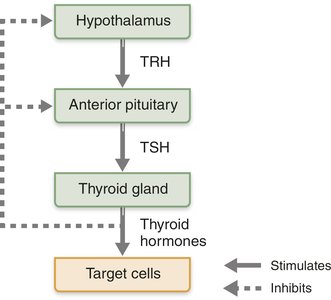
Produced by thyrotropic cells; stimulates thyroid gland to release thyroid hormones.
Regulated by TRH from hypothalamus; inhibited by rising thyroid hormone levels (negative feedback).
Adrenocorticotropic Hormone (ACTH)
Produced by corticotropic cells; stimulates adrenal cortex to release corticosteroids.
Regulated by CRH from hypothalamus; secretion peaks in the morning and is increased by stress.
Gonadotropins (FSH and LH)
FSH stimulates gamete production; LH stimulates production of gonadal hormones.
Regulated by GnRH from hypothalamus; inhibited by rising gonadal hormone levels.
Prolactin (PRL)
Stimulates milk production in females; role in males is unclear.
Regulated by PIH (dopamine) from hypothalamus; levels rise toward end of pregnancy and with infant suckling.
The Thyroid Gland
Location and Structure
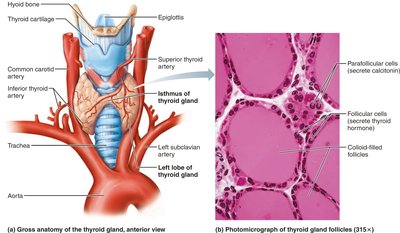
The thyroid gland is a butterfly-shaped organ located on the anterior trachea, just below the larynx. It consists of two lobes connected by an isthmus and contains follicles filled with colloid, where thyroid hormone is produced. Parafollicular cells produce calcitonin.
Thyroid Hormone (TH)
Major metabolic hormone; produced as thyroxine (T4) and triiodothyronine (T3).
Lipid-soluble; must travel in blood bound to carriers; enters target cells to bind nuclear receptors and regulate gene expression.
Effects: increases basal metabolic rate, heat production, regulates growth and development, and is permissive for catecholamines.
Regulated by TSH from anterior pituitary (negative feedback).
The Parathyroid Glands
Regulation of Blood Calcium
Four small parathyroid glands are embedded in the posterior aspect of the thyroid gland. They secrete parathyroid hormone (PTH), the primary regulator of blood calcium levels.
Falling blood Ca2+ stimulates PTH secretion; rising Ca2+ inhibits it.
PTH stimulates osteoclasts, enhances kidney reabsorption of Ca2+, and promotes activation of vitamin D for increased intestinal absorption of Ca2+.
The Adrenal Glands
Structure and Hormones
The adrenal glands are located atop the kidneys and consist of two regions:
Adrenal cortex: Produces corticosteroids (mineralocorticoids, glucocorticoids, gonadocorticoids).
Adrenal medulla: Produces catecholamines (epinephrine and norepinephrine) as part of the sympathetic nervous system.
The Pancreas
Endocrine Function
The pancreas is a mixed gland with both exocrine and endocrine functions. The endocrine portion consists of pancreatic islets containing alpha cells (produce glucagon) and beta cells (produce insulin).
Glucagon: Raises blood glucose by stimulating glycogen breakdown and gluconeogenesis in the liver.
Insulin: Lowers blood glucose by enhancing cellular uptake and storage of glucose, and inhibiting glycogen breakdown and gluconeogenesis.
Additional info: This summary covers the structure, function, and regulation of the endocrine system, focusing on hormone mechanisms, feedback regulation, and the major endocrine glands and their hormones, as outlined in the ANP college curriculum.
