 Back
The Endocrine System: Structure, Function, and Regulation
Study Guide - Smart Notes
 Tailored notes based on your materials, expanded with key definitions, examples, and context.
The Endocrine System
Introduction to the Endocrine System
The endocrine system is a major regulatory system in the human body, responsible for producing and releasing hormones that control and coordinate various physiological processes. Endocrine cells and tissues produce about 30 different hormones, which act as chemical messengers to influence growth, metabolism, development, and homeostasis.
Hormones: Chemical messengers released by endocrine cells.
Endocrine organs: Scattered throughout the body, releasing hormones directly into the bloodstream.
Functions: Control long-term processes such as growth, development, and metabolism.
Intercellular Communication
Intercellular communication is essential for the coordination of body functions. The endocrine and nervous systems use different mechanisms to transmit signals between cells.
Direct communication: Exchange of ions and molecules between adjacent cells via gap junctions; rare and highly specialized.
Paracrine communication: Chemical signals transfer information between cells within a single tissue.
Autocrine communication: Cells respond to signals they themselves secrete (autocrines).
Endocrine communication: Hormones released into the bloodstream affect distant target cells.
Synaptic communication: Neurons release neurotransmitters at synapses for rapid, targeted signaling.
Hormones: Structure, Classes, and Mechanisms
Hormones are classified based on their chemical structure and mode of action. The endocrine system relies on the release of hormones that bind to specific receptors on target cells, often regulated by negative feedback to maintain homeostasis.
Peptide hormones: Chains of amino acids (e.g., insulin, growth hormone).
Steroid hormones: Derived from cholesterol (e.g., cortisol, aldosterone).
Amino acid derivatives: Modified amino acids (e.g., epinephrine, thyroxine).
Hormone action: Hormones alter enzyme activity, protein synthesis, and metabolic processes in target cells.
Hormone Regulation: Sensitivity and Feedback
Hormone secretion and sensitivity are tightly regulated to ensure proper physiological responses.
Down-regulation: High hormone levels decrease receptor numbers, reducing sensitivity (e.g., insulin resistance).
Up-regulation: Low hormone levels increase receptor numbers, enhancing sensitivity.
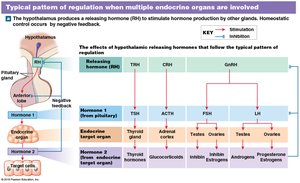
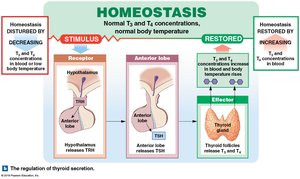
Negative feedback: Most hormone secretion is controlled by negative feedback, where the hormone reduces the stimulus that triggered its release.
Stimuli: Hormone secretion can be triggered by humoral (chemical), hormonal, or neural stimuli.
The Pituitary Gland
Structure and Function
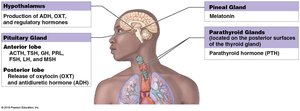
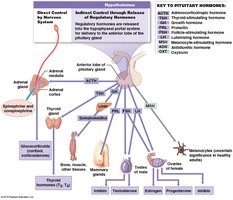
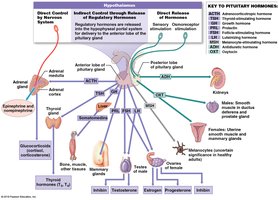
The pituitary gland, or hypophysis, is a central endocrine organ that releases nine important peptide hormones. It is regulated by the hypothalamus and consists of anterior and posterior lobes, each with distinct functions.
Anterior lobe (adenohypophysis): Produces hormones that regulate other endocrine glands and support organ functions.
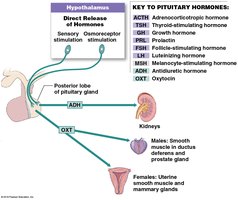
Posterior lobe (neurohypophysis): Releases antidiuretic hormone (ADH) and oxytocin (OXT).
Hypothalamic Control
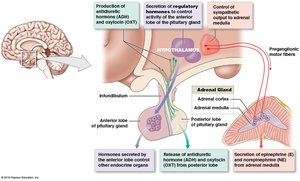
The hypothalamus regulates pituitary function through three mechanisms:
Synthesizes ADH and OXT, transported to the posterior pituitary for release.
Secretes regulatory hormones (releasing and inhibiting) that control the anterior pituitary.
Directly controls the adrenal medulla via autonomic centers.
Anterior Pituitary Hormones
The anterior pituitary produces several key hormones:
Thyroid-stimulating hormone (TSH): Stimulates thyroid hormone production.
Adrenocorticotropic hormone (ACTH): Stimulates adrenal cortex hormone release.
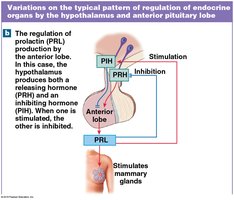
Prolactin (PRL): Regulates milk production; controlled by PIH and PRH.
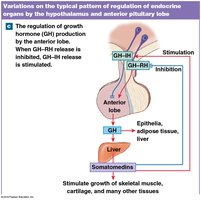
Growth hormone (GH): Stimulates growth and metabolism; regulated by GH-RH and GH-IH.
Gonadotropins (FSH, LH): Regulate reproductive functions; stimulated by GnRH.
Posterior Pituitary Hormones
Antidiuretic hormone (ADH): Regulates water balance by acting on kidneys.
Oxytocin (OXT): Stimulates uterine contractions and milk ejection.
The Thyroid Gland
Structure and Hormones
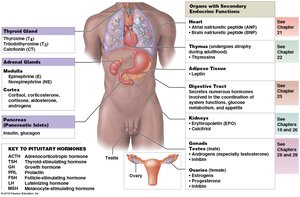
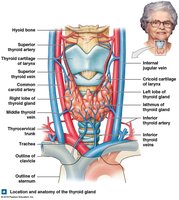
The thyroid gland is located inferior to the thyroid cartilage and consists of two lobes. It contains thyroid follicles and parafollicular (C) cells.
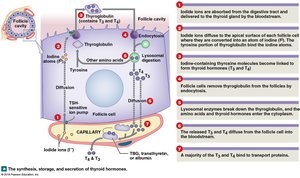
Thyroglobulin: Protein precursor for thyroid hormones.
Thyroid hormones: Thyroxine (T4) and Triiodothyronine (T3), both containing iodine.
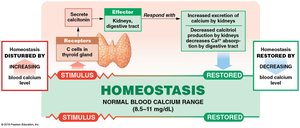
C cells: Produce calcitonin (CT), which regulates calcium levels.
Thyroid Hormone Regulation
Thyroid-binding globulins (TBGs): Transport thyroid hormones in the blood.
TSH: Stimulates thyroid hormone production; absence leads to inactivity.
Cellular effects: Thyroid hormones enter cells, bind to receptors, and activate genes involved in metabolism.
Calorigenic effect: Increased energy consumption and heat production.
Parathyroid Glands
Structure and Function
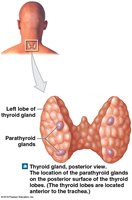
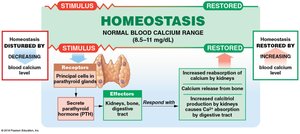
The parathyroid glands are four small glands embedded in the posterior surface of the thyroid gland. They secrete parathyroid hormone (PTH), which is essential for calcium homeostasis.
PTH: Increases blood calcium levels by stimulating osteoclasts, enhancing kidney reabsorption, and promoting calcitriol production.
Antagonist: Calcitonin from thyroid C cells lowers blood calcium.
Adrenal Glands
Structure and Hormones
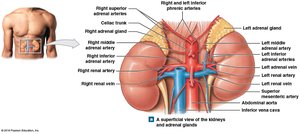
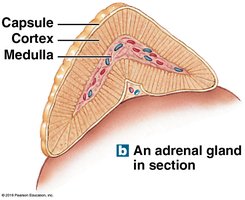
The adrenal glands are located on the superior border of each kidney and consist of an outer cortex and inner medulla.
Adrenal cortex: Produces corticosteroids (mineralocorticoids, glucocorticoids, and androgens).
Adrenal medulla: Produces catecholamines (epinephrine and norepinephrine).
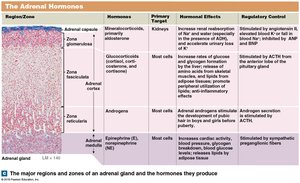
Region/Zone | Hormones | Primary Target | Hormonal Effects | Regulatory Control |
|---|---|---|---|---|
Zona glomerulosa | Mineralocorticoids (aldosterone) | Kidneys | Increase renal reabsorption of Na+ and water; accelerate loss of K+ | Stimulated by angiotensin II; inhibited by ANP |
Zona fasciculata | Glucocorticoids (cortisol, corticosterone) | Most cells | Increase rates of glucose and glycogen formation; anti-inflammatory effects | Stimulated by ACTH |
Zona reticularis | Androgens | Most cells | Stimulate development of pubic hair in boys and girls | Stimulated by ACTH |
Adrenal medulla | Epinephrine, norepinephrine | Most cells | Increase cardiac activity, blood pressure, glycogen breakdown | Stimulated by sympathetic preganglionic fibers |
Pineal Gland
Structure and Function
The pineal gland is located in the posterior portion of the roof of the third ventricle. It contains pinealocytes that synthesize melatonin.
Melatonin: Regulates circadian rhythms, inhibits reproductive functions, and protects against free radical damage.
Pancreas
Structure and Hormones
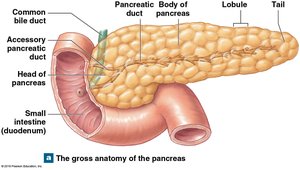
The pancreas is a large gland located between the stomach and small intestine. It contains both exocrine and endocrine cells.
Exocrine pancreas: Secretes digestive enzymes.
Endocrine pancreas: Contains islets of Langerhans with alpha (glucagon), beta (insulin), delta (GH-IH), and PP cells.
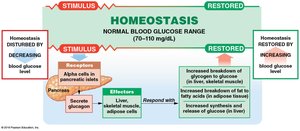
Regulation of Blood Glucose
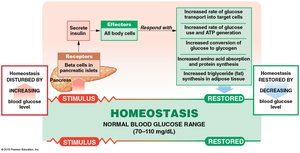
Insulin: Lowers blood glucose by promoting uptake, storage, and utilization of glucose.
Glucagon: Raises blood glucose by stimulating glycogen breakdown and gluconeogenesis.
Hyperglycemia: High blood glucose; hallmark of diabetes mellitus.
Type 1 diabetes: Inadequate insulin production; requires insulin therapy.
Type 2 diabetes: Insulin resistance; often associated with obesity.
Hormone Interactions and Stress Response
Types of Hormone Interactions
Cells may respond to multiple hormones simultaneously, resulting in different types of interactions:
Antagonistic effect: Opposing actions; result depends on balance.
Synergistic effect: Additive actions; combined effect is greater.
Permissive effect: One hormone enables another to act.
Integrative effect: Different but complementary actions.
General Adaptation Syndrome (GAS)
The body's response to stress is called the general adaptation syndrome, consisting of three phases:
Alarm phase: Immediate response; epinephrine is dominant.
Resistance phase: Sustained response; glucocorticoids are dominant.
Exhaustion phase: Breakdown of homeostasis; can be fatal.
Summary Table: Major Endocrine Glands and Hormones
Gland | Hormones | Main Functions |
|---|---|---|
Pituitary | TSH, ACTH, PRL, GH, FSH, LH, ADH, OXT, MSH | Regulates other glands, growth, reproduction, water balance |
Thyroid | T3, T4, Calcitonin | Metabolism, calcium regulation |
Parathyroid | PTH | Calcium regulation |
Adrenal | Corticosteroids, E, NE | Stress response, metabolism, electrolyte balance |
Pineal | Melatonin | Circadian rhythms |
Pancreas | Insulin, Glucagon | Blood glucose regulation |
